Understanding Vascular Plants: The Biological Engines of the Green World
From the towering redwoods of the Pacific Northwest to the delicate ferns in a forest understory, the diversity of plant life on Earth is staggering. Most of these plants belong to a specialized group known as vascular plants, or tracheophytes. Unlike simpler plants, such as mosses, vascular plants have developed a sophisticated internal transport system that allows them to grow larger, live longer, and thrive in diverse environments.
The term "vascular" refers to the presence of specialized conducting tissues that act as a biological highway, moving essential resources throughout the organism. This evolutionary breakthrough enabled plants to move beyond the damp, low-lying areas required by non-vascular plants and colonize much of the terrestrial landscape.
Key Facts
- Scientific Name: Tracheophyta (also known as tracheophytes).
- Species Count: Approximately 300,000 accepted known species.
- Primary Tissues: Xylem (water transport) and phloem (nutrient transport).
- Evolutionary Origin: First appeared in the mid-Silurian period, with Cooksonia being among the earliest known examples.
- Major Groups: Includes clubmosses, horsetails, ferns, gymnosperms (such as conifers), and angiosperms (flowering plants).
Core Characteristics of Vascular Plants
Botanists identify vascular plants through three fundamental biological traits that distinguish them from other plant groups.
1. Specialized Vascular Tissues
The defining feature of these plants is the presence of vascular tissues. These tissues are typically organized into vascular bundles, which consist of a strand of xylem and a strand of phloem located immediately adjacent to one another. The evolution of these tissues allowed plants to overcome the size limitations faced by non-vascular plants, which lack the structural and transport capabilities to move resources over long distances.
2. The Sporophyte Generation
In the life cycle of a vascular plant, the principal phase is the sporophyte. This is the diploid stage, meaning the cells contain two complete sets of chromosomes. This differs from non-vascular plants, where the primary phase is the haploid gametophyte (containing only one set of chromosomes). The development of complex diploid structures, such as elaborate spore stalks, likely improved the efficiency of spore dispersal, allowing plants to release spores higher into the air and spread them further.
3. True Roots, Stems, and Leaves
Vascular plants possess true roots for absorption, stems for support and transport, and leaves for photosynthesis. While some specific groups may have secondarily lost one of these traits through evolution, the presence of these organs remains a hallmark of the group.
The Internal Transport System: Xylem and Phloem
To maintain life, a plant must move water, minerals, and energy between its various parts. This is achieved through two distinct types of tissue: the xylem and the phloem.
The xylem is responsible for drawing water and inorganic nutrients up from the soil and transporting them to the rest of the plant. Xylem cells are typically dead, hard-walled, and hollow, forming long tubes that facilitate efficient flow. In many plants, these cell walls are reinforced with lignin, a tough polymer that provides structural strength. In flowering plants, the xylem consists of specialized vessels, while in other vascular plants, it is composed of tracheids (elongated, tapering cells).
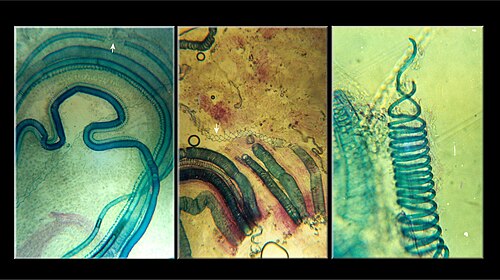
In contrast, the phloem is a living tissue responsible for distributing the products of photosynthesis, such as sucrose (a type of sugar), from the leaves to the growing shoots and roots. The phloem consists of living cells called sieve-tube members. Because these members lack essential organelles like nuclei or ribosomes, they rely on adjacent companion cells to maintain their biological functions and keep them alive. The movement of molecules between sieve-tube members occurs through small pores known as sieve plates.
| Feature | Xylem | Phloem |
|---|---|---|
| Primary Function | Transports water and minerals | Transports sugars and organic compounds |
| Cell Condition | Dead, hollow cells | Living cells |
| Key Components | Tracheids or vessels | Sieve-tube members and companion cells |
| Structural Role | Provides support via lignin | Primarily for conduction |
How Plants Move Water: Transpiration and Absorption
The movement of water within a plant is a remarkable process driven largely by transpiration. Transpiration is the evaporation of water from the plant's surface, specifically through tiny pores called stomata located on the leaves. As water evaporates into the atmosphere, it creates a transpiration pull—a tension or suction within the xylem vessels.
This pull is made possible by the unique properties of water, including hydrogen bonds that cause water molecules to stick together in a continuous column. As a molecule evaporates from the leaf, it pulls the next molecule up, which in turn pulls the next, effectively drawing water from the roots to the highest leaves. This process is largely passive, meaning the plant expends very little energy to move water. Additionally, transpiration helps the plant absorb soluble salts and nutrients from the soil.
At the root level, water is absorbed through osmosis—the movement of water from an area of high concentration to an area of low concentration. When the demand for water is high, the pressure within the roots decreases, facilitating the upward flow. However, if environmental conditions like high humidity, darkness, or drought prevent evaporation, water movement toward the shoots may cease.
Evolutionary History and Classification
The history of vascular plants dates back to the mid-Silurian period. One of the earliest known groups was the rhyniophytes, which possessed less developed vascular tissue. Modern scientists use the term eutracheophytes to describe all other vascular plants, including all currently living species.
The evolutionary tree of vascular plants is complex and continues to be refined by molecular studies. The major lineages include:
- Lycophytina: Including clubmosses.
- Euphyllophytina: A large group that includes ferns and all seed-bearing plants.
- Pteridophyta: True ferns and horsetails.
- Lignophytes: The lineage leading to modern wood-producing plants.
- Spermatophytes: Seed-bearing plants, which include gymnosperms (conifers, cycads, ginkgo, and gnetophytes) and angiosperms (flowering plants).
Frequently Asked Questions
What is the main difference between vascular and non-vascular plants?
The primary difference is the presence of specialized conducting tissues. Vascular plants have xylem and phloem to transport water and nutrients, allowing them to grow large. Non-vascular plants, such as mosses, lack these tissues and are generally restricted to small sizes and moist environments.
How do plants move water upward against gravity?
Plants use a process called transpiration. As water evaporates through pores in the leaves (stomata), it creates a tension or "pull" in the xylem. Because water molecules are bonded together, this evaporation pulls a continuous column of water upward from the roots to the leaves.
What are the different types of vascular plants?
Vascular plants are broadly categorized into several groups, including clubmosses, horsetails, ferns, gymnosperms (like conifers), and angiosperms (flowering plants).
What is the role of lignin in plants?
Lignin is a complex polymer found in the cell walls of xylem. It provides the structural rigidity and strength necessary for plants to grow upright and support their own weight, which is essential for large trees and shrubs.
Why is the term "higher plants" considered unscientific?
Historically, vascular plants were called "higher plants" under the belief that they were more "evolved" or complex than other plants. This concept is based on the obsolete scala naturae (ladder of nature) theory. Modern biology avoids this term because evolution is not a linear ladder of progress.