Understanding Seed Plants: The Evolution and Diversity of Spermatophytes
From the towering conifers of the northern forests to the vibrant blooms of a summer garden, seed plants dominate the terrestrial landscape. Known scientifically as spermatophytes (from the Ancient Greek spérma meaning "seed" and phutón meaning "plant"), these organisms represent a sophisticated leap in plant evolution. They are a category of embryophytes—land plants that protect their developing embryos—and belong to the tracheophytes, or vascular plants, which possess specialized tissues for transporting water and nutrients.
Historically, these plants were also called phanerogams (from the Greek phanerós, meaning "visible"). This term was used to distinguish them from "cryptogams" (plants with "hidden" sexual organs, such as ferns and mosses) because seed plants possess visible reproductive structures.
Key Facts
- Temporal Range: Seed plants have existed from the Famennian stage of the Devonian period to the present.
- Primary Distinction: They are divided into gymnosperms ("naked seeds") and angiosperms (seeds enclosed in fruit).
- Evolutionary Milestone: A whole genome duplication event occurred in the ancestor of seed plants approximately 319 million years ago.
- Earliest Precursor: Runcaria, a 385-million-year-old plant, is identified as a precursor to true seed plants.
- Diversity: Angiosperms are the largest and most diverse group of all spermatophytes.
The Living Divisions of Seed Plants
Modern seed plants are categorized into five primary divisions. The first four are grouped as gymnosperms, plants whose seeds are not enclosed within an ovary.
- Cycadophyta: The cycads, which are primarily found in tropical and subtropical regions.
- Ginkgophyta: A division consisting of a single living species of tree in the genus Ginkgo.
- Pinophyta: The conifers, comprising a wide array of cone-bearing shrubs and trees.
- Gnetophyta: A group of woody plants represented by the relict genera Ephedra, Gnetum, and Welwitschia.
The fifth division consists of the angiosperms (or magnoliophytes), commonly known as flowering plants. Unlike gymnosperms, angiosperms produce seeds that are enclosed within a fruit, a characteristic that has allowed them to become the most dominant plant group on Earth.
Evolutionary History and Fossil Record
The journey toward the modern seed began in the Middle Devonian period. One of the most significant discoveries is Runcaria, a 385-million-year-old precursor found in Belgium. Runcaria featured an integumented megasporangium (a spore-producing structure wrapped in a protective layer) surrounded by a cupule. While it lacked a solid seed coat and a formal pollen-guidance system, its distal extension suggests it relied on anemophilous (wind) pollination.
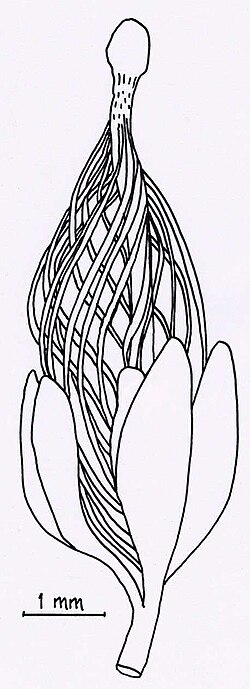
Following Runcaria, plants with more condensed cupules, such as Moresnetia and Spermasporites, appeared. By the Famennian—the final stage of the Devonian—seed-bearing plants had diversified significantly, with genera like Elkinsia and Archaeosperma emerging. Some of these early seeds are now classified under the order Lyginopteridales.
The fossil record also reveals extinct groups that once shaped the planet. The Pteridospermae, or "seed ferns," were among the first successful land plants and dominated late Paleozoic forests. In the Permian period, the genus Glossopteris became the most prominent tree in the southern supercontinent of Gondwana. While seed ferns declined by the Triassic, modern gymnosperms remained dominant until the end of the Cretaceous, when angiosperms underwent a massive radiation.
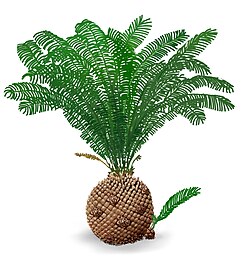
Other extinct orders, such as the Bennettitales, provide further insight into the complex history of plant reproduction.
Phylogeny and Classification
The relationship between different seed plants has been a subject of scientific debate. Traditionally, spermatophytes were split simply into angiosperms and gymnosperms. Early morphological studies suggested that gnetophytes were closely related to angiosperms due to the presence of vessel elements.
However, modern molecular studies have largely shifted this view. Many researchers now support the "gne-pine hypothesis," which suggests that gnetophytes are actually more closely related to conifers (Pinophyta) than to flowering plants. Despite this, the exact phylogenetic relationships between these groups are still being refined.
Depending on the classification system used, these groups are either ranked as separate divisions under a "Superdivision Spermatophyta" or as classes within a single division called Spermatophyta.
Comparison of Major Seed Plant Groups
| Feature | Gymnosperms | Angiosperms |
|---|---|---|
| Seed Position | "Naked" (unenclosed) | Enclosed within a fruit |
| Reproductive Structure | Cones or similar structures | Flowers |
| Diversity | Lower (4 divisions) | Highest (most diverse group) |
| Examples | Pine, Ginkgo, Cycads | Maple, Lilies, Grasses |
Frequently Asked Questions
What is the main difference between a gymnosperm and an angiosperm?
The primary difference is how the seeds are housed. Gymnosperms produce "naked" seeds that are not enclosed in an ovary, whereas angiosperms produce seeds that are enclosed within a fruit.
What was Runcaria and why is it important?
Runcaria was a Middle Devonian plant that served as a precursor to seed plants. It is scientifically significant because it shows the transitional steps toward the development of the seed, possessing most seed-plant qualities except for a solid seed coat.
What is the "gne-pine hypothesis"?
The gne-pine hypothesis is a phylogenetic proposal based on molecular data suggesting that gnetophytes (Gnetophyta) are more closely related to conifers (Pinophyta) than they are to flowering plants.
When did the ancestor of seed plants undergo genome duplication?
Evidence suggests that a whole genome duplication event occurred in the ancestor of seed plants approximately 319 million years ago.
What are "seed ferns"?
Seed ferns (Pteridospermae) are an extinct group of plants that were among the first successful land plants. They dominated forests during the late Paleozoic before declining in ecological importance by the Triassic period.