Trabectedin: A Marine-Derived Chemotherapy for Advanced Sarcoma and Ovarian Cancer
Trabectedin, marketed under the brand name Yondelis, is a potent antitumor chemotherapy medication used primarily to treat advanced soft-tissue sarcoma and ovarian cancer. Originally isolated from marine organisms, this complex molecule represents a significant achievement in both natural product chemistry and synthetic pharmacology.
The drug is administered intravenously and is approved for use in several regions, including the United States, the European Union, Russia, and South Korea. Due to the rarity of the conditions it treats, the U.S. Food and Drug Administration (FDA) and the European Commission have granted it orphan drug status.
Key Facts
- Indications: Advanced soft-tissue sarcoma (specifically liposarcoma and leiomyosarcoma) and relapsed ovarian cancer.
- Origin: Originally found in the sea squirt Ecteinascidia turbinata.
- Administration: Intravenous (IV) infusion only.
- Metabolism: Primarily processed in the liver via the CYP3A4 enzyme.
- Half-life: An average elimination half-life of 180 hours.
- Protein Binding: High binding rate between 94% and 98%.
Discovery and Production
The journey of trabectedin began in 1969 when the National Cancer Institute identified anticancer activity in extracts from the sea squirt Ecteinascidia turbinata. It took until 1984 for KL Rinehart of the University of Illinois to determine the structure of the active molecule, known as Ecteinascidin 743 (ET-743).
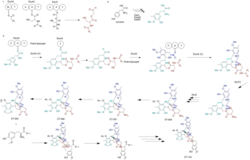
Production proved challenging because the drug occurs in extremely low concentrations in nature; approximately 1,000 kilograms of sea squirts were required to isolate just 1 gram of the compound. Research eventually revealed that the drug is actually produced by Candidatus Endoecteinascidia frumentensis, a microbial symbiont living within the tunicate.
To overcome the scarcity of natural sources, Harvard chemist E. J. Corey developed a total synthesis method in 1996. Today, the commercial supply is produced via a semisynthetic process developed by PharmaMar, utilizing safracin B—a chemical obtained from the fermentation of the bacterium Pseudomonas fluorescens.
Clinical Approvals and Indications
Soft Tissue Sarcoma
Trabectedin is indicated for patients with advanced soft tissue sarcoma who have failed treatment with anthracyclines and ifosfamide, or those unsuitable for such agents. In 2015, the US FDA specifically approved it for the treatment of liposarcoma and leiomyosarcoma that is either unresectable or has metastasized, provided the patient has received prior anthracycline chemotherapy.
Ovarian Cancer and Other Research
The drug has been used in combination with pegylated liposomal doxorubicin for women with relapsed ovarian cancer. Beyond these primary uses, trabectedin has undergone Phase II trials for breast, prostate, and pediatric cancers.
Mechanism of Action
The mechanism of trabectedin is complex and multifaceted. It primarily acts by binding to and alkylating DNA at the N2 position of guanine, specifically targeting the minor groove. This binding is most efficient with CGG sequences.
Once bound, the drug creates a covalent adduct that bends the DNA toward the major groove. This interference leads to several cellular disruptions:
- Direct interference with activated transcription.
- Poisoning of the transcription-coupled nucleotide excision repair (TC-NER) complex.
- Promotion of RNA polymerase II degradation.
- Generation of DNA double-strand breaks.
Recent research from 2024 indicates that trabectedin causes persistent single-strand breaks (SSBs) by blocking the second of two sequential NER incisions. Additionally, in myxoid liposarcoma, it blocks the DNA binding of the oncogenic transcription factor FUS-CHOP, effectively reversing the oncogenic phenotype and promoting cell differentiation.
Chemical and Pharmacokinetic Profile
Trabectedin is a complex molecule consisting of three tetrahydroisoquinoline moieties, eight rings (including one 10-membered heterocyclic ring with a cysteine residue), and seven chiral centers.
| Property | Detail |
|---|---|
| Chemical Formula | C39H43N3O11S |
| Molar Mass | 761.84 g·mol |
| Excretion | Mostly fecal |
| CAS Number | 114899-77-3 |
| Protein Binding | 94% to 98% |
Frequently Asked Questions
What are the most common side effects of Trabectedin?
The most frequent adverse reactions include nausea, fatigue, vomiting, constipation, decreased appetite, diarrhea, peripheral edema, dyspnea, and headache.
How is Trabectedin produced today?
While originally found in sea squirts, it is now produced through a semisynthetic process starting from safracin B, which is obtained by fermenting the bacterium Pseudomonas fluorescens.
What is the primary target of Trabectedin in the body?
It targets the DNA, specifically alkylating the N2 position of guanine in the minor groove, which interferes with transcription and DNA repair mechanisms.
Which specific types of sarcoma is Yondelis approved for in the US?
In the United States, it is approved for the treatment of liposarcoma and leiomyosarcoma that is either unresectable or has metastasized, following prior anthracycline chemotherapy.