Neoplasms: The Science of Tumors and Genomic Instability
In the field of oncology, the term neoplasm refers to an abnormal growth of tissue. While often used interchangeably with the word "tumor," a neoplasm specifically describes a new, uncontrolled growth of cells. These growths can vary wildly in their behavior, ranging from benign masses that remain localized to malignant neoplasms that can invade surrounding tissues and spread throughout the body, commonly known as cancer.
The development of a neoplasm is rarely a sudden event. Instead, it is typically the result of a complex series of genetic and epigenetic alterations that disrupt the normal lifecycle of a cell. By examining the molecular drivers of these growths, scientists can better understand how tumors originate and evolve.

Key Facts
- Neoplasms can be benign (non-cancerous) or malignant (cancerous).
- Common causes include radiation, environmental factors, and certain infections.
- Genomic instability is a hallmark of cancer, characterized by a high frequency of DNA mutations.
- Field defects are regions of tissue that predispose an area to the development of cancer before a tumor is visible.
- DNA repair gene deficiencies, often caused by epigenetic defects, play a central role in malignancy.
Types of Neoplasms
Neoplasms are broadly categorized based on their clinical behavior and impact on the host organism.
Benign Neoplasms
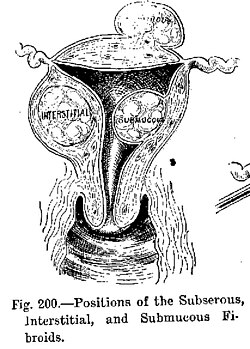
Benign neoplasms are non-cancerous growths. They typically grow slowly, are often encapsulated, and do not spread to distant parts of the body. Examples include fibroids of the uterus or hidradenomas (benign sweat gland tumors).
Malignant Neoplasms
Malignant neoplasms are cancerous. Unlike benign growths, they can invade nearby tissues and metastasize to other organs. The transition to malignancy is often driven by significant damage to the cell's genetic blueprint.
The Role of DNA Damage and Epigenetics
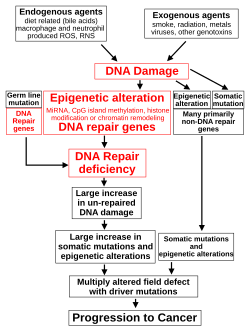
The progression toward malignancy is heavily influenced by the failure of the body's internal repair mechanisms. DNA repair genes are responsible for fixing errors that occur during cell division or as a result of external stressors.
When these genes are compromised, mutations accumulate. This can happen through direct genetic mutations or epigenetic defects—changes in gene expression that do not alter the DNA sequence itself. For example, promoter methylation can "silence" a repair gene, rendering it inactive.
In colorectal cancers, the loss of the PMS2 protein is a frequent occurrence. While some cases are caused by mutations in the PMS2 gene, a vast majority occur because its pairing partner, MLH1, is repressed due to promoter methylation. Additionally, the microRNA miR-155 can down-regulate MLH1, further contributing to the deficiency.
Field Defects and Cancer Predisposition
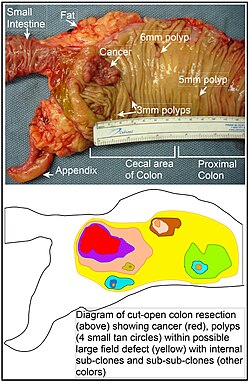
A field defect is a region of tissue that appears normal under a microscope but contains molecular alterations that predispose it to cancer. This means that a large area of an organ may be "primed" for tumor development, leading to the emergence of multiple independent tumors (multicentric origin) within the same region.
Research indicates that genes like MGMT, MLH1, and ERCC1 often show deficiency in these field defects long before a malignant tumor is fully formed. This is particularly evident in the colon, stomach, and head and neck regions.
Gene Frequency in Cancers and Field Defects
| Cancer Type | Gene | Frequency in Cancer | Frequency in Field Defect |
|---|---|---|---|
| Colorectal | MGMT | 46% - 70% | 11% - 60% |
| Colorectal | ERCC1 | 100% | 40% |
| Colorectal | PMS2 | 88% | 50% |
| Head and Neck | MGMT | 54% | 38% |
| Stomach | MGMT | 88% | 78% |
| Esophagus | MLH1 | 77% - 100% | 23% - 79% |
Genome Instability and the Mutator Phenotype
Cancers often exhibit a "mutator phenotype," meaning they have an abnormally high rate of genomic mutation. To understand the scale of this instability, it is helpful to look at the exome—the 1.5% of genomic DNA that actually codes for proteins.
In an average breast or colon cancer, the exome may contain 60 to 70 protein-altering mutations. These are divided into two categories:
- Driver mutations: A small number (usually 3 or 4) that actively push the cell toward cancerous growth.
- Passenger mutations: The remaining mutations that occur as a byproduct of instability but do not drive the cancer.
When looking at the entire genome (including non-coding regions), the numbers are staggering. A breast cancer sample may have roughly 20,000 mutations, and a melanoma sample can have up to 80,000. In contrast, a healthy human typically only acquires about 70 new mutations across the entire genome between generations.
Frequently Asked Questions
What is the difference between a neoplasm and a tumor?
While the terms are often used interchangeably, a neoplasm is a general term for any new and abnormal growth of tissue. A tumor is a mass of tissue that can be either a neoplasm or a non-neoplastic swelling (such as an inflammatory response).
What are driver mutations in cancer?
Driver mutations are specific genetic changes that provide a selective growth advantage to a cell, directly contributing to the development and progression of a malignant neoplasm.
How does a field defect contribute to cancer?
A field defect creates a region of tissue with epigenetic or genetic deficiencies (such as impaired DNA repair). This makes the entire area more susceptible to further mutations, increasing the likelihood that one or more tumors will develop in that specific region.
What is the role of promoter methylation in tumors?
Promoter methylation is an epigenetic mechanism that can turn off a gene. When this happens to DNA repair genes (like MLH1), the cell can no longer fix genetic errors, leading to the rapid accumulation of mutations and genomic instability.