Tiktaalik: The Transitional 'Fishapod' That Bridged Water and Land
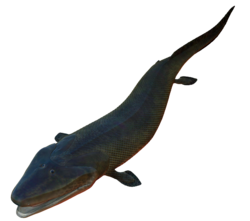
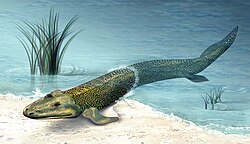
One of the most significant milestones in evolutionary history is the transition of vertebrates from an aquatic existence to life on land. At the center of this journey is Tiktaalik roseae, a monospecific genus of extinct sarcopterygian (lobe-finned fish) that lived approximately 375 million years ago during the Late Devonian Period. Often described as a "fishapod," Tiktaalik possesses a unique blend of fish-like characteristics and features that foreshadow the anatomy of tetrapods—the four-legged animals that would eventually dominate the terrestrial world.
Estimated to have reached lengths between 1.25 and 2.75 meters (4.1 to 9.0 feet), Tiktaalik serves as a critical anatomical bridge, offering a glimpse into how fins evolved into limbs and how gills and scales gave way to lungs and skin.
Key Facts
- Temporal Range: Late Devonian (Frasnian stage), roughly 375 million years ago.
- Classification: A lobe-finned fish within the clade Elpistostegalia.
- Size: Total length estimated between 1.25 and 2.75 meters.
- Defining Feature: Possesses limb-like fins capable of propping the animal up, similar to modern mudskippers.
- Anatomical Bridge: Combines fish traits (scales, gills) with tetrapod traits (mobile neck, lungs, ribcage).

Anatomical Breakthroughs: From Fins to Feet
Tiktaalik provides essential insights into the morphology of the closest relatives of tetrapods. Its body plan reveals a gradual shift in skeletal structure designed to handle the pressures of a shallow-water or semi-terrestrial environment.
The Skull and Neck
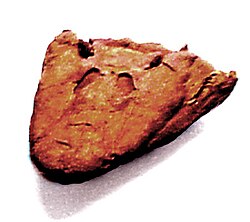
Unlike most fish, which have heads fused to their shoulders, Tiktaalik possessed a mobile neck. This separation of the pectoral girdle from the skull allowed the animal to move its head independently, a vital adaptation for hunting and navigating in shallow water. Its skull was broad and dorsoventrally compressed (flattened from top to bottom), featuring a subterminal mouth and paired frontal bones.
The Evolution of Forelimbs
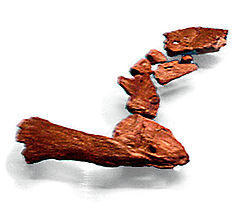
The most striking feature of Tiktaalik is its pectoral fins. While they still functioned as fins, they contained internal bone structures homologous to the wrist and fingers of land animals. Paleontologists use the digital arch model to explain this transition, suggesting that the metapterygial axis (the main stem of the fin) bent forward, allowing axials to become wrist bones while postaxial radials evolved into digits.
Torso and Hindlimbs
Tiktaalik's torso featured an enlarged ribcage, providing the necessary support for its internal organs when not buoyed by water. It also possessed a lung-like organ, allowing it to breathe atmospheric oxygen. Its pelvic girdle and hindlimbs further indicate a shift toward weight-bearing capabilities, though it remained primarily aquatic.
Classification and Evolutionary Context
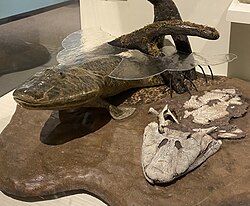
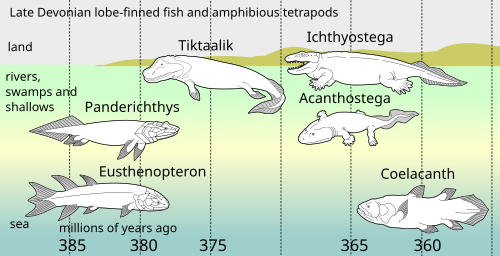
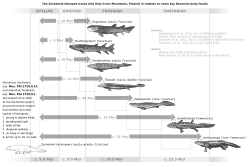
Tiktaalik is classified within the Elpistostegalia. To understand its place in history, it is helpful to view the sequence of adaptations seen in Late Devonian vertebrates. The transition generally progressed from pelagic (open sea) lobe-finned fish like Eusthenopteron to those suited for muddy shallows, such as Panderichthys, and then to Tiktaalik, which could venture onto land.
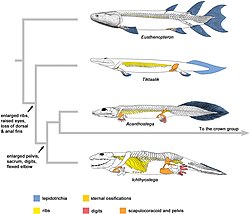
Following Tiktaalik, early tetrapods like Acanthostega (which had eight digits per foot) and Ichthyostega appeared in weed-filled swamps, fully embracing a limbed existence.
However, the timeline is not without debate. The discovery of the Zachełmie trackways in Poland suggests that some four-legged animals may have walked on land even earlier than previously thought, potentially predating elpistostegids like Tiktaalik. This has led some scientists to question whether Tiktaalik was a direct ancestor or a closely related cousin that evolved similar traits through convergent evolution.
Paleobiology and Ecology
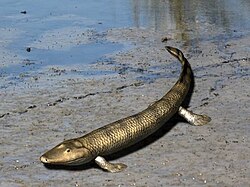
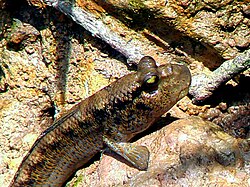
Researchers believe Tiktaalik lived in shallow, oxygen-poor waters. Its anatomy suggests it could prop itself up on its fins to breathe air or move between pools of water, much like the behavior of present-day mudskippers. This "bounding" or "walking" behavior provided a survival advantage in the fluctuating environments of the Devonian period.
Beyond its scientific value, Tiktaalik has entered popular culture, appearing in educational materials and even internet memes, symbolizing the awkward but essential transition from sea to land.
Summary of Fish-to-Tetrapod Transition
| Feature | Fish Traits | Tiktaalik ('Fishapod') | Tetrapod Traits |
|---|---|---|---|
| Neck | Fused to shoulders | Mobile neck | Fully flexible neck |
| Limbs | Ray-fins | Limb-like fins with wrist bones | Digits (fingers/toes) |
| Respiration | Gills | Gills and lung-like organ | Lungs |
| Skull | Streamlined/Narrow | Broad and flattened | Diverse terrestrial shapes |
| Ribs | Minimal support | Enlarged ribcage | Robust weight-bearing ribs |
Frequently Asked Questions
Was Tiktaalik the first animal to walk on land?
Not necessarily. While Tiktaalik shows the transition to limb-like fins, the Zachełmie trackways in Poland suggest that some tetrapods may have been walking on land earlier than Tiktaalik existed. It is viewed more as a representative of the transition rather than the absolute first.
What does the name 'Tiktaalik' mean?
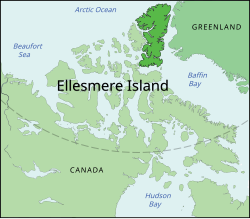
The name is derived from Inuktitut, meaning "large fish." This honors the region in the Canadian Arctic where the fossils were discovered.
How did Tiktaalik breathe?
Tiktaalik possessed both gills and a lung-like organ, allowing it to extract oxygen from water and breathe air from the surface, which was essential for surviving in shallow, stagnant environments.
What is the 'digital arch model'?
The digital arch model is a hypothesis suggesting that the main axis of the fish fin bent forward at a sharp angle, transforming the internal bones into wrists and allowing the outer radials to splay out and evolve into fingers.
Is Tiktaalik a direct ancestor of humans?
Tiktaalik is a stem-tetrapod, meaning it is part of the lineage that led to all four-limbed vertebrates. While it may not be the direct linear ancestor, it shares the fundamental body plan that eventually evolved into amphibians, reptiles, birds, and mammals.