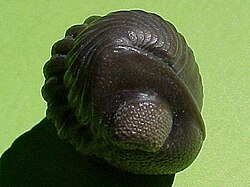
Unlocking the Past: A Comprehensive Guide to Fossils and Paleontology
From the towering skeletons of dinosaurs to the microscopic imprints of ancient bacteria, fossils serve as the primary archive of life on Earth. Derived from the Classical Latin word fossilis, meaning "obtained by digging," a fossil is any preserved remain, impression, or trace of an organism from a past geological age. These can include bones, shells, exoskeletons, hair, petrified wood, and even remnants of DNA.
The totality of these remains is known as the fossil record. While this record is incomplete, it provides scientists with a vital understanding of how life has diversified and evolved over billions of years, filling critical gaps in the sequence of biological history.
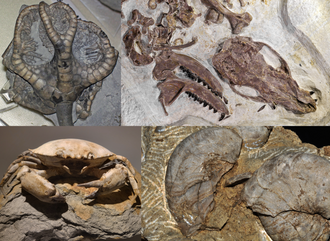
Key Facts
- Age Range: The oldest fossils date back between 3.48 billion and 4.1 billion years.
- Definition: Specimens are generally considered fossils if they are older than 10,000 years.
- The Science: Paleontology is the study of fossils, focusing on their age, formation, and evolutionary significance.
- Dating Methods: Scientists use stratigraphy for relative dating and radiometric techniques for absolute dating.
- Diversity: Fossils are not just bones; they include traces (like footprints), chemical signatures, and organisms trapped in resin.
The Science of Paleontology and Dating
Paleontology allows us to reconstruct ancient ecosystems by analyzing the age and method of formation of fossilized remains. To determine when an organism lived, scientists rely on two primary methods of dating.
Stratigraphy is the study of successive layers of rock. Because certain fossils are consistently associated with specific rock strata, researchers can determine the relative age of a fossil based on the layer in which it was found.
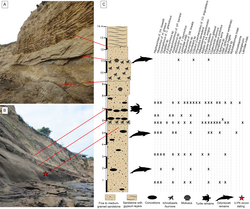
While stratigraphy provides a relative timeline, the development of radiometric dating in the early 20th century allowed for the measurement of absolute ages. This technique quantitatively measures the decay of radioactive isotopes within rocks and fossils to provide a specific numerical age.
How Fossils Form: The Process of Fossilization
Fossilization is a complex process that transforms organic material into stone or preserves it in a stable state. There are several distinct pathways this can take:
Mineralization and Replacement
- Permineralization: This occurs when mineral-rich water fills the pores of organic tissues, depositing minerals that turn the remain into stone.
- Replacement: The original organic material is entirely replaced by minerals. Common examples include silicification (replacement by silica/quartz), pyritization (replacement by pyrite), and phosphatization (replacement by phosphate).
- Recrystallization: The original minerals of a shell or bone change their crystal structure (e.g., aragonite changing to calcite) while maintaining the overall shape.
Casts, Molds, and Impressions
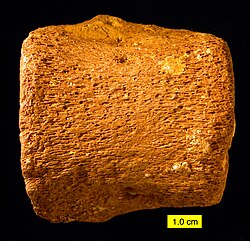
Sometimes the organism decays completely, leaving a void in the sediment. An internal mold, or steinkern, forms when sediment fills the interior of a shell, which later dissolves, leaving a stony cast of the inside.
Other Preservation Methods
- Carbonization: The volatile components of an organism are removed, leaving behind a thin film of carbon.
- Adpression: A combination of compression and impression that flattens the organism.
- Bioimmuration: A process where a soft-bodied organism is preserved by being grown over by another organism's skeleton.
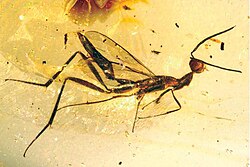
- Resin Preservation: Organisms, such as insects, become trapped in tree resin, which hardens into amber over millions of years.
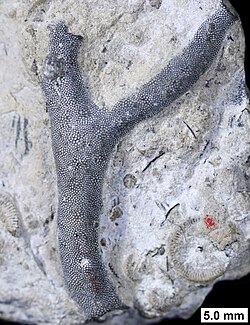
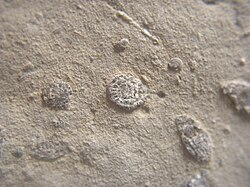
![The star-shaped holes (Catellocaula vallata) in this Upper Ordovician bryozoan represent a soft-bodied organism preserved by bioimmuration in the bryozoan skeleton.[93]](/images/59/6f/596fb17131eb880cdff7b6da406557c85427c9a817802f56a98df18e81b4fd78.jpg)
Types of Fossils
Fossils are categorized based on what they represent and how they are used by scientists.
Index and Trace Fossils
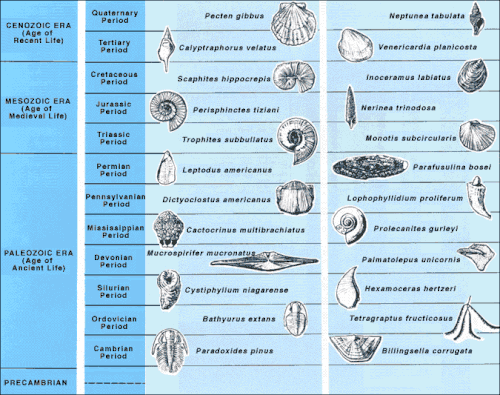
Index fossils are species that were widespread but existed for a short geological duration, making them perfect for dating rock layers. In contrast, trace fossils do not preserve the organism itself but rather its activity, such as footprints or coprolites (fossilized feces).
Microfossils and Subfossils
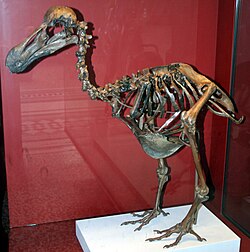
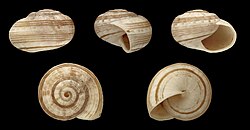
Microfossils are remains that require a microscope for study, often measuring around 1 mm. Subfossils are remains from more recent geological periods that have not yet undergone complete mineralization.
Specialized Fossils
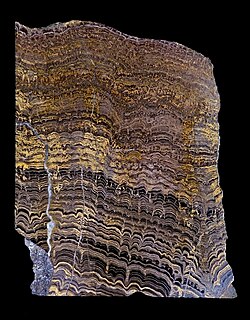
- Stromatolites: Layered sedimentary formations created by the activity of ancient microbes; these are among the oldest fossils known.
- Chemical Fossils: Molecular remnants of once-living things.
- Reworked (Remanié) Fossils: Fossils that were eroded out of an older rock layer and redeposited into a younger one.
Pseudofossils
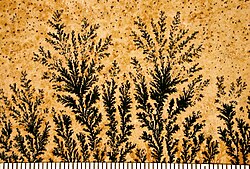
Not everything that looks like a fossil is one. Pseudofossils are inorganic geological structures—such as manganese dendrites—that mimic the appearance of organic remains.
Fossils in History, Art, and Culture
Humanity has been fascinated by fossils long before the birth of modern paleontology. In 1027, the Persian scholar Avicenna discussed the "stoniness" of fossils in The Book of Healing. Later, in the 17th century, Robert Hooke used early microscopy to observe fossil forams, noting that some creatures no longer existed on Earth.
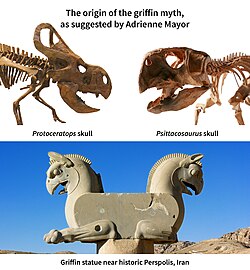
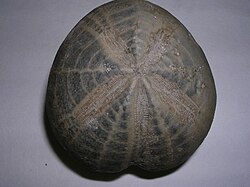
Fossils have also fueled mythology. For example, ceratopsian skulls found in Asia may have contributed to legends of gryphons, while fossilized sea urchins (Micraster) were once used in medieval times as "fairy loaves" to bring luck to bakers.
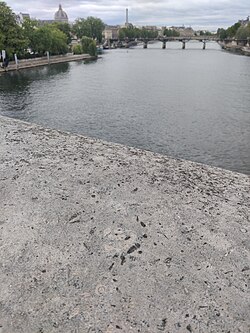
Beyond science, fossils appear in architecture—such as the quarried stone of the Pont Neuf in Paris—and have even been used historically in traditional medicine.
The Future: Astrobiology
The study of fossils now extends beyond Earth. Astrobiology applies the principles of paleontology to the search for extraterrestrial life. By studying how fossils form in extreme environments on Earth, scientists can better identify potential "biosignatures" or fossilized microbial life on other planets, such as Mars.
Fossil Summary Reference
| Category | Example/Process | Key Characteristic |
|---|---|---|
| Body Fossil | Bones, Shells, Teeth | Preserved physical remains of the organism. |
| Trace Fossil | Coprolites, Footprints | Evidence of biological activity. |
| Mineralization | Permineralization | Minerals fill cellular spaces. |
| Replacement | Silicification | Original material replaced by a new mineral. |
| Microfossil | Foraminifera | Requires magnification to be seen. |
| Subfossil | Dodo skeleton | Recent remains, not fully mineralized. |
Frequently Asked Questions
What is the oldest known fossil?
The oldest fossils are estimated to be between 3.48 billion and 4.1 billion years old, consisting primarily of microbial remains and stromatolites.
What is the difference between relative and absolute dating?
Relative dating (stratigraphy) determines if a fossil is older or younger than other fossils based on its position in rock layers. Absolute dating (radiometric dating) provides a specific numerical age in years.
Can soft tissues be preserved in fossils?
Yes, though it is rare. Soft tissues can be preserved through processes like carbonization, bioimmuration, or by being trapped in amber. Some studies have even identified molecular remnants in dinosaur bones.
What is a pseudofossil?
A pseudofossil is a mineral growth or geological formation that looks like a fossil—such as a leaf or a bone—but was actually created by inorganic chemical processes.
What are index fossils?
Index fossils are remains of organisms that were geographically widespread but existed for a very short period of time, allowing geologists to pinpoint the age of the rock layer they are found in.