Sarcopterygii: The Evolution and Legacy of Lobe-Finned Fishes
The Sarcopterygii, commonly known as lobe-finned fishes, represent one of the most significant lineages in vertebrate history. Spanning from the Late Silurian period to the present day, these creatures are not merely ancient curiosities but are the biological ancestors of all four-limbed vertebrates, including amphibians, reptiles, birds, and mammals. By evolving specialized fins and respiratory systems, they bridged the gap between aquatic life and the colonization of land.
Unlike the more common ray-finned fishes, sarcopterygians possess fleshy, lobed fins that are joined to the body by a single bone. This structural innovation provided the necessary support for the eventual transition to terrestrial locomotion.
Key Facts
- Temporal Range: Late Silurian to the present (approximately 425 million years ago to 0 Ma).
- Defining Feature: Lobed fins with an internal skeletal structure, unlike the thin rays of Actinopterygii.
- Ancestry: They are the sister group to ray-finned fishes within the clade Osteichthyes (bony fish).
- Largest Species: The extinct Rhizodus hibberti reached lengths of up to 6 meters.
- Living Relatives: Only coelacanths and lungfishes survive today.
Foundations of the Lobe-Finned Lineage
Sarcopterygians belong to the clade Osteichthyes, which is characterized by the presence of an ossified endoskeleton (bone) rather than cartilage and the possession of swim bladders, which share a common ancestry with lungs. While they share these traits with ray-finned fishes, sarcopterygians are distinguished by their unique fin structures and the presence of cosmoid layers in their scales.
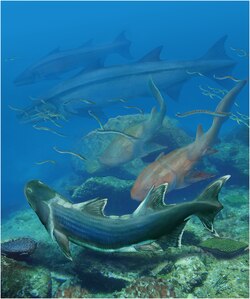
The earliest known bony fish, Guiyu oneiros, lived approximately 419 million years ago during the Late Silurian. This species exhibited a mosaic of features from both ray-finned and lobe-finned lineages, though it is ultimately classified closer to the lobe-finned group.
![Guiyu oneiros, the earliest-known bony fish, lived during the Late Silurian, 419 million years ago).[1] It has the combination of both ray-finned and lobe-finned features, although analysis of the totality of its features places it closer to lobe-finned fish.[4][5][6]](/images/89/99/8999fa87e3517c1676afa86660ea997132266da5a6012ca2883b5d34c004ea40.jpg)
Diversification and the "Age of Fishes"
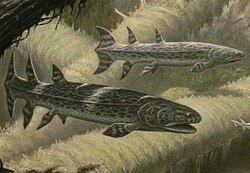
During the Early Devonian (416–397 Ma), the sarcopterygians split into two primary lineages: the coelacanths and the rhipidistians. While the predatory placoderms dominated the oceans at the time, many sarcopterygians began migrating into freshwater habitats.
The Coelacanths (Actinistia)
Coelacanths remained exclusively marine. Their peak diversity occurred during the Late Devonian and Carboniferous periods (385 to 299 Ma). Though long thought to be extinct, the genus Latimeria survives today in the open oceans. These "living fossils" retain primordial features that provide invaluable insights into ancient aquatic life.
The Rhipidistians and Tetrapodomorphs
The rhipidistian lineage eventually gave rise to the Tetrapodomorpha. This group included the massive rhizodonts, such as Hyneria, which could reach 3.5 meters in length. These fish shared a close kinship with lungfish but eventually evolved the four-limbed structure that defines tetrapods.
The Transition to Land
The evolution of tetrapods from lobe-finned fish is one of the most studied transitions in paleontology. Scientists have proposed several hypotheses to explain how these creatures adapted to land:
- Shrinking Waterhole: Adaptation driven by receding water levels in inland bodies.
- Inter-tidal Hypothesis: The theory that sarcopterygians emerged from intertidal zones, supported by the 395-million-year-old Zachełmie tracks.
- Woodland Swamp Adaptation: Evolution within shallow, vegetated swamp environments.
- Habitual Escape: Occasional movements onto land to avoid predators or find new food sources.
By the Late Devonian (385–359 Ma), true tetrapods appeared. While many tetrapodomorphs went extinct, the tetrapods and megalichthyids survived beyond the Devonian, with the latter persisting until the Permian.
Sarcopterygian Classification Summary
| Clade | Example Species | Key Description |
|---|---|---|
| Actinistia | West Indian Ocean coelacanth | Marine "living fossils" with primordial features. |
| Dipnoi | Queensland lungfish | Fishes capable of breathing air via lungs. |
| Tetrapodomorpha | Tiktaalik | Advanced fish that led to the evolution of four-limbed vertebrates. |
Frequently Asked Questions
What is the difference between a lobe-finned fish and a ray-finned fish?
Lobe-finned fishes (Sarcopterygii) have fleshy, paired fins supported by a central skeletal axis of bones. Ray-finned fishes (Actinopterygii) have fins supported by webs of bony spines or rays.
Which lobe-finned fish is the largest that ever lived?
The largest known lobe-finned fish was Rhizodus hibberti from the Carboniferous period of Great Britain, which reached lengths of up to 6 meters.
Are there any lobe-finned fishes alive today?
Yes, there are two surviving groups: the coelacanths (such as the West Indian Ocean coelacanth) and the lungfishes (such as the marbled lungfish).
How did lobe-finned fish lead to land animals?
Through the Tetrapodomorpha lineage, these fish evolved stronger, bone-supported fins and respiratory adaptations (lungs) that allowed them to eventually support their weight and breathe on land, evolving into the first tetrapods.
What is the significance of Guiyu oneiros?
Guiyu oneiros is the earliest-known bony fish (419 million years ago) and serves as a critical evolutionary link, showing a combination of features from both ray-finned and lobe-finned fishes.