Devonian PeriodAge of FishesPaleozoic Eratetrapod evolutionLate Devonian extinction

Devonian Period: The Age of Fishes and the Greening of Earth

Devonian Period: The Age of Fishes and the Greening of Earth Spanning approximately 60.7 million years, the Devonian Period stands as one of the most transformative eras in Earth's histor...

Devonian Period: The Age of Fishes and the Greening of Earth

Spanning approximately 60.7 million years, the Devonian Period stands as one of the most transformative eras in Earth's history. Occurring during the Paleozoic era, this period lasted from roughly 419.62 million years ago (Ma) to 358.86 Ma. It is famously nicknamed the "Age of Fishes" due to the incredible diversification of aquatic life, but its impact extends far beyond the oceans, marking the era when life truly began to claim the land.

Named after the county of Devon in South West England, where its defining rock layers were first studied, the Devonian represents a pivotal chapter in the Phanerozoic eon. From the rise of complex marine predators to the first sprawling forests, the world of the Devonian was a place of radical biological and geological change.
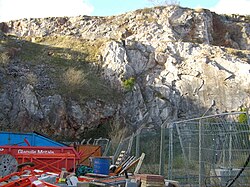
The rocks of Lummaton Quarry in Torquay in Devon played an early role in defining the Devonian Period
: The rocks of Lummaton Quarry in Torquay in Devon played an early role in defining the Devonian Period

Key Facts

  • Time Span: Approximately 419.62 to 358.86 million years ago.
  • Nickname: Often referred to as the "Age of Fishes."
  • Major Biological Milestones: The appearance of the first ammonoids, the rise of early forests, and the evolution of the first tetrapods (four-limbed vertebrates).
  • Geological Context: The fourth period of both the Paleozoic and Phanerozoic eras.
  • Mass Extinctions: The Late Devonian was marked by three significant extinction episodes.

Chronology and Subdivisions

The Devonian is divided into three distinct stages by the International Commission on Stratigraphy: the Early, Middle, and Late Devonian. Each stage represents a unique phase of evolutionary and environmental progression.

Early Devonian

Lasting from 419.62 to 393.47 Ma, the Early Devonian includes the Lochkovian, Pragian, and Emsian stages. This era saw the emergence of the first ammonoids—a class of cephalopod molluscs that descended from bactritoid nautiloids. These early ammonoids were relatively simple but would eventually evolve into dominant marine predators that ruled the seas until the Mesozoic Era.
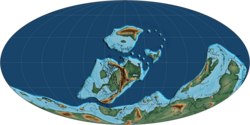
A map of Earth in the Emsian stage of the Early Devonian (405 million years ago)
: A map of Earth in the Emsian stage of the Early Devonian (405 million years ago)

Middle Devonian

The Middle Devonian served as a bridge of increasing complexity. During this time, the biological diversity of both land and sea continued to expand, setting the stage for the massive terrestrial shifts that would follow.
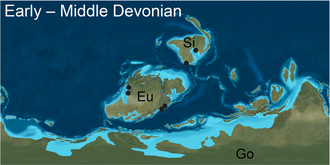
The Early-Middle Devonian world, with major continents Gondwana (Go), Euramerica/Laurussia (Eu), and Siberia (Si)
: The Early-Middle Devonian world, with major continents Gondwana (Go), Euramerica/Laurussia (Eu), and Siberia (Si)

Late Devonian

The Late Devonian began with the Frasnian stage (382.31 to 372.15 Ma) and concluded with the Famennian stage. This was a period of profound transition. The Frasnian saw the formation of the first true forests, while the Famennian recorded the appearance of the first tetrapods—vertebrates that began the transition from water to land. However, this era was also defined by instability, ending with significant extinction events.
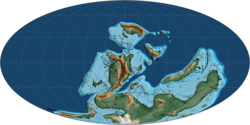
A map of Earth in the Famennian stage of the Late Devonian (370 million years ago)
: A map of Earth in the Famennian stage of the Late Devonian (370 million years ago)

Paleogeography: A Shifting World

The map of the world during the Devonian looked vastly different from the one we recognize today. The supercontinent Laurussia (also known as Euramerica) was a major landmass, and the massive supercontinent Gondwana occupied much of the southern hemisphere. The movement of these plates and the closure of ancient oceans, such as the Rheic Ocean, fundamentally reshaped global climates and marine habitats.
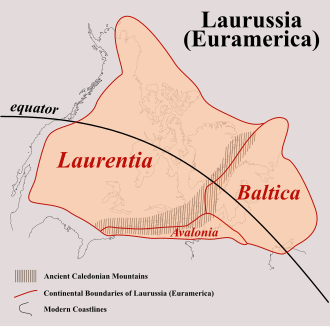
Continental boundary of Laurussia (Euramerica) and its constituents, superimposed onto modern coastlines
: Continental boundary of Laurussia (Euramerica) and its constituents, superimposed onto modern coastlines
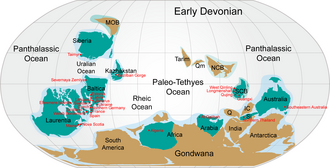
World map at 400 Ma (Early Devonian), showing continents and terranes with modern continent borders superimposed
: World map at 400 Ma (Early Devonian), showing continents and terranes with modern continent borders superimposed
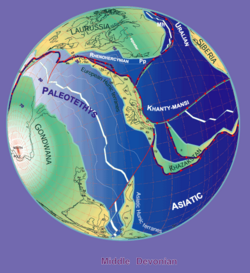
The earth at 380 Ma, centered on the Paleo-Tethys Ocean, which fully opened during the Devonian
: The earth at 380 Ma, centered on the Paleo-Tethys Ocean, which fully opened during the Devonian

The Evolution of Life

The Devonian is a masterclass in evolutionary biology, showcasing the rapid development of complex life forms across multiple environments.

Marine Life: The Age of Fishes

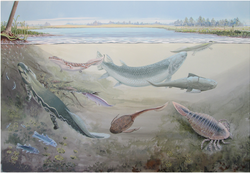
In the oceans, the Devonian was dominated by a massive variety of fish. This included early sharks, heavily armored placoderms (such as the giant Dunkleosteus), and various lobe-finned fishes. These lobe-finned species were particularly important, as they provided the evolutionary blueprint for the transition to land.

Spindle diagram for the evolution of vertebrates[36]
: Spindle diagram for the evolution of vertebrates[36]
The Devonian period saw the development of early sharks, armoured placoderms and various lobe-finned fishes including the tetrapod transitional species
: The Devonian period saw the development of early sharks, armoured placoderms and various lobe-finned fishes including the tetrapod transitional species

Terrestrial Life: The Greening of the Land

On land, the Devonian witnessed a biological revolution. The period marked the beginning of extensive land colonization by plants. As large land-dwelling herbivores had not yet evolved, vast forests of shrubs and early trees grew unchecked, fundamentally altering the Earth's atmosphere and soil composition.
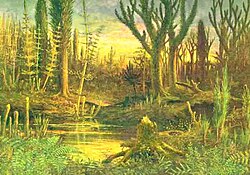
The Devonian Period marks the beginning of extensive land colonization by plants. With large land-dwelling herbivores not yet present, large forests grew and shaped the landscape.
: The Devonian Period marks the beginning of extensive land colonization by plants. With large land-dwelling herbivores not yet present, large forests grew and shaped the landscape.

Even more mysterious were organisms like Prototaxites milwaukeensis, a massive fungal-like organism that existed during the Middle Devonian, representing a unique branch of life that shaped the early terrestrial landscape.
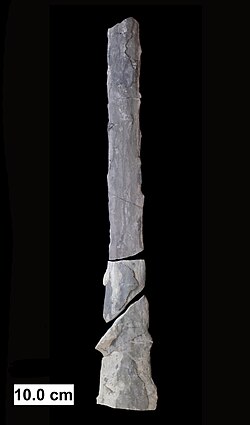
Prototaxites milwaukeensis, the only known member of an unknown kingdom of life, from the Middle Devonian of Wisconsin
: Prototaxites milwaukeensis, the only known member of an unknown kingdom of life, from the Middle Devonian of Wisconsin

Summary of the Devonian Period

Overview of Devonian Characteristics
Feature Details
Time Range 419.62 – 358.86 Ma
Major Landmasses Laurussia, Gondwana, Siberia
Key Marine Life Placoderms, early sharks, ammonoids, trilobites
Key Terrestrial Life Early forests, vascular plants, first tetrapods
Climate Trend Relatively steady sea levels, gradually falling from 189m to 120m

Late Devonian Extinction Events

Despite the biological flourishing, the end of the Devonian was marked by turmoil. The Late Devonian is characterized by three distinct episodes of mass extinction. These events, including the Kellwasser and Hangenberg events, significantly reduced marine biodiversity and reshaped the evolutionary trajectory of life on Earth.
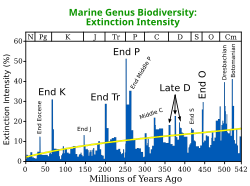
The Late Devonian is characterised by three episodes of extinction ("Late D")
: The Late Devonian is characterised by three episodes of extinction ("Late D")

Frequently Asked Questions

Why is the Devonian called the "Age of Fishes"?

The period saw an unprecedented diversification of fish species, including the rise of armored placoderms, early sharks, and the lobe-finned fishes that would eventually evolve into land vertebrates.

What was the most significant change on land during this time?

The most significant change was the "greening of the land," where plants began to colonize terrestrial environments, leading to the development of the first large forests.

Where does the name "Devonian" come from?

The period is named after the county of Devon in South West England, where the rock strata defining this geological period were first studied.

Did humans exist during the Devonian?

No. The Devonian occurred hundreds of millions of years before the evolution of humans. During this time, life was primarily composed of fish, early plants, and primitive invertebrates.

What caused the Late Devonian extinctions?

While the exact causes are still being studied, the Late Devonian is characterized by three major extinction episodes that impacted marine life significantly.

References

  1. Sedgwick and Murchison coined the term "Devonian system" in 1840:[16] "We propose therefore, for the future, to designate these groups collectively by the name Devonian system". Sedgwick and Murchison acknowledged William Lonsdale's role in proposing, on the basis of fossil evidence, the existence of a Devonian stratum between those of the Silurian and Carboniferous periods:[17] "Again, Mr. Lonsdale, after an extensive examination of the fossils of South Devon, had pronounced them, more than a year since, to form a group intermediate between those of the Carboniferous and Silurian systems". William Lonsdale stated that in December 1837 he had suggested the existence of a stratum between the Silurian and Carboniferous ones:[18] "Mr. Austen's communication [was] read December 1837 ... . It was immediately after the reading of that paper ... that I formed the opinion relative to the limestones of Devonshire being of the age of the old red sandstone; and which I afterwards suggested first to Mr. Murchison and then to Prof. Sedgwick".
  2. Kaufmann, Bernd; Trapp, Endres; Mezger, Klaus (July 2004). "The numerical age of the Upper Frasnian (Upper Devonian) Kellwasser horizons: A new U-Pb zircon date from Steinbruch Schmidt (Kellerwald, Germany)" (PDF). The Journal of Geology. 112 (4): 495–501. Bibcode:2004JG....112..495K. doi:10.1086/42107. eISSN 1537-5269. ISSN 0022-1376. JSTOR 421077. LCCN 25013118. OCLC 1608377. S2CID 129963970. Archived from the original (PDF) on 10 February 2024. Retrieved 16 December 2025.
  3. Algeo, Thomas; Scheckler, Stephen E. (29 January 1998). "Terrestrial-marine teleconnections in the Devonian: links between the evolution of land plants, weathering processes, and marine anoxic events". Philosophical Transactions of the Royal Society B: Biological Sciences. 353 (1365): 113–130. doi:10.1098/rstb.1998.0195. eISSN 1471-2970. PMC 1692181. S2CID 84656565.
  4. Parry, Stephen F.; Noble, Stephen R.; Crowley, Quentin C.; Wellman, Charles H. (15 June 2011). "A high-precision U–Pb age constraint on the Rhynie Chert Konservat-Lagerstätte: time scale and other implications" (PDF). Journal of the Geological Society. 168 (4). Geological Society of London: 863–872. Bibcode:2011JGSoc.168..863P. doi:10.1144/0016-76492010-043. eISSN 2041-479X. ISSN 0016-7649. LCCN 79641612. OCLC 1934542. S2CID 128679831. Archived (PDF) from the original on 11 July 2025. Retrieved 16 December 2025.
  5. "International Chronostratigraphic Chart" (PDF). International Commission on Stratigraphy. December 2024. Retrieved 23 October 2025.