Cambrian Period: The Dawn of Complex Life and the Paleozoic Era
The Cambrian Period marks one of the most transformative chapters in Earth's history. As the first geological period of the Paleozoic Era and the Phanerozoic Eon, it represents a time of profound biological innovation. Spanning approximately 51.95 million years—from 538.8 Ma to 486.85 Ma—this era witnessed the rapid diversification of life forms that would set the stage for all subsequent animal evolution.
During this time, the oceans became bustling hubs of activity, populated by a wide array of organisms ranging from simple soft-bodied creatures to complex arthropods and early chordates. This surge in biological complexity is often referred to as the evolutionary radiation of metazoans (multicellular animals).
Key Facts
- Duration: Approximately 51.95 million years.
- Timeframe: 538.8 Ma to 486.85 Ma.
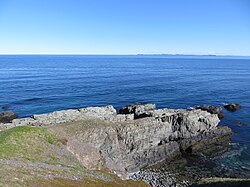
- Defining Boundary: Marked by the appearance of the trace fossil Treptichnus pedum.
- Major Biological Milestone: The rapid diversification of marine life, including trilobites and archaeocyaths.
- Geological Context: The first period of the Paleozoic Era.
Geological Chronology and Stratigraphy
The Cambrian is organized into several series and stages, which geologists use to map the passage of time through rock layers. The period is divided into three primary series:
Terreneuvian Series
The Terreneuvian is the lowermost series, lasting from roughly 538.8 Ma to 521 Ma. It is divided into the Fortunian stage and an unnamed Stage 2. Notably, the Terreneuvian is the only Cambrian series that does not contain trilobite fossils. Instead, it is characterized by complex, sediment-penetrating trace fossils and the appearance of small shelly fossils (SSF).
Cambrian Series 2
Spanning from c. 521 Ma to 506.5 Ma, this unnamed series includes Cambrian Stage 3 and Stage 4. This epoch saw a rapid diversification of metazoans. However, because many species, such as trilobites and archaeocyaths (early sponge-like organisms), had restricted geographic distributions, establishing a global standard for this period remains a challenge for scientists.
Miaolingian and Furongian Series
The later stages of the Cambrian include the Miaolingian and the Furongian. The Furongian is subdivided into the Paibian, Jiangshanian, and an unnamed Stage 10, concluding at the boundary with the Ordovician Period.
| Series | Stages | Approximate Age (Ma) |
|---|---|---|
| Terreneuvian | Fortunian, Stage 2 | 538.8 – 521 |
| Series 2 | Stage 3, Stage 4 | 521 – 506.5 |
| Miaolingian | Wuliuan, Drumian, Guzhangian | 506.5 – 497 |
| Furongian | Paibian, Jiangshanian, Stage 10 | 497 – 486.85 |
Paleogeography and Climate
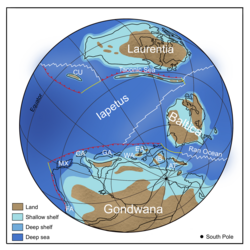
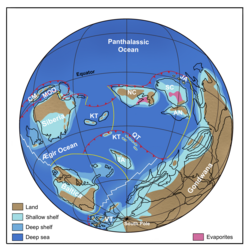
The physical layout of the Earth during the Cambrian was vastly different from today. The supercontinent Laurentia sat across the equator, separated from the massive landmass of Gondwana by the Iapetus Ocean. There is ongoing scientific debate regarding the existence of the supercontinent Pannotia and the exact timing of the Iapetus Ocean's opening.
Climate data suggests a greenhouse world. While there is debate regarding exact sea surface temperatures due to complexities in measuring oxygen isotopes (δO), estimates for tropical waters range from 28–32 °C to as high as 38 °C. This was significantly warmer than the modern average tropical sea surface temperature of 26 °C.
The Explosion of Marine Life
The Cambrian is most famous for its incredible fossil record, preserved in unique sites known as Lagerstätten (deposits that exhibit extraordinary fossil preservation). These sites provide a window into the diverse creatures that inhabited the ancient seas.
Diverse Marine Biota
The oceans were home to a variety of groundbreaking life forms:
- Trilobites: Highly successful and common arthropods.
- Anomalocaris: A formidable early marine predator belonging to the Radiodonta group.
- Archaeocyatha: Early reef-building organisms.
- Pikaia: A stem-chordate, representing an early relative of the lineage that led to vertebrates.
- Halkieria: A unique invertebrate that is considered an early member of the mollusk group.
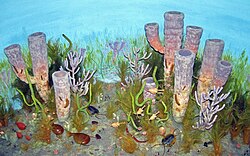
Other significant finds include the Chengjiang biota and the Burgess Shale, which offer detailed views of soft-bodied organisms that would otherwise have vanished from the fossil record.
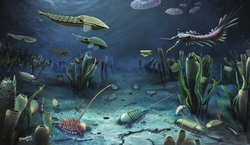
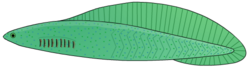
One notable example is Haikouichthys, an extinct fish-like craniate from approximately 518 million years ago, which provides insight into the early evolution of vertebrates.
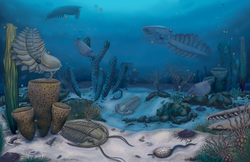
The Marjum biota also showcases the complexity of the era, featuring various arthropods, sponges, and echinoderms.
Even organisms once thought to be algae, such as Margaretia dorus, have been reclassified through modern study as hemichordates, demonstrating how our understanding of Cambrian life continues to evolve.
![A reconstruction of Margaretia dorus from the Burgess Shale, which were once believed to be green algae, but are now understood to represent hemichordates[57]](/images/e0/65/e065dfee5f7ec4b16ba379987fa01613fd3911ffd1365cbb79468b31854195c3.png)
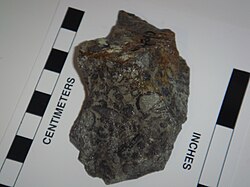
In other regions, such as the Death Valley area, archaeocyathids from the Poleta formation provide evidence of the complex reef systems that existed during this period.
Frequently Asked Questions
What defines the start of the Cambrian Period?
The lower boundary of the Cambrian is defined by the first appearance of the trace fossil Treptichnus pedum, a complex, sediment-penetrating burrow.
Where is the official boundary located?
The Global Boundary Stratotype Section and Point (GSSP) for the base of the Cambrian is located at the Fortune Head section in Newfoundland, Canada.
Were there animals on land during the Cambrian?
The fossil record for the Cambrian primarily reflects marine life. While some evidence of charophyte algae exists, the era is defined by the massive diversification of life within the oceans.
What were trilobites?
Trilobites were a very common group of marine arthropods that flourished during the Cambrian and became one of the most iconic symbols of the period.
How did the climate affect Cambrian life?
The Cambrian was characterized by a greenhouse climate with high sea levels and warm tropical sea surface temperatures, which likely supported the rapid diversification of marine organisms.