Silurian Period: Life, Climate, and the Rise of Early Vertebrates
The Silurian Period represents a pivotal chapter in Earth's history, spanning approximately 443.1 to 419.62 million years ago. Following the mass extinction at the end of the Ordovician, the Silurian was a time of recovery, diversification, and significant biological innovation. During this era, life began to make its definitive move from the oceans to the land, and the foundations of modern ecosystems were laid.
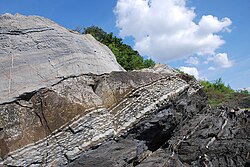
Key Facts
- Time Span: Approximately 443.1 to 419.62 million years ago.
- Major Biological Milestones: Appearance of the earliest vascular plants (such as Cooksonia) and the diversification of jawed vertebrates.
- Sea Levels: Generally high, around 180 meters above present-day levels, though subject to short-term fluctuations.
- Defining Fossils: The period is chronologically defined by the first appearance of specific graptolites, namely Akidograptus ascensus (lower boundary) and Monograptus uniformis (upper boundary).
- Geological Context: A major period within the Paleozoic Era.
Chronology and Subdivisions
The Silurian is organized into several distinct epochs and stages, which allow geologists to track the progression of time and biological change. The period is divided into three primary epochs:
Llandovery Epoch
The earliest epoch, consisting of the Rhuddanian, Aeronian, and Telychian stages. This era was critical for the initial recovery of marine life following previous extinction events.
Wenlock Epoch
The middle epoch, comprising the Sheinwoodian and Homerian stages. This period saw continued stabilization of marine environments.
Ludlow and Přídolí Epochs
The final stages of the Silurian include the Ludlow epoch (Gorstian and Ludfordian stages) and the Přídolí epoch, marking the transition into the Devonian Period.
| Epoch | Stage | Approximate Start (Ma) |
|---|---|---|
| Llandovery | Rhuddanian | 443.8 |
| Llandovery | Aeronian | 440.8 |
| Llandovery | Telychian | 438.5 |
| Wenlock | Sheinwoodian | 433.4 |
| Wenlock | Homerian | 430.5 |
| Ludlow | Gorstian | 427.4 |
| Ludlow | Ludfordian | 425.6 |
| Přídolí | — | 423.0 |
Marine Life and Evolutionary Breakthroughs
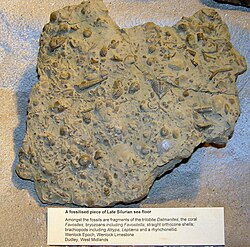
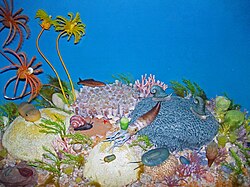
The Silurian oceans were teeming with diverse life forms. Marine invertebrates dominated the seafloor, including tabulate corals (such as Halysites), brachiopods, crinoids, and various mollusks. Arthropods also flourished, with giant sea scorpions known as eurypterids (like Pterygotus) becoming prominent predators.
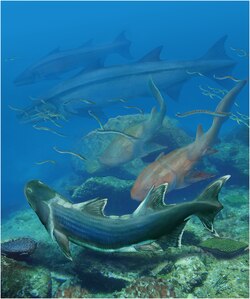
One of the most significant evolutionary developments during this time was the rise of jawed vertebrates. In regions like China, the fossil record reveals early stem-chondrichthyans (ancestors to sharks) and placoderms—armored fish that represented some of the earliest complex vertebrates. Other notable early fish included agnathans (jawless fish) such as Tujiaaspis, which showed the early development of paired fins.
The Colonization of Land
While the oceans were the primary theater of evolution, the Silurian also witnessed the beginnings of terrestrial life. The appearance of vascular plants, such as Cooksonia, marked a monumental shift. These plants possessed specialized tissues to transport water, allowing them to grow in terrestrial environments. Alongside these plants, early land-dwelling animals, including primitive arthropods like millipedes and arachnids, began to inhabit the coastal and inland margins.
Frequently Asked Questions
What defines the start and end of the Silurian Period?
The lower boundary is defined by the first appearance of the graptolite Akidograptus ascensus at Dob's Linn, UK. The upper boundary is defined by the first appearance of the graptolite Monograptus uniformis in Klonk, Czech Republic.
What were the most common animals in the Silurian oceans?
The seas were filled with trilobites, brachiopods, crinoids, corals, and various mollusks. Large arthropods, specifically eurypterids, were also significant predators.
Did plants exist on land during the Silurian?
Yes. The Silurian is notable for the emergence of the earliest vascular plants, such as Cooksonia, which allowed life to begin spreading onto land surfaces.
How did the climate compare to today?
The Silurian was characterized by high sea levels, roughly 180 meters above current levels, though the period experienced various climatic perturbations and sea-level excursions.
What is a placoderm?
Placoderms were a group of armored prehistoric fish. They are significant in the Silurian record as they represent some of the earliest known jawed vertebrates.