Thermodynamics: The Science of Heat, Energy, and Entropy
Thermodynamics is a fundamental branch of physics that examines the relationships between heat, work, temperature, and energy. It explores how these forces interact with the physical properties of matter and radiation, governed by a set of universal laws. While it provides a quantitative description of the world using macroscopic physical quantities—things we can measure on a large scale—it can also be explained through statistical mechanics, which looks at the microscopic behavior of individual particles.
From the engineering of massive power plants to the complex biochemical reactions within a human cell, thermodynamics is essential to fields such as physical chemistry, mechanical engineering, and meteorology.
Key Facts
- Core Focus: The study of heat, work, temperature, and their relation to energy and entropy.
- Governing Principles: Defined by four primary laws of thermodynamics.
- Absolute Zero: The theoretical point where all activity stops, measured at 0 K, −273.15 °C, or −459.67 °F.
- Interdisciplinary Reach: Critical for chemical engineering, biochemistry, and atmospheric science.
- Foundational Figures: Key contributors include Sadi Carnot, Rudolf Clausius, Lord Kelvin, and J. Willard Gibbs.
The Evolution of Thermodynamic Theory
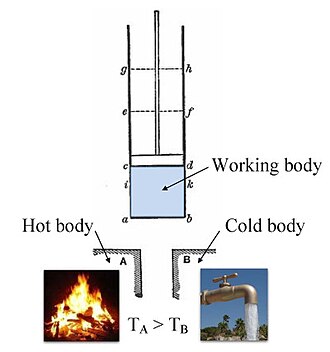
The discipline grew from a practical need to improve the efficiency of early steam engines. In 1824, French physicist Sadi Carnot laid the groundwork with his study of heat engines, introducing what is now known as the Carnot cycle.
By 1854, Lord Kelvin provided one of the first concise definitions of the field, describing it as the study of the relation of heat to forces acting between contiguous parts of bodies. Rudolf Clausius further refined these ideas; his 1850 paper, "On the Moving Force of Heat," first stated the second law of thermodynamics, and by 1865, he coined the term entropy—a measure of disorder or randomness in a system.
The field expanded through several influential schools of thought. The Berlin school, led by Clausius, and the Vienna school, featuring Ludwig Boltzmann's statistical mechanics, shaped modern understanding. Meanwhile, at Yale University, J. Willard Gibbs launched chemical thermodynamics with his 1876 work, On the Equilibrium of Heterogeneous Substances, which allowed scientists to determine if chemical reactions would occur spontaneously.
![The thermodynamicists of the original eight founding schools of thermodynamics. The schools with the most-lasting influence on the modern versions of thermodynamics are the Berlin school, particularly Rudolf Clausius's 1865 textbook The Mechanical Theory of Heat, the Vienna school, with the statistical mechanics of Ludwig Boltzmann, and the Gibbsian school at Yale University of Willard Gibbs' 1876 and his book On the Equilibrium of Heterogeneous Substances which launched chemical thermodynamics.[8]](/images/36/e5/36e54b794b8763925cf3c41a4b21c75007451ec03df0a769643e44d385f8c65a.png)
Early Experimental Milestones
Long before the formal laws were written, early scientists experimented with vacuums and pressure. In 1650, Otto von Guericke built the first vacuum pump to disprove the Aristotelian belief that "nature abhors a vacuum." Later, Robert Boyle and Robert Hooke discovered the inverse relationship between pressure and volume, now known as Boyle's Law. These discoveries led Denis Papin to conceive of the piston and cylinder engine, which eventually enabled engineers like Thomas Savery and Thomas Newcomen to build the first functional steam engines.
Branches and System Models
Thermodynamics is divided into several specialized branches depending on the scale and state of the system being studied:
- Classical Thermodynamics: Focuses on macroscopic properties of matter.
- Statistical Mechanics: Uses statistical predictions of particle motion to explain microscopic behavior.
- Chemical Thermodynamics: Studies the role of entropy and energy in chemical reactions.
- Equilibrium vs. Non-equilibrium Thermodynamics: Distinguishes between systems in a stable state and those undergoing change.
Defining the Thermodynamic System
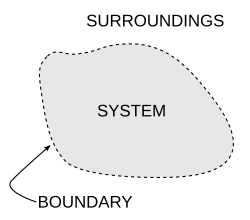
A thermodynamic system is the specific region of space or matter being studied. This could be as small as a single atom or as large as a tropical cyclone or the event horizon of a black hole. Systems are categorized by how they exchange mass and energy with their surroundings:
| System Type | Mass Flow | Work Exchange | Heat Exchange |
|---|---|---|---|
| Open | Yes | Yes | Yes |
| Closed | No | Yes | Yes |
| Thermally Isolated | No | Yes | No |
| Mechanically Isolated | No | No | Yes |
| Isolated | No | No | No |
Thermodynamic Processes and Variables
Scientists track changes in a system using conjugate variables, such as pressure and volume (mechanical parameters) or temperature and entropy (thermal parameters). Depending on which variable remains constant, a process is given a specific name:
- Isothermal: Constant temperature.
- Isobaric: Constant pressure.
- Isochoric: Constant volume.
- Adiabatic: No loss or gain of heat.
- Isentropic: A reversible adiabatic process with constant entropy.
A practical example of a sudden thermodynamic change can be seen when opening a bottle of sparkling wine. The rapid drop in pressure causes a corresponding drop in temperature, freezing moisture in the air into tiny ice crystals.
![Opening a bottle of sparkling wine (high-speed photography). The sudden drop of pressure causes a huge drop of temperature. The moisture in the air freezes, creating a smoke of tiny ice crystals.[29][30][31]](/images/a6/dd/a6dd098269d7196a750297eb61b3948cc6b7b9233daeee02b00566bc59a861e9.jpg)
Frequently Asked Questions
What is the difference between classical and statistical thermodynamics?
Classical thermodynamics deals with macroscopic properties—measurable quantities like pressure and temperature—without considering the individual atoms. Statistical thermodynamics explains these same properties by analyzing the collective motion and behavior of microscopic particles.
What is absolute zero?
Absolute zero is the lowest possible temperature, defined as 0 Kelvin (−273.15 °C). At this theoretical point, all molecular activity would cease.
What is an adiabatic process?
An adiabatic process is a thermodynamic change in which no heat is transferred into or out of the system. The energy change is driven entirely by work.
Who is considered the father of chemical thermodynamics?
Josiah Willard Gibbs is widely credited with launching chemical thermodynamics through his work on the equilibrium of heterogeneous substances, which provided a mathematical framework for analyzing chemical reactions.
What is entropy?
Introduced by Rudolf Clausius in 1865, entropy is a thermodynamic property that represents the degree of disorder or randomness within a system.