Max Planck: The Father of Quantum Theory
Max Karl Ernst Ludwig Planck was a pioneering German theoretical physicist whose work fundamentally altered our understanding of the universe. By challenging the established laws of classical physics, he laid the groundwork for quantum theory, a discovery so profound that he compared its significance to the achievements of Isaac Newton.
Planck is most renowned for his discovery of energy quanta—the idea that energy is not continuous but is instead emitted or absorbed in discrete units. This breakthrough earned him the Nobel Prize in Physics in 1918 and sparked a scientific revolution that continues to influence modern technology and physics today.
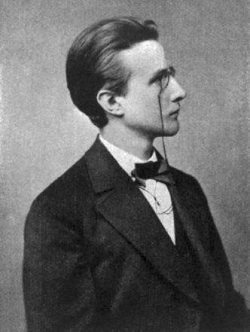
Key Facts
- Primary Achievement: Originator of old quantum theory and discoverer of energy quanta.
- Major Award: Nobel Prize in Physics (1918).
- Key Contribution: Defined the Planck constant, which is central to quantum mechanics.
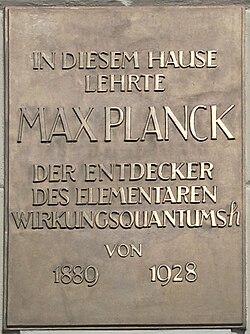
- Academic Legacy: Taught at the Friedrich Wilhelm University of Berlin from 1889 to 1928.
- Scientific Impact: Developed Planck's law and established Planck units based on fundamental physical constants.
Early Life and Academic Ascent
Born on April 23, 1858, in Kiel, Duchy of Holstein, Max Planck pursued a rigorous education in the sciences. He graduated from the Ludwig-Maximilians-Universität München in 1879, where he completed his thesis on the second law of mechanical heat theory under the guidance of Alexander von Brill.
Planck's academic career progressed rapidly. In 1889, he succeeded Gustav Kirchhoff at the Friedrich Wilhelm University of Berlin, becoming a Full Professor by 1892. During his tenure, he became a central figure in the German scientific community, helping to merge various local physical societies in 1898 to form the German Physical Society (DPG), which he later presided over from 1905 to 1909.
The Birth of Quantum Physics
Planck's most significant intellectual achievement arose from his study of black-body radiation (the thermal electromagnetic radiation within or emitted by a black body in thermodynamic equilibrium). While attempting to solve the problem of how energy is distributed in a normal spectrum, Planck introduced a "purely formal assumption" that energy is quantized.
This Planck postulate suggested that energy is not a continuous flow but exists in discrete packets. This concept was incompatible with the classical physics of the time, which viewed energy as continuous. This discovery led to the definition of the Planck constant, a fundamental value that allows for the creation of Planck units—universal physical units such as Planck length and Planck mass.
Impact and Recognition
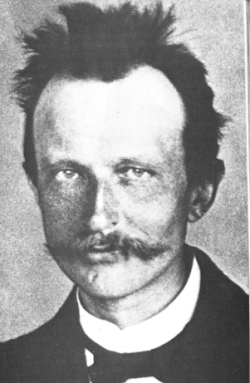
Although Planck initially viewed his quantization theory as a mathematical convenience, it became the cornerstone of quantum mechanics. His work provided the essential framework for subsequent physicists, including Albert Einstein, to further develop the theory of relativity and quantum behavior.
Life During Conflict and Later Years
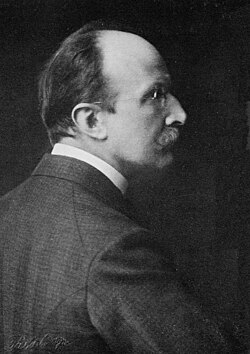
Planck's later life was marked by both professional prestige and profound personal tragedy. He remained a respected figure in science, often seen alongside other giants of the field like Einstein and Millikan.
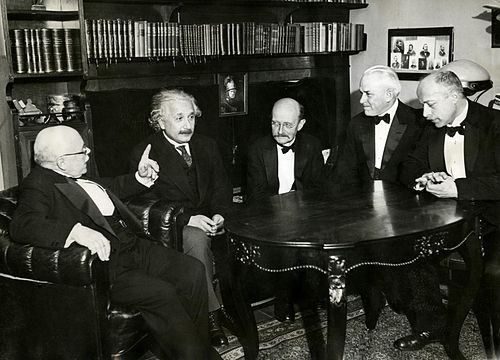
During the Nazi dictatorship, Planck faced immense political pressure. In 1938, he resigned from the presidency of the Prussian Academy in protest after the institution lost its independence to the Nazi process of Gleichschaltung (forced coordination).
The greatest tragedy of his life occurred in January 1945, when his son, Erwin, was executed by the People's Court for his involvement in the July 20 plot to assassinate Adolf Hitler. This loss severely impacted Planck's will to live. He passed away on October 4, 1947, in Göttingen, Germany.
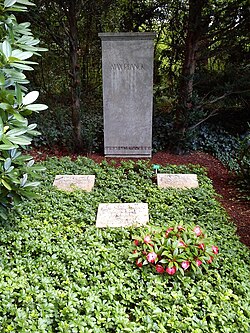
Legacy and Commemoration
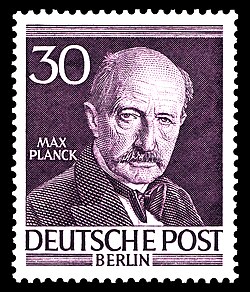
Max Planck's influence persists through the Max Planck Society and the various medals and prizes named in his honor. His portrait appeared on West German 2-DM coins from 1957 to 1971, and he continues to be celebrated as one of the most influential scientists in history.
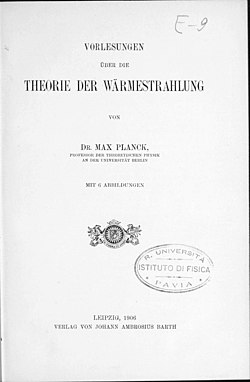
His seminal work, Vorlesungen über die Theorie der Wärmestrahlung (1906), remains a testament to his contributions to the theory of heat radiation.
| Category | Details |
|---|---|
| Born | April 23, 1858 (Kiel, Holstein) |
| Died | October 4, 1947 (Göttingen, Germany) |
| Key Discovery | Energy Quanta / Planck Constant |
| Major Awards | Nobel Prize in Physics (1918), Franklin Medal, Copley Medal |
| Education | Ludwig-Maximilians-Universität München |
| Notable Students | Max von Laue, Walther Bothe, Lise Meitner, Eugene Wigner |
Frequently Asked Questions
What is the Planck constant?
The Planck constant is a fundamental physical constant that relates the energy of a photon to its frequency. It is the central element of quantum theory, defining the scale at which quantum effects become significant.
Why was Max Planck awarded the Nobel Prize?
He was awarded the 1918 Nobel Prize in Physics for his discovery of energy quanta, which provided the theoretical foundation for the advancement of modern physics.
What is black-body radiation?
Black-body radiation is the thermal electromagnetic radiation emitted by an idealized physical body that absorbs all incident electromagnetic radiation. Planck's study of this phenomenon led him to the discovery of quantization.
How did Max Planck contribute to the scientific community in Germany?
Beyond his research, Planck was instrumental in organizing the German Physical Society (DPG) in 1898 and served as its president from 1905 to 1909.
What was the personal tragedy Planck faced during WWII?
Planck's son, Erwin, was arrested by the Gestapo and executed in January 1945 for participating in the failed attempt to assassinate Adolf Hitler.