Annalen der Physik: A Legacy of Scientific Discovery
Annalen der Physik (English: Annals of Physics) stands as one of the most venerable publications in the scientific world. Established in 1799, this peer-reviewed journal has served as a primary venue for original research across experimental, theoretical, applied, and mathematical physics. From its early days as a German-language cornerstone of science to its current status as a global English-language publication, it has documented the evolution of our understanding of the physical universe.
Key Facts
- Founded: 1799 (successor to journals from 1790).
- Current Publisher: Wiley-VCH.
- Editor-in-Chief: Stefan Hildebrandt.
- Impact Factor (2024): 2.5.
- Language Evolution: Transitioned from German to English, becoming exclusively English after 1990.
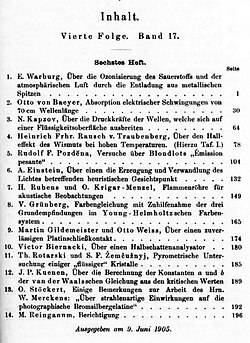
- Notable Contribution: Published Albert Einstein's 1905 Annus Mirabilis papers.
Historical Evolution and Language
The journal's origins trace back to the Journal der Physik (1790–1794) and the Neues Journal der Physik (1795–1797). Over two centuries, it has operated under several titles, including Annalen der Physik und der physikalischen Chemie and Wiedemann's Annalen der Physik und Chemie.
For much of its history, the journal was published in German, which was then the leading language of science. Between the 1950s and 1980s, it adopted a bilingual approach. While English was initially reserved for foreign contributors, German-speaking authors began writing in English during the 1970s to reach a wider international audience. Following the German reunification in 1990, English became the sole language of publication.
The Golden Age and Political Shifts
The journal reached its zenith of influence in 1905, the year Albert Einstein published his groundbreaking Annus Mirabilis (miracle year) papers. However, the 1920s saw a shift in prominence toward the Zeitschrift für Physik. The rise of Nazi Germany further impacted the journal; the 1933 emigration wave stripped the publication of many elite authors, and it was viewed as representing the more conservative elements of the German physics community.
World War II caused a total cessation of publication between 1944 and 1946. After receiving permission from Soviet military authorities to resume in August 1946, the journal maintained a unique co-editorship structure—featuring one editor from East Germany and one from West Germany—until 1992. Following reunification, the journal was acquired by Wiley-VCH and underwent a significant relaunch in 2012 to update its scope and editorial board.
Editorial Leadership and Peer Review
In its early years, the journal was often identified by the name of its editor-in-chief. Notable early leaders included Ludwig Wilhelm Gilbert, Johann Christian Poggendorff, and Gustav Heinrich Wiedemann. A peculiar tradition of the time was that volume numbering would restart from 1 with each new editor, creating a historical source of confusion.
By the early 20th century, leadership was split between experimentalists (such as Wilhelm Wien and Eduard Grüneisen) and theoreticians, most notably Max Planck. Interestingly, peer-review—the process where experts evaluate a paper before publication—was not yet standard. For instance, Albert Einstein would simply send his manuscripts directly to Max Planck for publication.
Landmark Publications
Annalen der Physik has been the birthplace of some of the most significant discoveries in human history. These range from the foundational laws of electrical circuits to the theories that redefined space and time.
| Author(s) | Year | Contribution/Topic |
|---|---|---|
| Gustav Kirchhoff | 1847 | Electrical circuit analysis equations |
| Heinrich Hertz | 1887 | The photoelectric effect |
| Max Planck | 1901 | Blackbody radiation |
| Albert Einstein | 1905 | Special relativity, Brownian motion, and mass-energy equivalence |
| Albert Einstein | 1916 | General theory of relativity |
Indexing and Accessibility
Today, the journal is indexed in major scientific databases, including the Science Citation Index, Scopus, and MathSciNet. It continues to provide access to its rich history through an online archive, with a free archive available for issues published between 1799 and 1940.
Frequently Asked Questions
Who is the current editor-in-chief of Annalen der Physik?
The current editor-in-chief is Stefan Hildebrandt.
Why did the journal change its language from German to English?
The shift began in the 1970s as German-speaking authors sought to reach a broader international audience. After German reunification in 1990, English became the exclusive language of the journal.
What is the significance of the year 1905 for the journal?
1905 is considered the journal's peak of importance because it published Albert Einstein's Annus Mirabilis papers, which included his work on the photoelectric effect, Brownian motion, mass-energy equivalence, and special relativity.
How was the journal managed during the division of Germany?
From 1946 until 1992, the journal operated under a policy of co-editorship, with one editor based in East Germany and another in West Germany.
Was peer review always used in Annalen der Physik?
No, peer review was not standard in the early years. For example, Albert Einstein submitted his manuscripts directly to Max Planck for publication without a formal peer-review process.