Theodor Mommsen: The Titan of Roman History and Classical Scholarship
Christian Matthias Theodor Mommsen was a towering figure of 19th-century intellectual life. A polymath whose expertise spanned classical scholarship, jurisprudence, archaeology, and politics, Mommsen redefined how the modern world understands ancient Rome. His rigorous approach to evidence and his sweeping historical narratives earned him a place among the greatest classicists in history, culminating in the 1902 Nobel Prize in Literature.
Key Facts
- Nobel Laureate: Received the Nobel Prize in Literature in 1902, a rare honor for a non-fiction writer.
- Academic Pioneer: Established a new framework for the systematic study of Roman history and pioneered epigraphy (the study of inscriptions on material artifacts).
- Legal Influence: His research on Roman law and obligations significantly influenced the development of the German civil code.
- Prolific Author: Published over 1,500 works throughout his career.
- Political Figure: Served as a delegate in both the Prussian House of Representatives and the German Reichstag.
Early Life and Academic Journey
Born on November 30, 1817, in Garding, Duchy of Schleswig (then under Danish rule), Mommsen grew up in Bad Oldesloe, where his father served as a Lutheran minister. His early education was largely self-directed, supplemented by four years at the Gymnasium Christianeum in Altona. Due to financial constraints, he enrolled at the University of Kiel rather than Göttingen.
Between 1838 and 1843, Mommsen studied jurisprudence at Kiel, eventually earning a Doctor of Roman Law. During this period, he developed a close friendship with the future poet Theodor Storm. A royal Danish grant later allowed him to travel to France and Italy, where he began studying preserved classical Roman inscriptions, sparking his lifelong passion for ancient history.
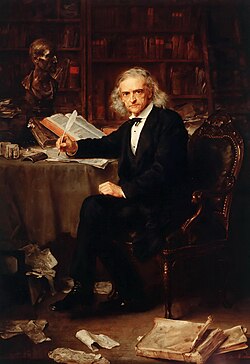
A Career of Academic Excellence and Exile
Mommsen's career was often intertwined with the volatile politics of his time. During the 1848 revolution, he worked as a war correspondent in Rendsburg, supporting constitutional reform and the German annexation of Schleswig-Holstein. This political activity led to his expulsion by the Danes, prompting his appointment as a professor of law at the University of Leipzig in 1848.
His commitment to his principles often led to professional upheaval. After protesting the new constitution of Saxony in 1851, he resigned and spent time in exile as a professor of Roman law at the University of Zurich. He later held positions at the University of Breslau and the Berlin Academy of Sciences, eventually becoming a professor of Roman History at the University of Berlin in 1861.
The Tragedy of the 1880 Fire
A devastating fire broke out in Mommsen's Berlin home on July 7, 1880. While attempting to save valuable papers, Mommsen suffered burns. The fire destroyed several irreplaceable manuscripts, including a loan from Trinity College, Cambridge, and a critical manuscript of Jordanes from the Heidelberg University library.
Major Contributions to Scholarship
Mommsen's legacy is defined by his insistence on the method of autopsy—the requirement that transcriptions of inscriptions be checked and compared directly against the original artifacts.
Corpus Inscriptionum Latinarum
His most enduring project, the Corpus Inscriptionum Latinarum, aimed to collect all known ancient Latin inscriptions. Mommsen prepared five of the first fifteen volumes published during his lifetime; the complete series eventually spanned seventeen volumes, with the final one published in 1986.
The History of Rome and Legal Works
Mommsen is perhaps most famous for The History of Rome (Römische Geschichte), for which he received the Nobel Prize. He also produced fundamental editions of the Corpus Iuris Civilis and the Codex Theodosianus, as well as a comprehensive treatment of Roman Constitutional Law.
| Work | Focus | Significance |
|---|---|---|
| The History of Rome | Ancient Roman History | Basis for his 1902 Nobel Prize in Literature |
| Corpus Inscriptionum Latinarum | Latin Inscriptions | Pioneered the systematic study of epigraphy |
| Corpus Iuris Civilis | Roman Law | Fundamental collection for legal scholarship |
| Codex Theodosianus | Imperial Law | Critical edition of Roman law codes |
Political Life and Social Views
Mommsen was an active politician, serving in the Prussian House of Representatives and the Reichstag. A Liberal nationalist, he supported German Unification but grew pessimistic about the German Empire's direction, frequently clashing with Otto von Bismarck over social policies.
He was a staunch opponent of antisemitism. During the Berliner Antisemitismusstreit in 1879, he denounced the views of Heinrich von Treitschke and co-founded the Association for Combating Antisemitism (Abwehrverein) in 1890. However, his nationalism had a darker side; he held militant and hostile views toward Slavic nations, specifically Czechs, in his later years.
Global Influence and Legacy
Mommsen's influence extended far beyond academia. The playwright George Bernard Shaw used Mommsen's interpretation of Julius Caesar as inspiration for Caesar and Cleopatra, and naval theorist Alfred Thayer Mahan formulated his theories on sea power while reading Mommsen's historical works.
Even Mark Twain recounted the immense respect Mommsen commanded, describing a banquet at the University of Berlin where the entire room rose in a "storm" of applause and shouting upon Mommsen's arrival, noting the scholar's "titanic deceptive modesty."
Frequently Asked Questions
Why did Theodor Mommsen win the Nobel Prize in Literature?
He was awarded the prize in 1902 primarily for his historical writings, most notably The History of Rome. He is one of the few non-fiction writers to ever receive this honor.
What is epigraphy and how did Mommsen contribute to it?
Epigraphy is the study of inscriptions on material artifacts. Mommsen pioneered this field by establishing the method of autopsy, ensuring that all recorded inscriptions were verified against the original physical source.
What was Mommsen's stance on antisemitism?
Mommsen strongly opposed antisemitism, writing pamphlets against it and co-founding the Association for Combating Antisemitism (Abwehrverein) to counter the growing prejudice in Germany.
How did Mommsen influence modern law?
His extensive research and publications on Roman law and the law of obligations had a significant impact on the drafting and structure of the German civil code.
What happened to his research in the 1880 fire?
A fire in his Berlin home destroyed several critical manuscripts, including a loan from Trinity College, Cambridge, and a significant manuscript of Jordanes from the Heidelberg University library.