Bob DylanNobel Prize in Literaturefolk rocksinger-songwriterHighway 61 Revisited

Bob Dylan: The Evolution of a Musical and Literary Icon

Bob Dylan: The Evolution of a Musical and Literary Icon Few artists have reshaped the landscape of popular culture as profoundly as Bob Dylan. Born Robert Allen Zimmerman, Dylan emerged f...

Bob Dylan: The Evolution of a Musical and Literary Icon

Few artists have reshaped the landscape of popular culture as profoundly as Bob Dylan. Born Robert Allen Zimmerman, Dylan emerged from the small town of Hibbing, Minnesota, to become a global symbol of social change, poetic innovation, and artistic restlessness. From his early days as a folk revivalist to his transition into rock and his eventual recognition as a Nobel laureate, Dylan's career is a study in constant reinvention.
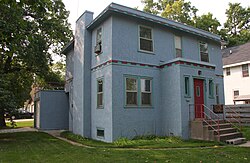
The Bob Dylan Childhood Home in Hibbing, Minnesota

Key Facts

ภาพประกอบบทความ
ภาพประกอบจากบทความต้นฉบับ
  • Real Name: Robert Allen Zimmerman.
  • Major Achievement: Awarded the 2016 Nobel Prize in Literature.
  • Musical Range: Spans folk, rock, blues, gospel, country, and traditional pop.
  • Instruments: Vocals, guitar, harmonica, and keyboards.
  • Notable Honors: Presidential Medal of Freedom (2012).
  • Active Years: 1957 to the present.

The Early Years and Rise to Stardom

Dylan's journey began in the late 1950s, but it was his move to New York City between 1960 and 1962 that catapulted him into the spotlight. Immersing himself in the folk scene, he quickly gained a reputation for his songwriting and raw delivery. By 1963, he had become a leading voice of the protest music movement, capturing the zeitgeist of the civil rights era.
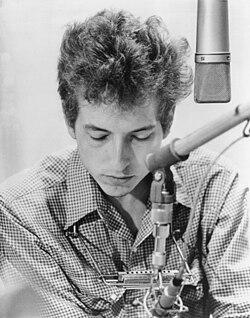
Bob Dylan, 1963 promo photo by Don Hunstein for The Times They Are a-Changin' in a recording studio

During this period, Dylan's association with figures like Joan Baez further solidified his status as a cultural catalyst. His early albums, including The Freewheelin' Bob Dylan and The Times They Are a-Changin', provided the soundtrack for a generation questioning authority and seeking social justice.
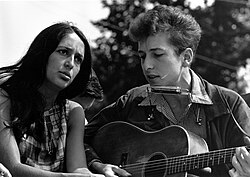
Dylan is seated, singing and playing guitar. Seated to his right is a woman gazing upward and singing with him.
Joan Baez and Dylan during the civil rights "March on Washington for Jobs and Freedom", August 28, 1963

Going Electric and Artistic Transformation

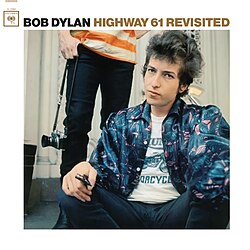
The mid-1960s marked one of the most controversial pivots in music history. Dylan began "going electric," blending folk sensibilities with rock and roll. This transition, highlighted by the release of Bringing It All Back Home and the seminal Highway 61 Revisited, alienated some folk purists but expanded the boundaries of songwriting.
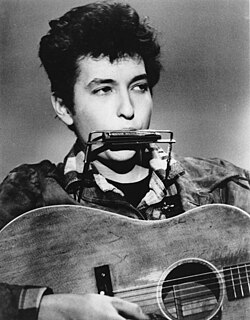
Bob Dylan performing in 1963

The era was defined by surrealist lyrics and a bold new sound, peaking with the 1966 album Blonde on Blonde. However, the intensity of his fame took a toll; a motorcycle accident in 1966 led to a period of withdrawal from the public eye.
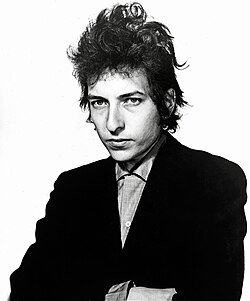
Dylan in 1965
Dylan in 1965

The album cover of Highway 61 Revisited, an iconic image of Dylan

The 1965 tour of England, captured in the cinéma vérité documentary Dont Look Back, remains a definitive record of this chaotic and creative period, featuring an early music video for "Subterranean Homesick Blues."
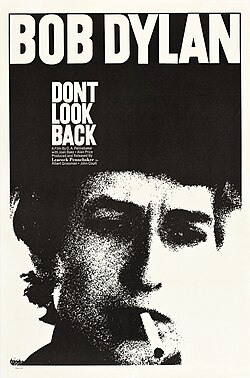
The cinéma vérité documentary Dont Look Back (1967) follows Dylan on his 1965 tour of England. An early music video for "Subterranean Homesick Blues" was used as the film's opening segment.

Decades of Reinvention: 1970 to 2000

Dylan's career has never followed a linear path. In the 1970s, he explored Christian music and returned to touring, notably collaborating with The Band in 1974. The mid-70s also saw the release of the critically acclaimed Blood on the Tracks and the experimental The Basement Tapes.
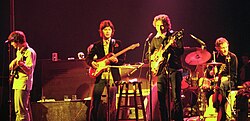
Dylan together with three musicians from The Band onstage. Dylan is third from left, wearing a black jacket and pants. He is singing and playing an electric guitar.
Bob Dylan and the Band commenced their 1974 tour in Chicago on January 3, 1974.[164]

The 1980s were characterized by career fluctuations, but the 1990s brought a resurgence as Dylan returned to his folk roots. This momentum carried into the 2000s, during which he won an Oscar, published a memoir, and released Modern Times.
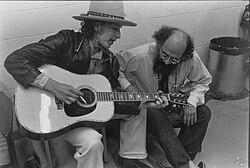
Dylan, wearing a hat and leather coat, plays guitar and sings, seated. Crouched next to him is a bearded man, listening to him with head bent.
Bob Dylan with Allen Ginsberg on the Rolling Thunder Revue in 1975

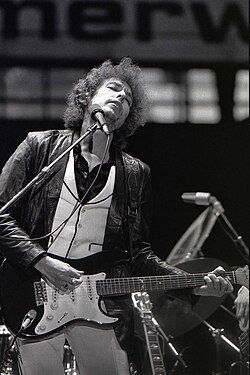
Dylan performing in the De Kuip Stadium, Rotterdam, June 23, 1978

Dylan, onstage and with eyes closed, plays a chord on an electric guitar.
Dylan in Toronto, April 18, 1980

The Modern Era and the Never Ending Tour

In the 21st century, Dylan has maintained a rigorous performance schedule known as the Never Ending Tour. His later recordings, such as Tempest (2012) and Rough and Rowdy Ways (2020), demonstrate a continued commitment to lyrical depth and musical exploration.
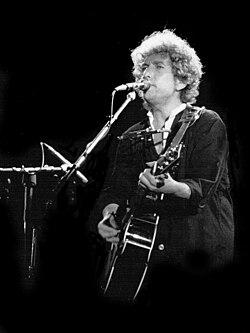
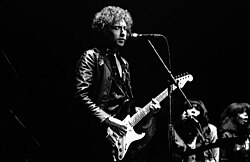
Dylan plays his guitar and sings into a microphone onstage.
Dylan in Barcelona, Spain, 1984

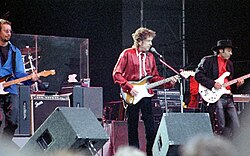
Dylan and members of his band perform onstage. Dylan, wearing a red shirt and black pants, plays an electric guitar and sings.
Dylan performs during the 1996 Lida Festival in Stockholm

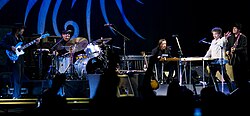
Dylan together with five members of his band onstage. Dylan, dressed in a white shirt and black pants, is second from right.
Dylan at the Spectrum, 2007

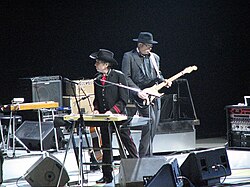
Dylan, dressed in a black western outfit with red highlights, stands onstage and plays the keyboards. He gazes to the left of the photo. Behind him is a guitar player, dressed in black.
Dylan performs at Air Canada Centre, Toronto, November 7, 2006

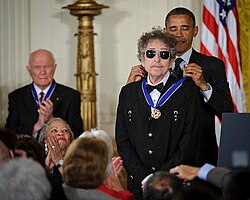
Beyond the stage, Dylan's contributions to the arts have been recognized at the highest levels. In 2012, he was presented with the Presidential Medal of Freedom by President Obama, and in 2016, he became the first musician to receive the Nobel Prize in Literature, acknowledging his influence on the poetic tradition.
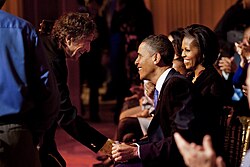
Dylan and the Obamas at the White House, after a performance celebrating music from the civil rights movement on February 9, 2010

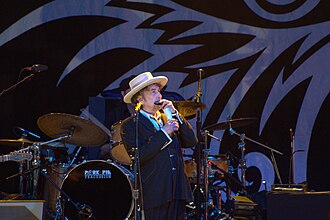
Bob Dylan performing at Finsbury Park, London, June 18, 2011
Dylan performing at Finsbury Park, London, June 18, 2011

President Obama presents Dylan with a Medal of Freedom, May 2012.

Beyond Music: Visual Arts and Literature

Dylan's creativity extends far beyond songwriting. He is an accomplished painter and sculptor, with his work exhibited in galleries such as the Gagosian Gallery and the Danish National Gallery. His written works, including his memoir and The Philosophy of Modern Song, further cement his status as a literary figure.
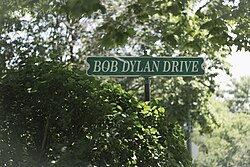
Bob Dylan Drive street sign in Hibbing, Minnesota

Below is a summary of his extensive studio album discography across the decades.

Selected Studio Albums of Bob Dylan
Era Notable Albums
1960s Bob Dylan, The Freewheelin' Bob Dylan, Highway 61 Revisited, Blonde on Blonde
1970s Self Portrait, Blood on the Tracks, Desire, Slow Train Coming
1980s Infidels, Empire Burlesque, Oh Mercy
1990s Time Out of Mind
2000s-Present Love and Theft, Modern Times, Tempest, Rough and Rowdy Ways, Shadow Kingdom

Frequently Asked Questions

What is Bob Dylan's real name?

Bob Dylan was born Robert Allen Zimmerman. He has also used various other names and pseudonyms throughout his career, including Shabtai Zisel ben Avraham.

Why did Bob Dylan win the Nobel Prize in Literature?

He was awarded the 2016 Nobel Prize in Literature for having created new poetic expressions within the great American song tradition.

What is the "Never Ending Tour"?

The Never Ending Tour refers to Dylan's relentless schedule of live performances that has spanned several decades, characterized by frequent setlist changes and constant touring.

Did Bob Dylan do more than just music?

Yes, Dylan is also a painter, sculptor, and writer. His visual art has been displayed in major galleries, and he has authored books and memoirs.

Which instruments does Bob Dylan play?

Dylan is primarily known for his vocals, but he also plays the guitar, harmonica, and keyboards.

References

  1. According to Dylan biographer Robert Shelton, Dylan first confided his change of name to his high school girlfriend, Echo Helstrom, in 1958, telling her that he had found a "great name, Bob Dillon". Shelton surmises that Dillon had two sources: Marshal Matt Dillon was the hero of the TV western Gunsmoke; Dillon was also the name of one of Hibbing's principal families. While Shelton was writing Dylan's biography in the 1960s, Dylan told him, "Straighten out in your book that I did not take my name from Dylan Thomas. Dylan Thomas's poetry is for people that aren't really satisfied in their bed, for people who dig masculine romance." At the University of Minnesota, Dylan told a few friends that Dillon was his mother's maiden name, which was untrue. He later told reporters that he had an uncle named Dillon. Shelton added that only when he reached New York in 1961 did he begin to spell his name "Dylan", by which time he was acquainted with the life and work of Dylan Thomas. Shelton (2011), pp. 44–45.
  2. In a May 1963 interview with Studs Terkel, Dylan broadened the meaning of the song, saying "the pellets of poison flooding the waters" refers to "the lies people are told on their radios and in their newspapers." Cott (2006), p. 8.
  3. The title "Spokesman of a Generation" was viewed by Dylan with disgust in later years. He came to feel it was a label the media had pinned on him, and in his autobiography, Chronicles, Dylan wrote: "The press never let up. Once in a while I would have to rise up and offer myself for an interview so they wouldn't beat the door down. Later an article would hit the streets with the headline 'Spokesman Denies That He's A Spokesman.' I felt like a piece of meat that someone had thrown to the dogs." Dylan (2004), p.119
  4. In an interview with Seth Goddard for Life (July 5, 2001) Ginsberg said Dylan's technique had been inspired by Jack Kerouac: "(Dylan) pulled Mexico City Blues from my hand and started reading it and I said, 'What do you know about that?' He said, 'Somebody handed it to me in '59 in St. Paul and it blew my mind.' So I said 'Why?' He said, 'It was the first poetry that spoke to me in my own language.' So those chains of flashing images you get in Dylan, like 'the motorcycle black Madonna two-wheeled gypsy queen and her silver- studded phantom lover,' they're influenced by Kerouac's chains of flashing images and spontaneous writing, and that spreads out into the people". Schumacher, Michael, ed. (2017). First Thought: Conversations with Allen Ginsberg. U of Minnesota Press. pp. 322–. ISBN 978-1-4529-4995-6.
  5. Later recorded by Jimi Hendrix, whose version Dylan acknowledged as definitive.