Bertrand Russell: The Architect of Analytic Philosophy and Global Humanism
Bertrand Russell was a towering figure of the 20th century, whose intellectual reach spanned the rigorous depths of mathematical logic to the passionate heights of political activism. As a philosopher, logician, and social critic, he fundamentally reshaped how the Western world approaches language, truth, and the structure of knowledge. His life was a testament to the pursuit of reason, marked by a relentless commitment to freedom of expression and a profound skepticism toward dogma.
From his early days at Cambridge to his later years as a global advocate for peace, Russell combined an analytical mind with a humanist heart. He is perhaps best remembered for his contributions to Analytic philosophy—a school of thought that emphasizes the logical analysis of language to solve philosophical problems.
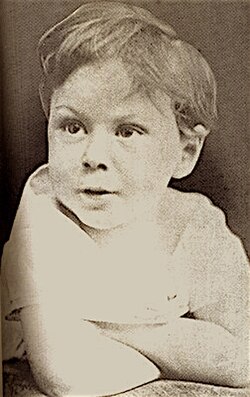
Key Facts
- Full Name: Bertrand Arthur William Russell
- Lifespan: May 18, 1872 – February 2, 1970 (Aged 97)
- Major Achievement: Co-authored Principia Mathematica, a foundational work in mathematical logic.
- Highest Honor: Nobel Prize in Literature (1950).
- Academic Affiliations: Trinity College, Cambridge; Harvard University; University of Chicago; UCLA.
- Core Philosophy: Pioneer of Analytic philosophy and Logical Atomism.
Early Life and Academic Foundation
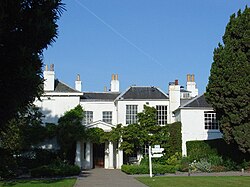
Born in Trellech, Monmouthshire, Russell spent much of his youth in an environment that fostered intellectual curiosity. He grew up in Pembroke Lodge, located in London's Richmond Park, where he began to develop the rigorous thinking patterns that would define his career.
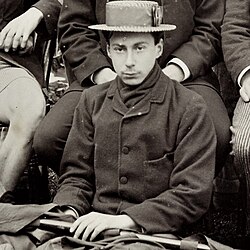
Russell's formal academic journey took him to Trinity College, Cambridge. He excelled in mathematics and philosophy, earning First Class Honours in Mathematics in 1893 and in Philosophy in 1894. During this period, he studied under influential advisors including A.N. Whitehead, J.M.E. McTaggart, and James Ward.
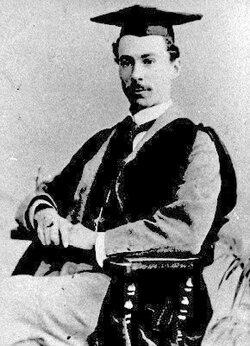
By 1895, he had secured a fellowship at Trinity College, marking the start of a lifelong association with the institution. His early work focused on the intersection of mathematics and logic, seeking to ground mathematics in a purely logical framework.
Philosophical Contributions and Logical Breakthroughs
Russell's intellectual legacy is defined by his effort to strip away the ambiguities of natural language. He introduced several critical concepts that remain central to modern logic and epistemology (the study of knowledge).
The Paradox and Type Theory
One of his most famous contributions is Russell's Paradox, which revealed a fundamental contradiction in naive set theory. To resolve this, he developed Type Theory, a hierarchical system that prevents a set from containing itself, thereby stabilizing the foundations of mathematics.
Principia Mathematica
Between 1910 and 1913, Russell and Alfred North Whitehead published Principia Mathematica. This massive three-volume work attempted to derive all mathematical truths from a small set of logical axioms, cementing the role of Mathematical logic in modern science.
The Theory of Descriptions
Russell also revolutionized the study of meaning with his Theory of Descriptions. He argued that phrases referring to non-existent entities (like "the present King of France") are not names but logical descriptions, allowing philosophers to discuss non-existent objects without attributing reality to them.
Political Activism and Social Views
Russell was not merely an academic; he was a fierce advocate for social justice and human rights. He believed that reason should be applied to society as rigorously as it is applied to mathematics.
During the First World War, Russell became a prominent opponent of conscription. He served on the National Committee of the No-Conscription Fellowship, a stance that often put him at odds with the British establishment.
![Russell served on the National Committee of the No-Conscription Fellowship, shown here in May 1916 (back right).[53]](/images/8c/aa/8caa8e4ffd12aaa569cdab7e15d15b8aab7b3fb11d4c37c29702a90913e284af.gif)
His commitment to freedom of opinion and expression led him to oppose censorship and indoctrination. In his later years, he became a leading voice against nuclear weapons, collaborating with Albert Einstein on the Russell-Einstein Manifesto to warn the world of the dangers of thermonuclear war.
Personal Life and Later Years
Russell's personal life was as complex as his professional one. He was married four times—to Alys Pearsall Smith, Dora Black, Patricia Spence, and Edith Finch. He had three children, including John and Conrad, who succeeded him as the 4th and 5th Earls Russell, respectively.
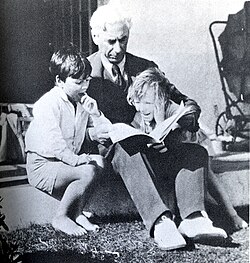
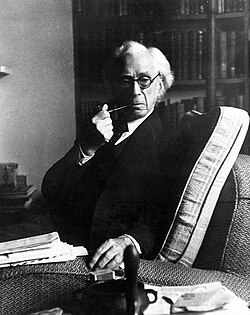
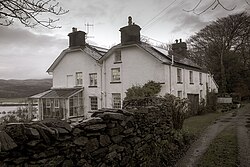
In 1931, he became a member of the House of Lords as a hereditary peer. Despite his titles, he remained a critic of traditional power structures. He spent his final years at Plas Penrhyn in Wales, continuing to write and speak on ethics and society until his death at the age of 97.
Summary of Achievements
| Year | Award / Position | Organization / Institution |
|---|---|---|
| 1893 | First Class Honours (Math) | Trinity College, Cambridge |
| 1932 | De Morgan Medal | United Kingdom |
| 1934 | Sylvester Medal | United Kingdom |
| 1949 | Order of Merit | United Kingdom |
| 1950 | Nobel Prize in Literature | Sweden |
| 1957 | Kalinga Prize | United Nations |
| 1963 | Jerusalem Prize | Israel |
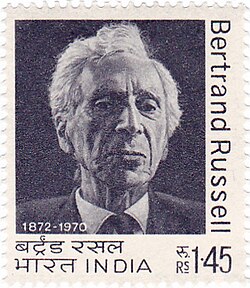
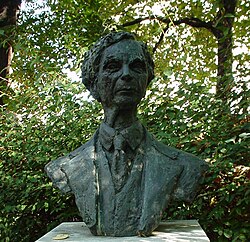
Russell's global influence is still recognized today, from his appearance on Indian postage stamps to the various monuments dedicated to his memory in London.
Frequently Asked Questions
What is Russell's Paradox?
Russell's Paradox is a contradiction in set theory that occurs when considering a set that contains all sets that do not contain themselves. If such a set contains itself, it shouldn't; if it doesn't, it should. This discovery forced a complete re-evaluation of the foundations of mathematics.
Why did Bertrand Russell win the Nobel Prize in Literature?
He was awarded the Nobel Prize in Literature in 1950 in recognition of his varied and significant writings in which he championed humanitarian ideals and freedom of thought.
What is the "Russell's Teapot" analogy?
Russell's Teapot is an analogy used to illustrate that the burden of proof lies upon a person making a claim, rather than upon skeptics to disprove a claim that is unfalsifiable (such as the existence of a tiny teapot orbiting the sun).
What was Russell's view on religion?
Russell was a well-known skeptic and critic of organized religion. In his famous work Why I Am Not a Christian, he argued against the existence of a deity based on the lack of evidence and the presence of suffering in the world.
Who were some of Russell's most notable students?
Among his notable students were the influential philosopher Ludwig Wittgenstein and the polymath Walter Pitts, reflecting Russell's deep impact on both philosophy and the early foundations of computer science.