David Hume: The Architect of Scottish Enlightenment Philosophy
David Hume (1711–1776) stands as one of the most influential figures of the Enlightenment, a period defined by a shift toward reason, science, and individual liberty. Born in Edinburgh, Scotland, Hume became a cornerstone of the Scottish Enlightenment, challenging the foundations of human knowledge and the nature of belief. His work spans a vast array of disciplines, from epistemology and ethics to economics and political theory, leaving a legacy of rigorous skepticism that continues to shape modern philosophy.
Hume's approach was rooted in Empiricism—the theory that all knowledge is derived from sense-experience. By questioning how we perceive cause and effect and the nature of the "self," he forced a re-evaluation of what humans can truly claim to know with certainty.
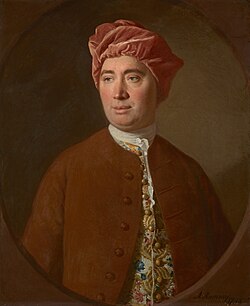
Key Facts
- Era: The Scottish Enlightenment.
- Core Philosophy: Empiricism, Scepticism, and Naturalism.
- Major Contribution: The "Problem of Induction," questioning the logical basis for predicting the future based on past experience.
- Key Concept: "Hume's Fork," which divides all objects of human inquiry into relations of ideas and matters of fact.
- Notable Works: A Treatise of Human Nature and An Enquiry Concerning Human Understanding.
Life and Career
Born on May 7, 1711, in the Lawnmarket area of Edinburgh, Hume was educated at the University of Edinburgh. His early intellectual journey was marked by a period of intense study that some contemporaries referred to as the "disease of the learned," a state of mental exhaustion resulting from excessive academic rigor.
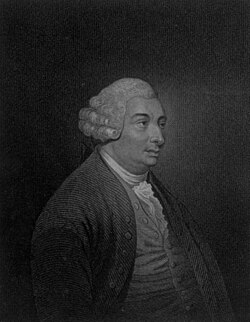
Throughout the 1730s and 1740s, Hume developed his most provocative theories, though his early works often met with limited initial success. By the 1750s and 1760s, he had established himself as a prominent intellectual, spending significant time in Paris and maintaining a complex relationship with fellow philosopher Jean-Jacques Rousseau. In his later years, Hume turned his attention toward history, producing a highly regarded History of England.
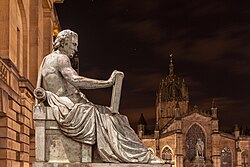
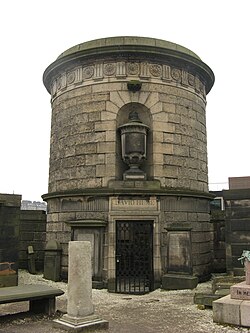
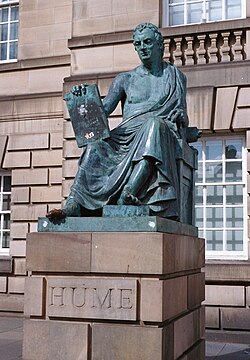
Hume passed away on August 25, 1776, in the New Town of Edinburgh at the age of 65. His life and work are commemorated today through various monuments in his hometown, reflecting his enduring status as a giant of Scottish thought.
Philosophical Foundations
Impressions and Ideas
Hume proposed a fundamental distinction between impressions (vivid sensory experiences) and ideas (faint copies of those impressions used in thinking). For Hume, any idea that cannot be traced back to a corresponding impression is meaningless.
Hume's Fork
To categorize human knowledge, Hume developed what is known as "Hume's Fork." He divided all knowledge into two categories:
- Relations of Ideas: Analytic truths, such as mathematics and logic, which are discoverable by thought alone and are necessarily true.
- Matters of Fact: Synthetic truths based on experience, which are not logically necessary and can be contradicted without contradiction.
Induction and Causation
One of Hume's most enduring contributions is the Problem of Induction. He argued that we have no rational justification for believing that the future will resemble the past. Our belief in causation (cause and effect) is not based on a logical necessity but on constant conjunction—the habit of seeing one event follow another until our minds automatically associate them.
Ethics, Religion, and Politics
Moral Sentimentalism
Hume rejected the idea that morality is derived from reason. Instead, he championed Moral Sentimentalism, arguing that our moral judgments are based on feelings of approval or disapproval. This led to the is–ought problem, the observation that one cannot logically derive a statement of what "ought" to be (value) from a statement of what "is" (fact).
Views on Religion
A known skeptic regarding religious claims, Hume provided influential arguments against the design argument (the idea that the complexity of the universe proves a creator) and the validity of miracles, arguing that the evidence for a miracle is almost always outweighed by the evidence that the report is false.
Political and Economic Thought
Hume's political theory was characterized by a precautionary conservatism, emphasizing the importance of stability and custom. He also made significant contributions to early economic thought, particularly regarding the role of money and commerce in society.
Summary of Hume's Intellectual Profile
| Category | Key Concept/Theory | Core Meaning |
|---|---|---|
| Epistemology | Empiricism | Knowledge comes primarily from sensory experience. |
| Logic | Hume's Fork | Distinction between relations of ideas and matters of fact. |
| Causality | Constant Conjunction | Cause and effect are habits of mind, not logical certainties. |
| Ethics | Is–Ought Problem | Facts cannot logically dictate moral values. |
| Metaphysics | Bundle Theory | The 'self' is a collection of changing perceptions, not a permanent entity. |
Frequently Asked Questions
What is the 'Problem of Induction'?
The Problem of Induction is Hume's argument that we cannot rationally justify the assumption that the future will behave like the past. Because we cannot prove this through logic or experience without using circular reasoning, our belief in induction is a matter of custom and habit rather than rational proof.
What does Hume mean by 'Hume's Fork'?
Hume's Fork is the division of all human knowledge into two types: 'Relations of Ideas' (logical/mathematical truths) and 'Matters of Fact' (empirical observations). This framework allows him to dismiss any claim that fits neither category as meaningless.
How did Hume view the 'self'?
Hume proposed the Bundle Theory of identity, suggesting that there is no permanent, unchanging 'self.' Instead, the self is merely a bundle of rapidly changing perceptions, memories, and feelings that the mind associates together.
What is the 'is–ought problem'?
The is–ought problem is the claim that there is a logical gap between descriptive statements (what is) and prescriptive statements (what ought to be). Hume argued that many writers move from factual descriptions to moral imperatives without providing a logical justification for the transition.
What was Hume's stance on miracles?
Hume argued that a miracle is a violation of the laws of nature. Since these laws are supported by uniform human experience, the probability that a miracle occurred is always lower than the probability that the person reporting the miracle is mistaken or lying.