The Guianas: History, Geography, and Cultural Diversity of the Wild Coast
The Guianas (also spelled Guyanas or Guayanas) comprise a distinct geographical region in north-eastern South America. While the term broadly describes the coastline stretching from the mouth of the Orinoco River to the mouth of the Amazon, it is most commonly used today to refer to "the three Guianas": Guyana, Suriname, and French Guiana.
This region is unique as it represents the only part of South America outside the primary Spanish and Portuguese spheres of influence. Characterized by dense jungles to the south and a narrow coastal strip, the Guianas remain one of the most sparsely populated areas on Earth.
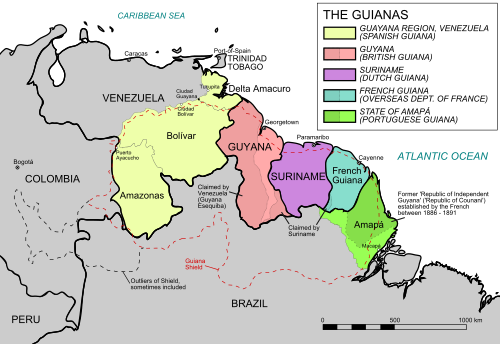
Key Facts
- Composition: Includes Guyana, Suriname, French Guiana, as well as the Delta Amacuro and Guayana regions of Venezuela and the Amapá State of Brazil.
- Population: The three primary Guianas have a combined population of 1,718,651.
- Geography: Most inhabitants live along the coast due to the impenetrable southern jungles.
- Colonial Legacy: The region was shaped by Dutch, British, and French competition, primarily centered on sugar cultivation.
- Diversity: One of the most racially and linguistically diverse regions globally due to histories of slavery and indentured labor.
Regional Divisions and Demographics
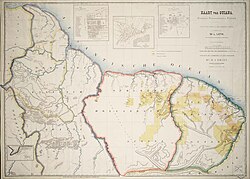
The region is divided from west to east into several distinct political entities. To the far west lies the former Spanish or Venezuelan Guiana (now Venezuela's Delta Amacuro State and Guayana Region). Moving east, one finds Guyana (independent since 1966), Suriname (independent since 1975), and French Guiana (an overseas department of France). To the east lies the former Portuguese or Brazilian Guiana, now the Amapá State of Brazil.
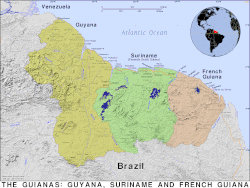
Population distribution is heavily skewed toward the Atlantic coast, specifically around river deltas in cities like Georgetown, Paramaribo, Cayenne, and Macapá. A notable exception is Venezuela, where major inland cities such as Ciudad Guayana (nearly 1 million people) and Ciudad Bolivar (approximately 422,578) serve as primary hubs.
| Territory | Population | Political Status |
|---|---|---|
| Guyana | 804,567 | Independent Nation |
| Suriname | 612,985 | Independent Nation |
| French Guiana | 301,099 | French Overseas Department |
The History of the "Wild Coast"
Pre-Colonial Era
Before European arrival, the region was inhabited by scattered bands of Indigenous Lokono people. Evidence suggests the Lokono migrated from the Orinoco and Essequibo River basins into the northern islands before being supplanted by the more warlike Kalinago Indians.
European Exploration and the Myth of El Dorado
Christopher Columbus first sighted the coast in 1498, but intensive colonization began in the late 16th century. In 1594, Sir Walter Raleigh began exploring the region in search of Manoa, the legendary golden city of El Dorado, which he believed was located on Lake Parime.
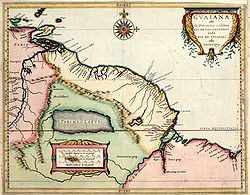
Raleigh's accounts sparked widespread European interest. The Dutch, focusing on profitable trading networks rather than territorial conquest, dispatched explorer Jacob Cornelisz in 1597. By 1621, the Dutch West India Company expanded its influence through trading outposts, often facing harassment from the Spanish and Portuguese who claimed the land under the Treaty of Tordesillas.
Colonial Conflict and Sugar Production
The 17th and 18th centuries were marked by constant shifts in power. The French attempted settlement along the Sinnamary River in 1604 and later in Cayenne, though early efforts were plagued by high mortality rates. Meanwhile, the Dutch and British frequently traded control of territories like Essequibo and Berbice.
By the mid-18th century, the economic focus shifted from trade to cultivation. Under governors like Laurens Storm van 's Gravesande, the region transitioned into a powerhouse for sugar plantations. This shift required massive labor forces, leading to the forced migration of enslaved West Africans and, later, indentured laborers from India and Indonesia.
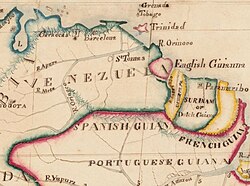
The geopolitical map was finally stabilized following the Convention of London in 1814. The British consolidated Berbice, Essequibo, and Demerara into British Guiana (established 1831), while the Dutch retained Suriname and France kept French Guiana.
Cultural and Linguistic Diversity
The Guianas are a melting pot of ethnicities. The population includes large Amerindian groups (Arawakan and Carib), descendants of enslaved Africans (divided into coastal Creoles and interior Maroons), and indentured laborers from the Bhojpuri regions of India and Java (Indonesia). There are also significant Chinese, Portuguese, and Jewish communities.
This diversity has birthed a complex linguistic landscape. While official languages include English, Dutch, French, Spanish, and Portuguese, several creole (stable natural languages developed from mixing different languages) and pidgin (simplified languages used for communication between different groups) languages have emerged. Examples include Sranan Tongo in Suriname and Guyanese Creole in Guyana.
Frequently Asked Questions
What are the three Guianas?
The three Guianas are Guyana, Suriname, and French Guiana, located on the north-eastern coast of South America.
Who was El Dorado?
El Dorado was a legendary king of a golden city called Manoa. Sir Walter Raleigh explored the Guianas in the late 16th century searching for this city, which he believed was located on Lake Parime.
Why is the population concentrated on the coast?
The interior of the Guianas is covered by dense jungles, making the coastal river deltas the only viable areas for large-scale settlement and urban development.
Which European powers colonized the region?
The region was primarily contested and colonized by the Dutch, British, and French, with Spanish and Portuguese influence on the western and eastern fringes respectively.
What is the primary economic legacy of the colonial era?
The primary legacy was the establishment of large-scale sugar plantations, which drove the region's economy and led to the diverse demographic makeup seen today through slavery and indentured servitude.