French Guiana: A Unique European Outpost in South America
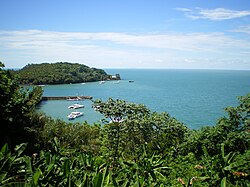
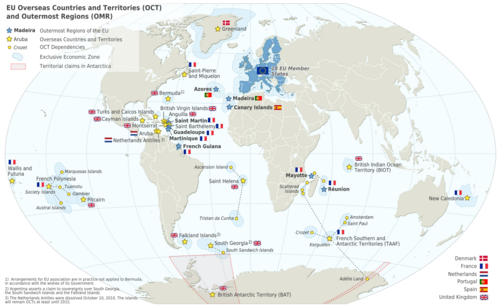
Located on the northeastern coast of South America, French Guiana (Guyane française) is a territory of striking contrasts. As an overseas department, region, and single territorial collectivity of France, it serves as an outermost region of the European Union. From the dense rainforests of the Amazon to the high-tech launch pads of the Guiana Space Centre, this region blends European administration with South American geography and a rich, multicultural heritage.
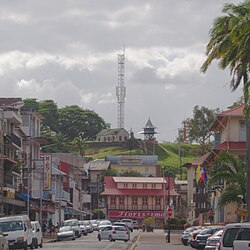
The territory is governed by a Prefect and an Assembly, with its prefecture located in the coastal city of Cayenne. Its strategic position and unique status make it a vital link between Europe and the Americas.
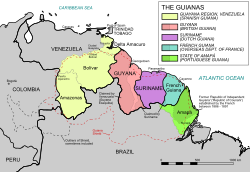
Key Facts
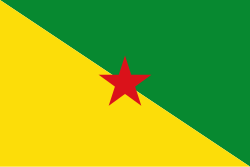
- Status: Overseas department and region of France and an outermost region of the European Union.
- Capital: Cayenne.
- Population: Approximately 298,554 (as of January 2026).
- Official Language: French, with French Guianese Creole and various Amerindian languages spoken regionally.
- Currency: Euro (€).
- Economy: Heavily influenced by the Guiana Space Centre, which contributes up to 16% of the GDP.
- Geography: Total area of 84,000 km², dominated by tropical rainforests.
Geography and Climate
French Guiana is characterized by its lush, tropical environment. The landscape is dominated by the Guiana Amazonian Park, the largest national park in France and the European Union. The region's terrain is largely covered by dense jungle, with a coastline facing the Atlantic Ocean.
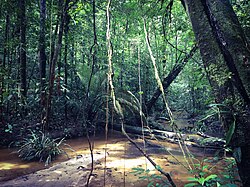
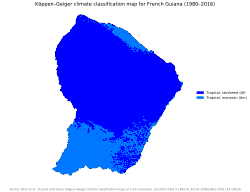
The climate is tropical, classified under the Köppen system as Am/Af. This means the region experiences high humidity and significant rainfall throughout the year, though there are distinct variations in precipitation. For example, in Cayenne, rainfall peaks in May (averaging 579.4 mm) and is lowest in September (averaging 55.7 mm). Temperatures remain consistently warm, with daily means typically hovering around 26-27°C.
Administrative Structure and Demographics
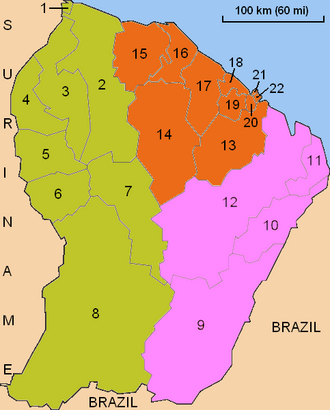
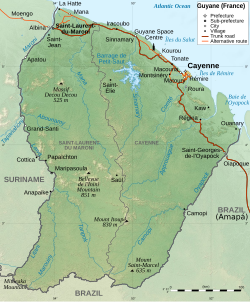
Administratively, French Guiana is divided into three arrondissements and 22 communes. The population is concentrated primarily in three major metropolitan areas: Cayenne, Saint-Laurent-du-Maroni, and Kourou.
| Metropolitan Area | Population (2023) |
|---|---|
| Cayenne | 153,884 |
| Saint-Laurent-du-Maroni | 54,429 |
| Kourou | 27,580 |
The demographic makeup is highly diverse. According to 2022 census data, 55.4% of the population was born in French Guiana, while 32.3% are immigrants. This diversity is reflected in the linguistic landscape, where French is the official language, but Ndyuka, Lokono, Palikur, and various Cariban family languages (such as Kali'na and Wayana) are spoken by indigenous and Maroon communities.
Economy and Infrastructure
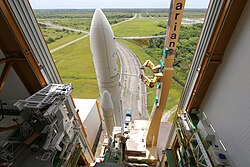
The economy of French Guiana is unique due to the presence of the Guiana Space Centre in Kourou. This facility is a cornerstone of the regional economy, with the launch site estimated to account for as much as 16% of the territory's GDP. The nominal GDP for 2024 was recorded at €5.244 billion.
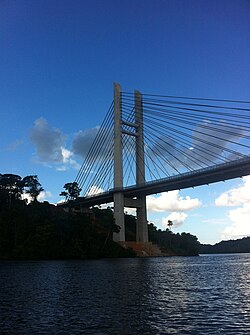
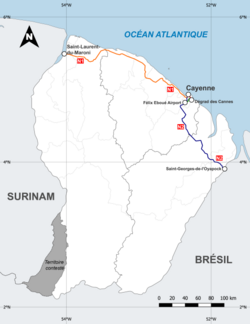
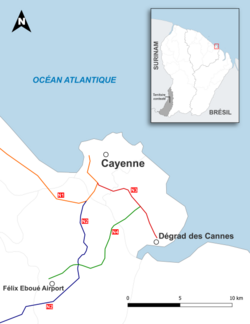
Infrastructure is primarily focused on the coast. The road system consists of approximately 2,200 km of roads, including the N1 and N2 highways. A significant recent development is the Oyapock River Bridge, opened in March 2017, which connects Saint-Georges-de-l'Oyapock in France to Oiapoque in Brazil, facilitating cross-border trade and travel.
Culture and Society
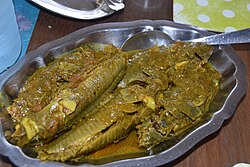
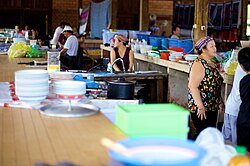
French Guianese culture is a vibrant blend of European, African, and Indigenous influences. This is most evident in the local cuisine, which frequently utilizes manioc (cassava) and smoked meats or fish. A typical dish is Atipa served in coconut milk.
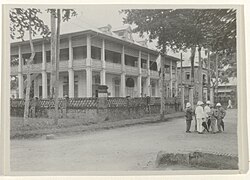
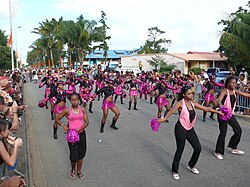
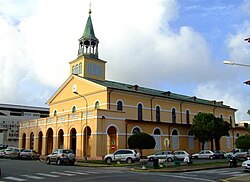
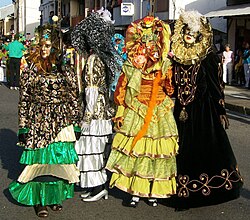
Religion is predominantly Catholic, as evidenced by the Cayenne Cathedral. The region is also known for its lively festivities, including the Carnival of Kourou and the Big Parade of the Litoral, featuring traditional costumes and music.
Frequently Asked Questions



Is French Guiana a separate country?
No, French Guiana is not an independent country. It is an overseas department and region of France, meaning it is fully integrated into the French Republic and is part of the European Union.
What is the primary economic driver of the region?
While agriculture and other sectors exist, the Guiana Space Centre in Kourou is the most significant economic driver, contributing a substantial portion of the territory's GDP.
What languages are spoken in French Guiana?
French is the official language. However, French Guianese Creole is widely spoken, along with Ndyuka and several indigenous Amerindian languages like Palikur and Kali'na.
How does the climate affect the region?
The region has a tropical rainforest climate with high humidity and heavy rainfall, particularly between April and June, which supports the vast Amazonian biodiversity.
How is French Guiana connected to Brazil?
The two territories are connected via the Oyapock River Bridge, which has been open to vehicle traffic since 2017, linking Saint-Georges-de-l'Oyapock and Oiapoque.