Nikolaus Federmann: The German Conquistador of the New Kingdom of Granada
Nikolaus Federmann (also known by the Spanish version of his name, Nicolás de Federmán) was a German adventurer and conquistador who played a pivotal role in the early European exploration of modern-day Venezuela and Colombia. Born around 1505 in the Free Imperial City of Ulm, Federmann became a key agent for the Welser banking family of Augsburg during a period when the Spanish Crown granted them a concession to explore the Venezuela Province, a region known as Klein Venedig (Little Venice).
Key Facts
- Origin: Born c. 1505 in Ulm, Germany.
- Primary Employers: The Welser family of Augsburg and the Spanish Crown.
- Major Achievement: Co-founded the city of Bogotá on April 27, 1539.
- Key Expeditions: Explored the Orinoco river basin and the Eastern Ranges of the Colombian Andes.
- Notable Work: Wrote Indianische Historia, published posthumously in 1557.
- Death: Died in February 1542 in a prison in Valladolid, Spain.
Early Career and the Orinoco Expedition
Federmann's journey to the New World began in 1529 when the Welser family sent him to Santo Domingo. Between 1529 and 1530, he transported miners and settlers from Seville to Coro, Venezuela. His leadership capabilities were quickly recognized; Governor Ambrosius Ehinger appointed him as his deputy, and by July 30, 1530, Federmann was entrusted with the responsibility of the Klein Venedig colony while Ehinger returned to Hispaniola for health reasons.
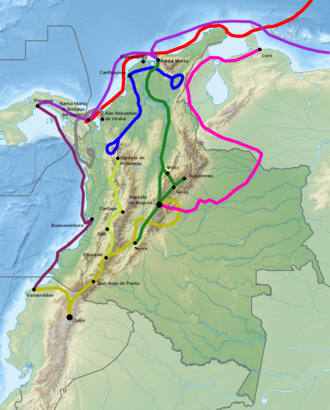
Driven by the ambition to find a trade route to Asia via the "South Sea" (the Pacific Ocean), Federmann launched an unauthorized expedition in September 1530. Leading 110 foot soldiers, 16 mounted soldiers, and 100 natives into the northern river basin of the Orinoco, he failed to reach the Pacific. However, he returned to Coro on March 17, 1531, with 5,565 pesos of gold. This act of insubordination led Governor Ehinger to banish him to Europe for four years.
The Quest for Pearls and the Guajira Coast
Upon his return to the Americas, Federmann set his sights on the territory of La Guajira in northern Colombia. His primary objective was to secure valuable pearls found in the Caribbean waters. History suggests he may have founded Riohacha in 1535, though he struggled to secure native divers for pearl hunting. His dream of establishing a city named "Ulma"—after his birthplace—ultimately failed, and he returned to Coro in February 1536 after reaching Cabo de la Vela.
The Conquest of the Muisca and the Foundation of Bogotá
Federmann's most significant historical contribution occurred during his trek through the Llanos and along the eastern edges of the Colombian Andes. Following the salt trade routes, he encountered the Muisca Confederation, an indigenous society whose realm had already been largely occupied by another conquistador, Gonzalo Jiménez de Quesada.
The meeting of three rival leaders—Federmann, Jiménez de Quesada, and Sebastián de Belalcázar—marked a turning point. On April 27, 1539, Federmann and Belalcázar joined Quesada to re-found the city of Bogotá. This was necessary because Quesada's initial attempt on August 6, 1538, had not met the official legal requirements of the Spanish Crown.
After agreeing to return to Spain to seek compensation for their efforts, the three men appointed Hernán Pérez de Quesada as interim governor of the New Kingdom of Granada. While many of Federmann's soldiers remained in Bogotá to bolster the local forces, Federmann himself departed for Cartagena in May 1539, eventually arriving in Spain in November of that year.
Legal Battles and Final Years
Federmann's return to Europe was not triumphant. The Welser family accused him of breaching his contract and misappropriating funds, demanding a staggering 100,000 ducats in emeralds and 15,000 ducats in gold. Unable to pay, Federmann was imprisoned in Antwerp. He fought a protracted legal battle in Ghent and Valladolid before the Council of the Indies, counter-suing the Welsers for tax evasion.
A settlement was reached on October 19, 1541, where the Welsers dropped their financial claims in exchange for Federmann's property rights in New Granada. However, his troubles persisted; suspected of being a Lutheran by the Inquisition and still viewed with distrust by his former employers, Federmann died in a Valladolid prison in February 1542 at approximately 37 years of age.
| Period | Key Location | Major Event/Outcome |
|---|---|---|
| 1529–1530 | Coro, Venezuela | Appointed deputy governor of Klein Venedig. |
| 1530–1531 | Orinoco Basin | Unauthorized search for the Pacific; returned with gold. |
| 1535–1536 | La Guajira, Colombia | Attempted pearl hunting and founding of "Ulma". |
| 1539 | Bogotá, Colombia | Co-founded Bogotá with Quesada and Belalcázar. |
| 1539–1542 | Spain/Europe | Legal disputes with Welsers; died in prison. |
Frequently Asked Questions
Who were the Welsers and why did they employ Federmann?
The Welsers were a powerful banking family from Augsburg, Germany. They were granted a concession by King Charles I of Spain to explore and colonize the Venezuela Province (Klein Venedig) as a means of investment and territorial expansion.
What was the significance of the foundation of Bogotá?
The re-foundation of Bogotá on April 27, 1539, was a collaborative effort between Federmann, Sebastián de Belalcázar, and Gonzalo Jiménez de Quesada to ensure the settlement met the official legal requirements of the Spanish Crown.
Did Nikolaus Federmann find El Dorado?
No, despite his extensive expeditions through the Colombian Andes and the search for the legendary city of gold, Federmann did not find El Dorado.
Why did Federmann die in prison?
Federmann's final years were marred by financial disputes with the Welser family and religious suspicions from the Inquisition, who suspected him of being a Lutheran.
How is Federmann remembered today in Colombia?
He is commemorated with a pedestrian statue in the Parque de los Cañones of Riohacha and a neighborhood in Bogotá named Nicolás de Federmán.