The Great Migration: The Mass Exodus of Black Americans from the South
Between 1910 and 1970, the United States witnessed one of the most significant internal movements of people in its history. Known as the Great Migration (or the Great Northward Migration), this era saw approximately 6 million Black Americans leave the rural South to seek refuge and opportunity in the Northeast, Midwest, and West. This movement was not merely a change of address, but a profound quest for freedom and economic survival during the Nadir of American race relations.
Key Facts
- Scale: Approximately 6 million Black Americans migrated from the South.
- Timeline: The movement occurred in two primary waves from 1910 to 1970.
- Primary Drivers: Escape from Jim Crow laws, racial violence (lynching), and poor economic conditions.
- Demographic Shift: In 1900, only 8% of the Black population lived outside the South; by 1970, this rose to 47%.
- Major Destinations: Cities such as Chicago, Detroit, New York, and Philadelphia.
The Drivers of Departure
The decision to leave the South was driven by a combination of "push" and "pull" factors. The push factors were rooted in the oppressive Jim Crow economy and legal system—a set of state and local laws that enforced racial segregation. Black Americans faced systemic violence, including lynching, and were trapped in poor economic conditions that offered little hope for advancement.
Conversely, the "pull" factors included the promise of better job opportunities in the industrial North and West. The prospect of escaping legalized segregation and finding higher-paying factory work made Northern cities appear as a "Promised Land." The Chicago Defender, a prominent Black newspaper, played a vital role in encouraging this movement by highlighting the opportunities available outside the South.
![The Arthur family arrived at Chicago's Polk Street Depot on August 30, 1920, during the Great Migration.[17]](/images/e0/05/e005fdf88d37ced5bd206dfad2b81806429e58cc0ce9ba784b110cbc54f927b9.jpg)
The First Great Migration (1910–1940)
The first wave of migration began around 1910. During this period, thousands of families moved toward industrial hubs. Chicago became a primary destination; for example, between 1900 and 1920, the city's total population grew by over 1 million residents, with a significant portion being Black migrants.
However, the transition was not seamless. Migrants often encountered intense racial tensions and violence in their new homes. While they escaped the legal segregation of the South, they faced de facto segregation—segregation that happens by custom and practice rather than by law—in housing and employment.
The Second Great Migration (mid-1940s–1970)
The second wave was larger and more geographically diverse than the first. Following World War II, the demand for industrial labor surged, drawing even more people toward the Midwest and the West Coast. During this period, the Black population in Chicago grew from 278,000 in 1940 to 813,000 by 1960.

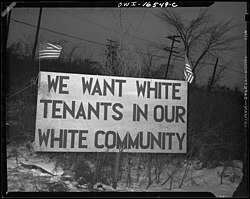
Despite the economic gains, this era was marked by severe discrimination. White tenants and homeowners often reacted with hostility to the growing Black presence. In some cities, signs were erected to explicitly prevent Black people from moving into certain neighborhoods, as seen in Detroit's Sojourner Truth Project in 1942.
Demographic and Cultural Impact
The Great Migration fundamentally altered the map of the United States. Southern states saw a dramatic decrease in their Black populations. In Mississippi, the Black population dropped from roughly 56% in 1910 to 37% by 1970. Similarly, Georgia saw a decline from 45% to 26% over the same period.
In the North, the influx of migrants created vibrant cultural hubs. The South Bronx in New York City, for instance, became a center of retail and community life.
![The Hub is the retail heart of the South Bronx, New York City.[47]](/images/f2/9a/f29a4ce0edb6214b18f047ce2ef48b44f7d3002f8b82fdbc0c3fd5be56265981.jpg)
Regional Population Shifts (1900–1980)
The following table illustrates the percentage change of the Black population across different U.S. regions over eight decades.
| Region | 1900 | 1940 | 1980 | Total Change |
|---|---|---|---|---|
| Northeast | 1.8% | 3.8% | 9.9% | +8.1% |
| Midwest | 1.9% | 3.5% | 9.1% | +7.2% |
| South | 32.3% | 23.8% | 18.6% | -13.7% |
| West | 0.7% | 2.9% | 5.2% | +4.5% |
Frequently Asked Questions
What was the primary cause of the Great Migration?
The migration was caused by a combination of poor economic conditions and systemic racial oppression in the South, including Jim Crow laws and the threat of lynching, coupled with the lure of industrial job opportunities in the North and West.
How many people participated in the Great Migration?
Approximately 6 million Black Americans migrated from the Southern United States between 1910 and 1970.
Did Black migrants find total equality in the North?
No. While they escaped the legal Jim Crow laws of the South, migrants faced significant discrimination, racial tensions, and segregation in housing and employment in Northern and Western cities.
Which cities saw the most significant growth in their Black populations?
Cities like Chicago, Detroit, New York, and Philadelphia saw massive increases. Detroit, for example, saw its Black population percentage grow from 1.4% in 1900 to 75.7% by 1990.
How did the migration affect the South's demographics?
The South experienced a sharp decline in its Black population percentage. For example, South Carolina's Black population decreased from about 55% in 1910 to about 30% by 1970.