The Digest of Justinian: The Foundation of Roman Civil Law
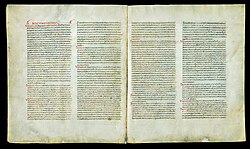
The Digest (Latin: Digesta), also known as the Pandects (Greek: Pandéktai, meaning "All-Containing"), stands as one of the most influential legal compilations in human history. Commissioned by the Byzantine Emperor Justinian I between 530 and 533 AD, this massive work condensed centuries of Roman juristic thought into a structured, authoritative body of law.
The Digest was not a standalone project but a critical component of Justinian's broader effort to codify all Roman laws. This comprehensive collection, later known in the 16th century as the Corpus Juris Civilis (Body of Civil Law), consisted of three primary parts: the Digest, the Codex (a collection of imperial statutes), and the Institutes (an introductory textbook). While the set was intended to be exhaustive, Justinian continued to issue new legislation, which were later gathered as the Novellae Constitutiones (the Novels).
Key Facts
- Compiled: 530–533 AD under Emperor Justinian I.
- Structure: 50 books containing extracts from over 1,500 original works.
- Primary Authors: Ulpian (approx. 2/5 of the text) and Paulus (approx. 1/6).
- Legal Status: Declared the sole source of non-statute law; commentaries were forbidden.
- Key Manuscript: The Littera Florentina (late 6th or early 7th century).
- Modern Translation: First fully translated into English by Alan Watson in 1985.
The Creation and Organization of the Digest
The path to the Digest began with the Codex Justinianus in 529 AD, which repealed earlier codifications. While it established imperial law, it still allowed references to authoritative ancient jurists. Under the Law of Citations, the primary authorities were Papinian, Paulus, Ulpian, Modestinus, and Gaius.
However, the sheer volume of these writings—over 1,500 books—led to frequent contradictions. To resolve this, Justinian first published the quinquaginta decisiones (fifty decisions) to settle specific conflicts. He then ordered a commission of sixteen members—comprising one government official, four professors, and eleven advocates—led by Tribonian to condense these works into fifty books.
The commission was granted the authority to alter and simplify texts to eliminate conflicts and ensure clarity. The resulting organization is highly detailed: each of the fifty books is divided into titles, which are further broken down into extracts and paragraphs.
Legal Contributions and Lasting Influence
The Digest preserved critical legal concepts that still resonate in modern law. For instance, an opinion by Paulus from 235 AD discusses the Lex Rhodia (Rhodian law). This text outlines the principle of general average—the idea that if cargo is jettisoned to save a ship, the loss is shared by all beneficiaries. This remains a fundamental principle of modern marine insurance.
Additionally, the Digest contains an early life table compiled by Ulpian around 220 AD. This actuarial data was so significant that it was later analyzed in an 1851 article by Joseph P. Bradley, a future U.S. Supreme Court Associate Justice.
The rediscovery of the Digest in Amalfi in 1135 (though some sources suggest 1070) sparked a massive revival of Roman law across Europe. This intellectual awakening was a primary catalyst for the establishment of the University of Bologna in 1088, the first university in Europe.
Summary of Justinian's Legal Codification
| Component | Description | Purpose |
|---|---|---|
| The Digest | Compendium of juristic writings | To synthesize and clarify non-statute law |
| The Codex | Collection of imperial statutes | To provide a single source of imperial law |
| The Institutes | Introductory textbook | To serve as a guide for law students |
| The Novels | New laws (Novellae Constitutiones) | To record legislation passed after the initial codification |
Frequently Asked Questions
What is the difference between the Digest and the Codex?
The Codex is a collection of official imperial statutes (laws passed by the emperor), whereas the Digest is a compilation of the opinions and writings of professional Roman jurists.
Who were the most influential contributors to the Digest?
The jurist Ulpian is the most prominent, contributing approximately two-fifths of the content, followed by Paulus, who contributed about one-sixth.
How did the Digest influence modern insurance?
Through the inclusion of the Lex Rhodia, the Digest preserved the principle of general average, which is the foundational concept underlying all modern insurance.
Why was the commission allowed to change the original texts?
The commission was empowered to condense and alter the texts specifically to simplify the law, clarify ambiguities, and eliminate contradictions between different jurists.
When was the Digest first translated into English?
While Samuel Parsons Scott published a translation in 1932, the first complete translation of the entire Digest was produced by Alan Watson in 1985.