Berytus: The Roman Mother of Laws in Ancient Beirut
Long before the modern skyline of Beirut defined the Lebanese coast, the city existed as Berytus, a prestigious Roman colony and a global epicenter of legal scholarship. From its origins as a Phoenician port to its status as a fully Romanized city, Berytus served as a critical bridge between the Latin West and the Hellenistic East.
Known for its unique linguistic identity and its contribution to the foundations of Western law, Berytus was more than just a provincial settlement; it was a center of power, culture, and intellect in the Eastern Mediterranean.
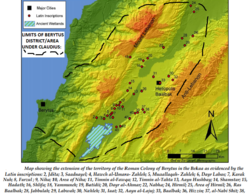
Key Facts
- Official Name: Colonia Iulia Augusta Felix Berytus.
- Legal Legacy: Home to the pre-eminent law school that helped shape the Code of Justinian.
- Unique Status: The only fully Latin-speaking city in the Syria-Phoenicia region until the 4th century.
- Privilege: Held Ius Italicum, granting the city exemption from imperial taxation.
- Demographics: Population reached nearly 50,000 during the reign of Trajan.
From Phoenician Port to Roman Colony
The site of Berytus has roots stretching back to the Iron Age III and Persian periods. Originally a Phoenician settlement called Be'erūt, the city faced a period of upheaval in 140 BC when it was destroyed by Diodotus Tryphon. It was subsequently rebuilt under a Hellenistic plan and renamed Laodicea in Phoenicia (or Laodicea in Canaan) in honor of a Seleucid princess.
The trajectory of the city changed permanently in 64 BC when Pompey conquered the region. The Romans reverted the name to Berytus, referencing the original Phoenician port. By 14 BC, under Emperor Augustus, the city was elevated to a Roman colonia (a settlement of Roman citizens) and named Colonia Iulia Augusta Felix Berytus in honor of Augustus' daughter, Julia the Elder.
![Roman coin minted in Berytus[18]](/images/d5/98/d598453009c04eaee457bef176ea6b882fbb8a302356de7e2944edcbc8559d59.jpg)
The Romanization of Berytus
Augustus settled veterans from two legions—the fifth Macedonian and the third Gallic—in the city. This influx of soldiers and their families led to rapid Romanization, with two-thirds of the population becoming descendants of these veterans. This demographic shift made Berytus a linguistic anomaly: a Latin-speaking enclave in a predominantly Greek and Aramaic region.
Urban Splendor and Infrastructure
As a favored city of the Empire, Berytus boasted an impressive array of public works. The city was laid out on a grid plan, featuring a massive forum, a necropolis, and the largest hippodrome (chariot racing track) known in the Levant.
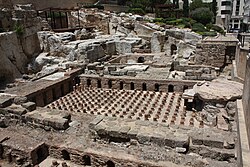
Water management was a hallmark of Berytian engineering. To support four large public bath complexes and numerous private baths, the Romans constructed an aqueduct fed by the Beirut River. This system transported water from a source 10 km away, crossing the river at Qanater Zbaydeh before storing it in large cisterns at the foot of Serail Hill.
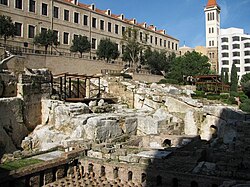
The city also served as a trade hub for silk and wine, connected by efficient roads to Heliopolis and Caesarea. Its religious life was eclectic, blending Graeco-Roman and Phoenician traditions. While Poseidon was the city's chief deity—revered by merchants who called themselves "Poseidonistes"—the god Jupiter was often given the Phoenician epithet "Baal."
Berytus Nutrix Legum: The Mother of Laws
Berytus earned its most enduring fame as the site of the empire's most prestigious law school. The Latin motto Berytus Nutrix Legum ("Beirut, Mother of Laws") reflected the city's role as the primary training ground for the Roman Empire's lawyers and magistrates.
Two of the most influential jurists in history, Papinian and Ulpian, taught here. Their work provided the intellectual foundation for the Code of Justinian (part of the Corpus Juris Civilis), the massive codification of Roman law ordered by Justinian I in the 6th century AD. In 533 AD, Justinian officially recognized the Berytian school as one of the three official law schools of the empire.
Decline and Fall
The prosperity of Berytus was shattered in 551 AD by a catastrophic earthquake. The disaster leveled the city, destroyed the famous law school, and killed approximately 30,000 inhabitants. While the students were transferred to Sidon, the city never fully recovered its former glory.
During the Early Byzantine period, the city became a Christian See and a metropolis. However, internal religious disagreements and the lingering effects of the earthquake weakened the population. By 635 CE, the reduced settlement fell to the Arab forces during the early Islamic conquests.
Summary of Berytus' Historical Evolution
| Period | Name/Status | Key Characteristic |
|---|---|---|
| Iron Age III / Persian | Be'erūt | Phoenician port settlement. |
| 2nd Century BC – 64 BC | Laodicea in Phoenicia | Hellenistic rebuilding under Seleucids. |
| 14 BC – 4th Century AD | Colonia Iulia Augusta Felix Berytus | Latin-speaking Roman colony; center of law. |
| 4th Century – 635 CE | Byzantine Berytus | Hellenization and transition to a Christian See. |
Recent Archaeological Discoveries
Modern excavations in Beirut's Central District continue to reveal the city's Roman past. At the Garden of Forgiveness, archaeologists discovered the cardo and decumanus (the primary north-south and east-west streets), which once featured shaded colonnades used as markets.
The Roman Baths Garden, uncovered in 1968 and further excavated in the 1990s, preserves the ruins of the ancient bathing complexes. Additionally, a funerary stele found near the Saint George Cathedrals identifies a 5th-century professor named Patricius, providing a tangible link to the legendary law school.
Frequently Asked Questions
Why was Berytus called the "Mother of Laws"?
Berytus hosted the most pre-eminent law school in the Roman Empire. It trained the empire's top magistrates and provided the scholarly basis for the Code of Justinian, one of the most important legal documents in Western history.
What made Berytus different from other cities in the region?
Unlike most cities in the Syria-Phoenicia region, Berytus was fully Latin-speaking until the 4th century due to the settlement of Roman legionary veterans. It also held Ius Italicum, which exempted its citizens from imperial taxes.
What caused the downfall of the city?
A massive earthquake in 551 AD was the primary catalyst, killing nearly 30,000 people and destroying the city's infrastructure and law school. This vulnerability, combined with religious strife, led to its eventual fall to Arab forces in 635 CE.
Who were the most famous people associated with Berytus?
The city is associated with the great jurists Papinian and Ulpian, the Latin grammarian Marcus Valerius Probus, and the influential bishop Eusebius.