Syrphidae: The Fascinating World of Hoverflies
Commonly known as hoverflies, flower flies, or syrphids, members of the family Syrphidae are among the most recognizable insects in the natural world. As their name implies, these flies are famous for their ability to hover mid-air, maintaining a precise position as part of their unique display behavior. While they may look like tiny acrobats, they play a massive role in our global ecosystems as both pollinators and natural pest controllers.
Found on every continent except Antarctica, hoverflies are a cosmopolitan family. With approximately 6,000 described species across 200 genera, they inhabit almost every biome, from lush forests to agricultural fields. Whether they are nectaring on a bright daisy or patrolling a garden for pests, their presence is a sign of a healthy, functioning environment.
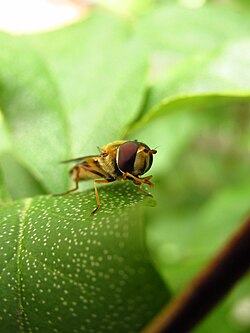
Key Facts
- Diversity: Approximately 6,000 species and 200 genera have been identified.
- Global Presence: Found worldwide, excluding Antarctica and extreme deserts or high-latitude tundras.
- Ecological Role: Adults serve as vital pollinators, while many larvae act as biological control agents against pests.
- Mimicry: Many species use Batesian mimicry, appearing like stinging wasps or bees to deter predators.
- Diet: Adults primarily consume nectar and pollen; larvae vary from saprotrophs to insectivores.
Anatomy and Identification
Hoverflies belong to the order Diptera (true flies), which means they possess only a single functional pair of wings. Their hind wings have evolved into specialized balancing organs. While their sizes vary significantly—from the tiny Paragus tibialis at 3–5 mm to the larger, hairy Criorhina nigriventris reaching up to 20.6 mm—they share several distinguishing features.
To distinguish a hoverfly from similar-looking insects like bee flies (family Bombyliidae), look for a spurious vein located parallel to the fourth longitudinal wing vein. Additionally, hoverflies typically have shorter, less needle-like mouthparts and legs compared to bee flies. Their faces often feature prominent bulges or knob-like projections, and their bodies often exhibit a glossy appearance with colors derived from cuticular pigments rather than just hair.
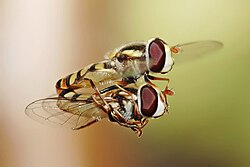
Many species are brightly colored with yellow, brown, or black stripes and spots. This coloration is a survival strategy known as Batesian mimicry, where a harmless organism evolves to look like a dangerous one. For instance, the drone fly (Eristalis tenax) closely resembles a honeybee to ward off insect-eating birds.
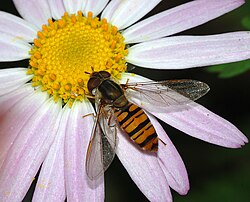
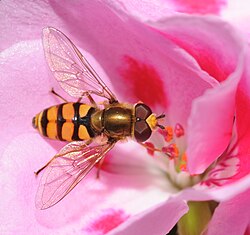
The Life Cycle: From Maggots to Pollinators
The life cycle of a hoverfly reveals a dramatic shift in diet and ecological function. While the adults are nectar-seeking pollinators, the larvae, or maggots, occupy very different niches.
Insectivorous Larvae and Biological Control
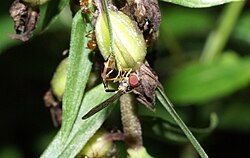
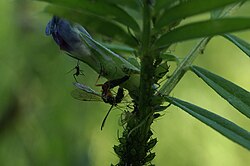
Many hoverfly species are highly beneficial to agriculture. Their larvae are insectivores, preying on common crop pests such as aphids and thrips. The common hoverfly (Episyrphus balteatus) is a prime example, with larvae that actively hunt aphids. This makes them excellent candidates for biological control—using natural predators to manage pest populations without chemical pesticides.
Saprotrophic Larvae
Other species are saprotrophs, specifically detritivores that consume decaying plant or animal matter in soil, ponds, or streams. A notable example is the "rat-tailed maggot" of the drone fly (Eristalis tenax). These larvae live in stagnant water and possess a breathing siphon at their rear end. Interestingly, these maggots are sometimes used commercially for ice fishing.
Pollination Services
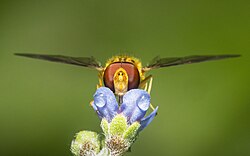
Hoverflies are considered the second-most important group of pollinators after wild bees. While bees may carry larger volumes of pollen per visit, hoverflies often compensate by making a significantly higher number of flower visits. They are generalists that visit a wide range of plants, though some species, like Cheilosia albitarsis, are highly specialized to specific flowers.
Hoverflies often show a preference for white and yellow flowers, though they also use olfactory (smell) cues to locate blooms. Because many species have short, unspecialized mouthparts, they tend to frequent open flowers where nectar and pollen are easily accessible.
Summary of Syrphidae Characteristics
| Feature | Adult Stage | Larval Stage (Maggot) |
|---|---|---|
| Primary Diet | Nectar and Pollen | Aphids, Thrips, or Decaying Matter |
| Ecological Role | Pollinator | Predator or Decomposer |
| Habitat | Flowers and Vegetation | Leaves, Soil, or Stagnant Water |
| Economic Value | Crop Pollination | Biological Pest Control |
Frequently Asked Questions
Are hoverflies dangerous to humans?
No, hoverflies are harmless to humans and most mammals. While they may look like stinging wasps or bees due to mimicry, they do not possess stingers.
Can hoverfly larvae harm people?
In extremely rare instances, hoverfly larvae can cause accidental myiasis (infestation) in humans, but this typically only occurs if the larvae are accidentally ingested through contaminated food.
How can I tell a hoverfly apart from a bee fly?
Look at the mouthparts and legs; hoverflies generally have shorter, thicker mouthparts and legs than the long, needle-like structures often seen in bee flies. Additionally, hoverflies have a distinct "spurious vein" in their wings.
Why are hoverflies important for gardeners?
They provide dual benefits: the adults help pollinate flowers and crops, while the larvae act as natural predators that eat aphids, helping to control plant pests naturally.
Where can I find hoverflies?
They are found globally in most environments, especially near flowering plants. You are most likely to see them hovering around gardens, meadows, and agricultural fields.