Eristalinus taeniops: The Fascinating Band-Eyed Drone Fly
In the diverse world of insects, few creatures demonstrate the art of deception as effectively as Eristalinus taeniops. Commonly known as the band-eyed drone fly, this member of the Syrphidae family is a master of mimicry, often blending into the environment by imitating more formidable insects. Whether you are an entomologist or a nature enthusiast, understanding this hoverfly reveals much about the complex relationships between appearance, habitat, and survival.
Key Facts
- Common Name: Band-eyed drone fly
- Scientific Name: Eristalinus taeniops
- Size: 11–14 millimetres in length
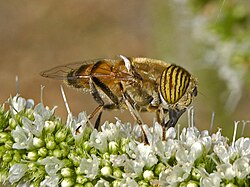
- Distinctive Feature: Five vertical dark stripes on the compound eyes
- Mimicry Type: Batesian mimicry (imitating bees or wasps)
- Larval Form: Known as rat-tailed maggots
Physical Characteristics and Mimicry
The Eristalinus taeniops is a relatively small insect, typically measuring between 11 and 14 millimetres. It utilizes Batesian mimicry—a survival strategy where a harmless species evolves to look like a dangerous one—to protect itself from predators. By sporting a yellow and black coloration, it is frequently mistaken for a wasp or a bee.
Detailed anatomical features include a thorax with a metallic yellow-brown hue that is densely covered in yellow hair. The scutellum, a part of the thorax, also shares this yellow-brown color. Its abdomen is a striking reddish-yellow, marked by transversal black bands. Perhaps its most defining characteristic is its compound eyes, which feature five distinct, vertical, dark stripes. The wings are transparent, often showing a yellowish-brown tint at the base, complemented by brightly pale yellow halteres (small, knob-like structures used for balance during flight).
Habitat and Global Distribution
This species thrives in varied environments, ranging from holly oak forests and forest clearings to maquis shrublands. It is also commonly found near water sources such as rivers, streams, and coastal marshes.
The distribution of the band-eyed drone fly is extensive. It is found across parts of Europe (including France, Italy, Greece, Spain, and Poland), North Africa, and the Near East (such as Turkey, Israel, and Syria). Its range extends through the Caucasus, into the Eastern parts of the Afrotropical realm down to South Africa, and into the Oriental realm, including Northern India and Nepal. It has also been introduced to California and Florida in North America. Recent sightings have expanded its known footprint in South America, with records in Brazil (Rio de Janeiro, Poços de Caldas, Curitiba, Nova Maringá, and the State of Goiás) and Argentina.
Life Cycle and Biology
The adult life cycle of Eristalinus taeniops typically spans from April to October, with the highest population density observed between May and August. As adults, they play a role in pollination, feeding on the nectar of various white and yellow flowers, including species from the Erica, Daphne, Senecio, and Rosaceae families.
The larval stage is quite distinct. The larvae are known as rat-tailed maggots. They inhabit environments rich in organic matter, such as mud, animal carcasses, or water contaminated by pig manure, where they can thrive.
Scientific Classification Summary
| Rank | Classification |
|---|---|
| Kingdom | Animalia |
| Phylum | Arthropoda |
| Class | Insecta |
| Order | Diptera |
| Family | Syrphidae |
| Genus | Eristalinus |
| Species | E. taeniops |
Frequently Asked Questions
What makes the eyes of this hoverfly unique?
The compound eyes of Eristalinus taeniops are characterized by five distinct, vertical, dark stripes, which give the species its common name, the band-eyed drone fly.
Is the band-eyed drone fly dangerous to humans?
No. While it uses Batesian mimicry to look like a wasp or bee to deter predators, it is a hoverfly and does not possess the same defensive capabilities as the stinging insects it mimics.
What do the larvae of this species eat?
The larvae, often called rat-tailed maggots, live in mud, animal carcasses, or water contaminated by pig manure.
When is the best time to observe adult hoverflies?
Adults are most active from April to October, with a peak period of visibility occurring between May and August.
Where can I find Eristalinus taeniops in North America?
In North America, this species has been introduced to parts of California and Florida.