Sweden Solar System: A Massive Scale Model of Our Cosmic Neighborhood
Imagine a map of our solar system so vast that you would need to travel across entire cities and provinces to visit each planet. This is the reality of the Sweden Solar System, an ambitious artistic and scientific project that translates the incomprehensible distances of space into a tangible, terrestrial experience. By using a consistent scale, the model allows visitors to grasp the true spatial relationship between the Sun and the celestial bodies that orbit it.
The model is an evolving installation. While it features the primary planets and their moons, it also incorporates dwarf planets, comets, asteroids, and even abstract astrophysical boundaries. Because the real solar system contains countless small bodies, the Swedish model is designed to be expanded indefinitely.
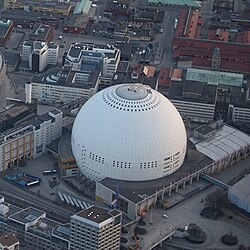
At the heart of this system is the Sun, represented by the Avicii Arena (also known as the Globe) in Stockholm. As the second largest hemispherical building in the world, with a diameter of 110 meters (360 ft), it serves as the perfect anchor. To maintain scientific accuracy, the arena represents the Sun including its corona—the outermost layer of the Sun's atmosphere.
Key Facts
- Central Anchor: The Avicii Arena in Stockholm represents the Sun.
- Scale: The model spans hundreds of kilometers to accurately reflect planetary distances.
- Diversity: Includes planets, moons, dwarf planets, asteroids, and comets.
- Reach: Extends from central Stockholm to the Arctic Circle in Kiruna.
- Interdisciplinary: Combines sculpture, architecture, and astronomy.
The Inner Planets
The terrestrial planets are located relatively close to the central Sun in Stockholm, though they vary significantly in size and artistic execution.
Mercury and Venus
Mercury, a metallic sphere 25 cm (9.8 in) in diameter created by artist Peter Varhelyi, sits 2,900 meters (1.8 mi) from the Globe at the Stockholm City Museum.
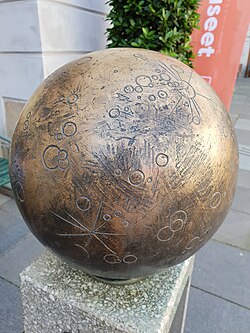
Venus is represented by a 62 cm (24 in) sphere located at Vetenskapens hus at the KTH Royal Institute of Technology, 5,500 meters (3.4 mi) from the center. The current model replaced an earlier version by Daniel Oberti, which was inaugurated during a Venus transit in 2004 but was destroyed in 2011.
Earth and Mars
Earth is located 7,600 meters (4.7 mi) away at the Swedish Museum of Natural History. The 65 cm (26 in) model is accompanied by satellite imagery and a detailed 18 cm (7.1 in) model of the Moon, placed 20 meters (66 ft) away.
Mars, a copper sculpture by Finnish artist Heikki Haapanen, is found 11.6 km (7.2 mi) from the Globe at Mörby centrum. Measuring 35 cm (14 in), the model features chemical markers of the Martian surface and is connected to an image of Earth via a symbolic "umbilical cord."
The Gas Giants
As we move further from the Sun, the distances increase dramatically, and the models grow in size to represent the massive nature of the outer planets.
Jupiter and Saturn
Jupiter, the largest planet, is represented by a 7.3 m (24 ft) ring light in the lobby of the Clarion Hotel at Stockholm Arlanda Airport, 40 km (25 mi) from the Globe.
Saturn is located 73 km (45 mi) away in Uppsala at Celsiustorget. Though the original mat representation was removed due to vandalism, the site remains part of the system. Local schools have contributed to the model by creating moons, such as the 2.5 cm (0.98 in) Enceladus at Kvarngärdesskolan.
Uranus and Neptune
Uranus is depicted as a blue steel structure 2.6 m (8 ft 6 in) in diameter located in Lövstabruk. The model specifically highlights the planet's unique rotation axis in red.
Neptune, the deity of the seas, is appropriately placed by the river Söderhamnsån in the coastal town of Söderhamn. This 2.5 m (8 ft 2 in) acrylic model glows with a blue light at night and is situated 229 km (142 mi) from the Globe.
Trans-Neptunian Objects and Dwarf Planets
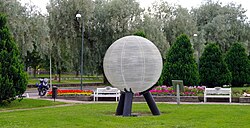
Beyond Neptune lie the icy reaches of the solar system, represented by smaller sculptures scattered across the Swedish landscape.
- Pluto and Charon: Located 300 km (190 mi) away in Delsbo. These are supported by pillars made of dellenite, a rare mineral formed by a meteorite impact 90 million years ago.
- Haumea: A 8.5 cm (3.3 in) model located at the 2047 Science Centre in Borlänge.
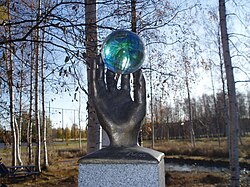
- Quaoar and Ixion: Quaoar (6 cm) is in the Gislaved library, while Ixion (6.5 cm) is held by a sculpted arm at Technichus in Härnösand.
- Makemake and Gonggong: Makemake (7 cm) is at the Slottsskogsobservatoriet in Gothenburg, and Gonggong (7.5 cm) is near the Tycho Brahe Observatory in Malmö.
- Eris: A golden 13 cm (5.1 in) model at the Umeå Arts Campus, referencing the Greek myth of the golden apple.
- Sedna: Located 734 km (456 mi) away at Teknikens Hus in Luleå, representing a distance of approximately 15 billion km (100 AU).
Other Celestial Bodies and Boundaries
The model also includes smaller asteroids and comets to provide a complete picture of the solar system's debris.
Notable inclusions are the near-Earth Object Eros (a tiny gold model at Mörbyskolan), the asteroid Saltis (at Saltsjöbaden's Kunskapsskola), and Vesta (at Åva gymnasium). Other objects include the asteroid Nut in Knivsta and the interstellar visitor 'Oumuamua in Halland.
Comets are also represented, including Halley's Comet in Skövde—which features both outdoor sculptures and an indoor laser installation—and Comet Swift-Tuttle in Karlshamn.
Finally, the model reaches its furthest point at the Termination Shock. This is the boundary where the solar wind transitions to subsonic velocity. While no sculpture currently exists, a foundation is ready at the Institute of Space Physics in Kiruna, 950 km (590 mi) from the Globe.
| Object | Location | Distance from Sun (Globe) | Model Diameter |
|---|---|---|---|
| Sun | Avicii Arena, Stockholm | 0 km | 110 m |
| Earth | Swedish Museum of Natural History | 7.6 km | 65 cm |
| Jupiter | Clarion Hotel, Arlanda Airport | 40 km | 7.3 m |
| Neptune | Söderhamn | 229 km | 2.5 m |
| Pluto | Delsbo | 300 km | 12 cm |
| Sedna | Luleå | 734 km | 10 cm |
Frequently Asked Questions
What is the central point of the Sweden Solar System?
The central point is the Avicii Arena (Globen) in Stockholm, which represents the Sun, including its corona.
How is the scale of the model maintained?
The model uses a consistent scale for both the size of the celestial bodies and the distances between them, requiring some objects to be placed hundreds of kilometers away from Stockholm.
What is the furthest point represented in the model?
The furthest point is the Termination Shock, located at the Institute of Space Physics in Kiruna, 950 km from the Globe.
Are there any objects other than planets in the model?
Yes, the model includes moons (such as Earth's Moon and Enceladus), dwarf planets (like Pluto and Eris), asteroids (such as Vesta and Eros), and comets (such as Halley's Comet).
What makes the Pluto and Charon models unique?
They are supported by pillars made of dellenite, a rare mineral created by a meteorite impact that occurred 90 million years ago in the Dellen lakes region.