Swabian Jura: Germany's High Plateau of History and Innovation
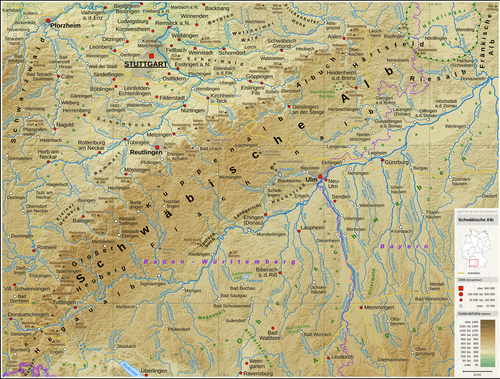
The Swabian Jura (known in German as Schwäbische Alb) is a striking mountain range located in Baden-Württemberg, Germany. Stretching 220 km from the southwest to the northeast and ranging from 40 to 70 km in width, this region is part of the Table Jura. It is characterized by a high plateau that gently slopes toward the southeast, bounded by the Danube River and the upper Neckar.
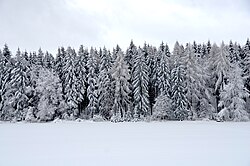
The landscape is defined by its dramatic northwestern edge, a steep forested escarpment known as the Albtrauf (or Albanstieg) that rises 400 meters. While the plateau top is generally flat or rolling, the region rises in the southwest to meet the Black Forest, reaching its peak at the Lemberg mountain.
Key Facts
- Highest Point: Lemberg at 1,015 meters (3,330 ft).
- UNESCO Status: A Global Geopark covering 6,688 km², including a Biosphere Reserve.
- Geology: Primarily composed of Jurassic limestone, creating a porous karst landscape.
- Prehistory: Home to some of the world's oldest human artifacts and musical instruments.
- Economy: A global hub for high-tech engineering, textiles, and automotive industries.
Geology and the Karst Landscape
The Swabian Jura was formed from the seabed of the Jurassic period. The range consists of three stacked limestone layers: Black, Brown, and White Jurassic. The White Jurassic layer is particularly pure, consisting of up to 99% calcium carbonate.
Because limestone is soluble in water, the region has developed a karst landscape—a geological formation where water seeps through cracks to create subterranean rivers and vast cave systems. This porosity means surface water is scarce on the plateau. A famous example of this phenomenon is the Donauversickerung, where the Danube River nearly or completely disappears underground near Immendingen, only to resurface kilometers away at the Aachtopf, eventually flowing into the Rhine.
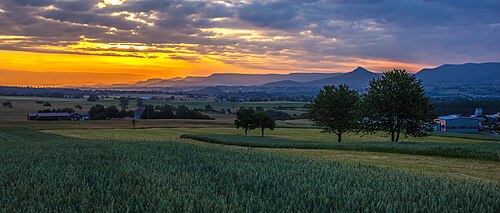
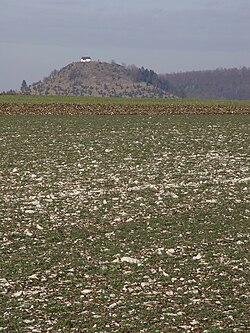
The range is not static; it recedes by approximately 2 mm every year due to weathering. This process has left behind Zeugenberge (witness mountains), such as the Achalm or Hohenstaufen, which are isolated peaks that mark the former extent of the plateau.
Unique Geological Features
- Nördlinger Ries: A massive meteorite crater approximately 15 million years old.
- Zollerngraben: A tectonic depression in the west that occasionally triggers mild earthquakes.
- Volcanic Traces: Evidence of ancient volcanic activity in the form of maars and hills.
Prehistoric and Roman History
The caves of the Swabian Jura are of global archaeological importance. In sites like Hohle Fels and Vogelherd, researchers have discovered some of the oldest known human artifacts, dating back over 30,000 years. These include high-quality sculptures of lions, mammoths, and the Venus of Schelklingen, the oldest known representation of the human body.
The region also holds the record for the oldest musical instruments: flutes crafted from swan and griffon vulture bones (35,000 years old) and a mammoth tusk flute dating back 37,000 years. Furthermore, over 3,000 engraved signs on Aurignacian artifacts suggest an early, conventionalized system of graphic communication.
Later, from the first to the third century A.D., the region was part of the Roman Empire. Evidence of this era remains at the Roman outpost in Hechingen-Stein and the cavalry post (ala) in Aalen, which gave the town its name.
Culture, Language, and Tradition
Historically, life in the Jura was arduous due to poor soil and a lack of accessible water. This hardship shaped local customs; for instance, residents often mixed cider (Most) with water for disinfection. Today, the region is known for its distinct Swabian German dialect. The highland version, Albschwäbisch, is characterized by a sing-song melody and unique verb forms that differ even from lowland Swabian.
The Swabian-Alemannic Carnival (Fastnacht) is a vital tradition, particularly in Rottweil. These celebrations feature witches and nature spirits intended to drive out winter. The prevalence of these traditions often correlates with the region's religious history, as Catholic areas typically maintain stronger carnival traditions than those influenced by Calvinistic Pietism.
Economic Evolution: From Sheep to High-Tech
Due to the infertile soil, the region originally relied on sheep farming, which laid the foundation for a powerful textile industry. This legacy continues today with world-renowned brands such as Hugo Boss, Trigema, and Groz-Beckert.
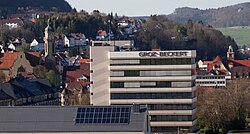
The textile sector evolved into advanced machine building and engineering. The "Neckar-Alb" region is now the third-largest and most stable industrial zone in Germany, anchored by giants like Daimler AG and Robert Bosch. The area boasts one of the highest patents-to-population ratios globally, driven by a strong sector of small and medium-sized enterprises.
Regional Geography and Tourism
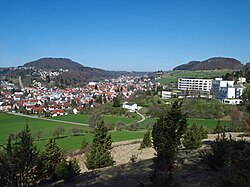
The Swabian Jura is a premier recreation area. While the plateau is sparsely populated, the foreland contains vibrant university towns like Tübingen and industrial centers like Reutlingen, often called "The gate to the Swabian Jura."
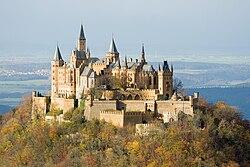
Visitors often travel the Schwäbische Albstraße, a National Scenic Byway. Key attractions include the towering Ulm Minster (featuring the world's highest church spire), the majestic Burg Hohenzollern, and the crystalline waters of the Blautopf.
Summary of Regional Highlights
| Category | Notable Examples |
|---|---|
| Castles | Burg Hohenzollern, Schloss Lichtenstein, Schloss Sigmaringen |
| Nature/Geology | Blautopf, Nebelhöhle, Nördlinger Ries |
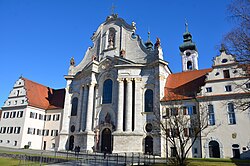
| Culture/Religion | Zwiefalten Abbey, Ulm Minster, Rottweil Fasnet |
| Industry | Daimler AG, Robert Bosch, Hugo Boss |
Local cuisine reflects the region's history, with Brenntar (made from roasted Musmehl flour) and Alb-Leisa (traditional lentils) serving as regional staples.

Frequently Asked Questions
Is the Swabian Jura part of the Alps?
No. Despite being called the "Swabian Alps" in some English translations, it is geographically part of the Jura mountains and is not part of the Alps (die Alpen).
What makes the geology of the Swabian Jura unique?
The region is primarily composed of Jurassic limestone. Because this rock is soluble, it creates a karst landscape with few surface rivers but many subterranean caves and disappearing streams.
Why is the region significant for archaeology?
It contains some of the oldest known human art and musical instruments in the world, including 37,000-year-old flutes and the Venus of Schelklingen.
What is the economic driver of the region today?
The region has transitioned from sheep farming and textiles to high-tech engineering, automotive manufacturing, and electronics, maintaining one of the highest patent densities in the world.
What is the "coldest spot in Germany"?
Due to a specific microclimate, a weather station located near the town of Stetten am kalten Markt is recognized as the coldest spot in the country.