Swabian Dialect: The Unique Language of Southwestern Germany
Swabian (German: Schwäbisch) is a distinctive group of Upper German dialects spoken primarily in the Swabia region. This linguistic variety is central to the identity of people in southeastern Baden-Württemberg—including the capital city of Stuttgart and the Swabian Jura—as well as southwestern Bavaria. Beyond Germany, Swabian influences are found among Caucasus Germans in Transcaucasia and the Danube Swabian populations of Hungary, Romania, and the former Yugoslavia.
While it is part of the High German dialect continuum, Swabian is often cited as being only about 40 percent intelligible to speakers of Standard German. This gap is caused by significant differences in pronunciation, grammar, and a specialized vocabulary that reflects the region's unique cultural heritage.

Key Facts
- Native Speakers: Approximately 820,000 as of 2006.
- Language Family: Indo-European > Germanic > West Germanic > High German > Upper German > Alemannic.
- Primary Regions: Baden-Württemberg and Bavarian Swabia.
- Defining Feature: Frequent use of the diminutive suffix "-le".
- Writing System: Latin (German alphabet).
Linguistic Characteristics
Phonology and Pronunciation
Swabian is often described as having a "soft" or "mild" feel compared to the harder sounds of Northern German dialects. This is largely due to the use of voiced plosives and specific consonant shifts. For example, the "s" sound before "t" or "p" is pronounced as [ʃ] (e.g., Fest becomes Feschd).
A notable phonetic trait is the blurring of the line between voiced and unvoiced plosives. In Swabian, "t" often sounds like "d", and "p" often sounds like "b".
| Standard High German (SHG) | Swabian | English Translation |
|---|---|---|
| Tasche | Dasch | Bag |
| Tag | Dag | Day |
| putzen | butza | To clean |
| Papa | Baba | Dad |
Grammar and Vocabulary
One of the most recognizable features of Swabian is the diminutive suffix "-le" (pronounced /lə/), which is used far more frequently than the Standard German "-lein" or "-chen". When this suffix is added, the noun's article automatically becomes "das". For instance, a house (Haus) becomes a Haisle.
Other grammatical markers include the use of the ending "-ad" for first-person plural verbs. Instead of the Standard German wir gehen ("we go"), a Swabian speaker would say mir gangad.
The dialect also features unique vowel shifts. For example, the long "a" in schlafen (to sleep) shifts to an "o" sound (schlofa), and the long "u" in gut (good) becomes guat.
Cultural Impact and Modern Usage
Swabian is not just a means of communication but a point of regional pride. This was highlighted by a Baden-Württemberg Chamber of Commerce campaign with the slogan "Wir können alles. Außer Hochdeutsch" ("We can do everything. Except [speak] Standard German").
![A sticker that translates as: "We can do everything. Except [speak] standard German."](/images/77/0f/770f60edb3b8f2fd00b5aa6a43ba97f53c3b930698bca8f80f279e07f3826d11.webp)
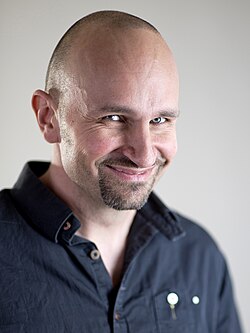
The dialect has also found its way into popular culture. Comedian Dominik Kuhn (Dodokay) gained fame for creating "fandubs" where he dubbed figures like Barack Obama with Swabian vocals. Additionally, the Swabian dialect was used for the character of the Abominable Snowman in the German dub of the 2001 film Monsters Inc.
In terms of vocabulary, the word Muggeseggele—literally meaning the scrotum of a housefly—was once voted the most beautiful Swabian word in a survey by the Stuttgarter Nachrichten. Ironically, it is used to describe a very small unit of measure and is considered acceptable to use around children.
Classification and Variation
Linguistically, Swabian is categorized as an Alemannic dialect. It is composed of various sub-dialects, which are often distinguished by how they form the past participle of the verb "to be" (sein), using either gwäa or gsei. The gsei group shares closer ties with other Alemannic varieties, such as Swiss German.
The Danube Swabian dialects (Schwowisch) spoken in Eastern Europe are more complex. While nominally Swabian, they are often a blend of Swabian, Bavarian, Franconian, and Hessian dialects.
Frequently Asked Questions
How different is Swabian from Standard German?
Swabian is considered roughly 40 percent intelligible to Standard German speakers due to its distinct pronunciation, different vowel sounds, and unique vocabulary.
What is the meaning of the "-le" suffix?
The "-le" suffix is a diminutive used to denote smallness or affection, similar to "-chen" or "-lein" in Standard High German, but it is used much more frequently in Swabian speech.
Where is the Swabian dialect primarily spoken?
It is mainly spoken in the Swabia region of southwestern Germany, specifically in southeastern Baden-Württemberg (including Stuttgart) and southwestern Bavaria.
What are Danube Swabian dialects?
These are dialects spoken by Swabian populations in Hungary, Romania, and the former Yugoslavia. They are often a mixture of Swabian, Bavarian, Franconian, and Hessian influences.