Swabia: The History, Culture, and Language of Southwestern Germany
Swabia is a distinguished cultural, historical, and linguistic region located in southwestern Germany. Rooted in the medieval Duchy of Swabia—one of the original German stem duchies—the region represents the ancestral settlement lands of the Alemanni and Suebi tribal alliances. While the historical territory once spanned a vast area of Central Europe, the modern concept of Swabia is more focused, primarily divided between the contemporary German states of Bavaria and Baden-Württemberg.
Today, the region is home to millions, including those who identify as Swabians (Schwaben) and speakers of the Swabian German dialect. From its Celtic origins to its role in the Holy Roman Empire, Swabia has remained a pivotal center of European political and literary development.
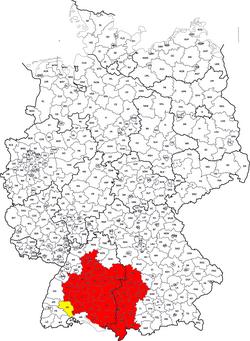
Key Facts
- Core Identity: A cultural and linguistic region in southwestern Germany.
- Historical Roots: Derived from the Suebi and Alemanni tribes and the subsequent Duchy of Swabia.
- Modern Geography: Spans parts of Baden-Württemberg and the Swabian administrative region of Bavaria.
- Language: Swabian German, a variant of the Alemannic dialect group.
- Population: Approximately 7.5 million people live in the regions of Stuttgart, Tübingen, and Bavarian Swabia.
The Evolution of Swabia: From Tribes to Duchy
Early Origins and the Roman Era
The foundations of Swabia lie in the La Tène culture, giving the region a Celtic (Gaulish) substrate. During the Roman period, the area was integrated into the province of Raetia. The name "Suebia" originates from the Suebi, a term used as early as the 1st century by the historian Tacitus.
By the mid-3rd century, the Suebi became the core of the Alamanni tribal alliance. These groups expanded toward the Roman Limes (the fortified border of the Roman Empire) south of the Main and east of the Rhine. Following the migration period, some Suebi established a kingdom in Galicia, while others settled in Pannonia after the Battle of Nedao in 454.
The Rise and Fall of the Duchy of Swabia
By the 9th and 10th centuries, Swabia emerged as one of the stem duchies of East Francia. It became a beacon of Old High German literary culture, largely due to the influence of the abbeys of Reichenau and St. Gallen. The duchy was eventually incorporated into the Holy Roman Empire under Otto I in the 960s.
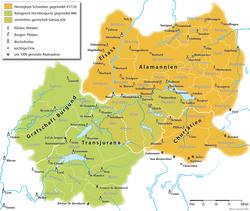
The Hohenstaufen dynasty, which rose from Swabia, ruled the Holy Roman Empire during the 12th and 13th centuries. However, the duchy collapsed following the execution of Conradin in 1268. During the subsequent Great Interregnum, the territory fragmented into smaller units, including Free Imperial Cities and Imperial Abbeys, as Emperor Rudolf I of Habsburg resisted restoring the duchy to limit imperial power.

Medieval Power Struggles and the Swabian League
The League of Cities
In the 14th century, Swabian cities began organizing to protect their interests. The first Swabian League of Cities was formed in 1331, including hubs like Ulm, Augsburg, Heilbronn, and Reutlingen. Despite various conflicts and a temporary disbandment in 1389, the spirit of cooperation persisted.
The Schwäbischer Bund
A new Swabian League (Schwäbischer Bund) was established in 1488 to counter the expansion of the House of Wittelsbach (Bavarian dukes) and the independence movements of the Swiss. This league was instrumental in suppressing the Peasants' Revolt (1524–26) and managing regional conflicts until the Reformation caused its dissolution in 1534.
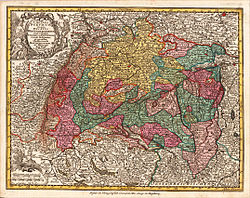
Modern Transition and Geography
Territorial Reorganization
The modern boundaries of Swabia were largely shaped by the Reichsdeputationshauptschluss of 1803. This reorganization secularized ecclesiastical estates and mediatized smaller states. This left the Kingdom of Württemberg, the Grand Duchy of Baden, and the Principality of Hohenzollern-Sigmaringen as the primary sovereign entities. Much of Eastern Swabia was absorbed by Bavaria, leading to the creation of the Swabian administrative region of Bavaria.
Defining the Region Today
While borders are fluid, Swabia is generally defined as the former Swabian Circle. This includes the modern districts of Stuttgart and Tübingen, as well as Bavarian Swabia. Interestingly, while Baden was historically part of the duchy, its residents today typically identify as Alemanni rather than Swabians.
| Period | Political Entity | Key Characteristics |
|---|---|---|
| Ancient/Roman | Raetia / Tribal Alliances | Celtic substrate; Suebi and Alemanni settlement. |
| 9th - 13th Century | Duchy of Swabia | Stem duchy; center of Old High German literature. |
| 15th - 16th Century | Swabian League | Alliance of cities and rulers against expansionism. |
| Post-1803 | Modern Administrative Regions | Divided between Baden-Württemberg and Bavaria. |
The Swabian People and Language
The Swabian identity is deeply tied to the Swabian German dialect. As of 2006, SIL Ethnologue estimated there were approximately 819,000 active speakers, representing about 10% of the region's population. This dialect is a branch of Alemannic German, closely linking Swabians to Alsatians and German-speaking Swiss.
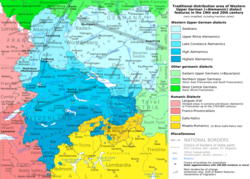
Linguistically, Swabian is characterized by specific diminutive suffixes in surnames, such as -le, -el, and -lin (derived from the Middle High German -elîn). Common examples include names like Schäuble or Gmelin. The surname Schwab itself literally translates to "Swabian."
Frequently Asked Questions
What is the difference between Swabians and Alemanni?
While both are part of the broader Alemannic linguistic group, "Swabian" typically refers to those from the former Swabian Circle (including Württemberg and Bavarian Swabia), whereas residents of Baden more commonly identify as Alemanni.
Which German states include Swabia today?
Swabia is currently divided between the state of Baden-Württemberg (specifically the districts of Stuttgart and Tübingen) and the state of Bavaria (the Swabian administrative region).
Who were the Hohenstaufen?
The Hohenstaufen were a powerful dynasty originating from Swabia that ruled the Holy Roman Empire during the 12th and 13th centuries.
What was the purpose of the Swabian League?
The Swabian League was formed to protect smaller secular rulers and imperial cities from the expansionist ambitions of larger powers, such as the Bavarian dukes, and to maintain regional stability.
How many people speak Swabian German?
According to 2006 estimates from SIL Ethnologue, there are approximately 819,000 speakers of the Swabian dialect.