Supreme Court of the United States
The Supreme Court of the United States serves as the highest judicial body in the American legal system. Established on March 4, 1789, and authorized by the U.S. Constitution, the Court acts as the final arbiter of law, ensuring that the Constitution is interpreted and applied consistently across the nation.
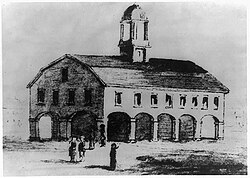
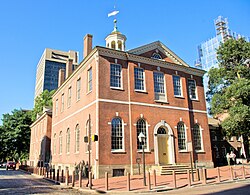
For much of its early history, the Court lacked a permanent home. Its first meeting took place at the Royal Exchange in New York City, and it later met in Philadelphia's City Hall between 1791 and 1801.
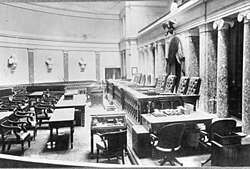
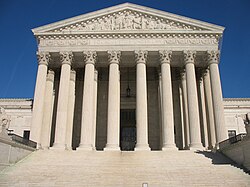
Following its time in Philadelphia, the Court operated out of chambers within the Capitol Building in Washington, D.C., including the Old Senate Chamber from the 1860s until the 1930s. It was not until 1935 that the Court moved into its own dedicated building.
Key Facts
- Established: March 4, 1789.
- Composition: 9 justices (by statute).
- Appointment: Nominated by the President and confirmed by the Senate.
- Tenure: Life tenure.
- Current Chief Justice: John Roberts (since September 29, 2005).
- Primary Role: Final appellate jurisdiction and original jurisdiction over specific cases.
The Evolution of the Court

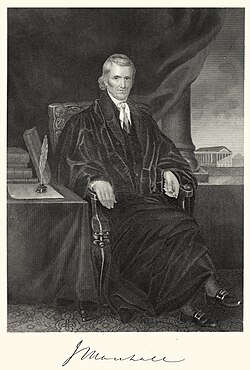
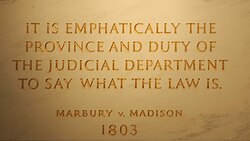
The Court's influence grew significantly under the leadership of figures like John Marshall, who served as Chief Justice from 1801 to 1835. Marshall is credited with outlining the concept of judicial review—the power of the Court to declare legislative and executive acts unconstitutional—most notably in the landmark case Marbury v. Madison (1803).
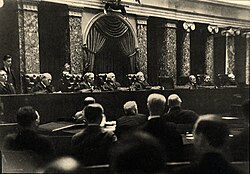
Throughout the 20th century, the Court navigated pivotal eras, including the New Deal period. During this time, the "Four Horsemen"—Justices Butler, McReynolds, Sutherland, and Van Devanter—were known for their opposition to New Deal policies.
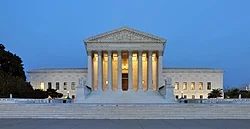
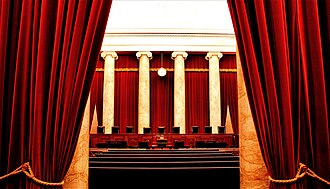
The Court's physical presence in Washington, D.C., remains a symbol of judicial authority, with the current building serving as its home since 1935.
Composition and Membership
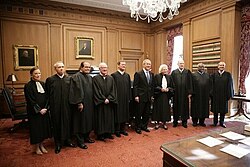
The Supreme Court currently consists of nine justices. The process for joining the Court involves a presidential nomination followed by a confirmation vote in the U.S. Senate. Once appointed, justices hold their positions for life, providing a degree of insulation from immediate political pressure.
The Court has seen a gradual shift in demographics, including the appointment of the first four female justices: Sandra Day O'Connor, Ruth Bader Ginsburg, Sonia Sotomayor, and Elena Kagan.
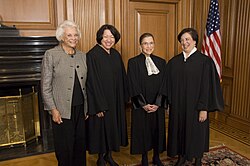
The nomination process is often highly scrutinized, as seen in the Senate Judiciary Committee hearings for nominees such as John Roberts and Ruth Bader Ginsburg.


Current Sitting Justices
The modern Court, known as the Roberts Court, includes a mix of justices appointed by Republican and Democratic presidents.
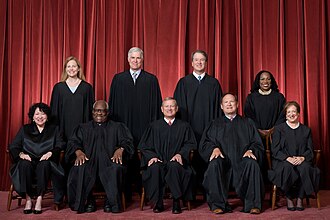

| Justice | Appointed By | Start Date | Confirmation Vote |
|---|---|---|---|
| John Roberts (Chief Justice) | G.W. Bush (R) | Sept 29, 2005 | 78–22 |
| Clarence Thomas | G.H.W. Bush (R) | Oct 23, 1991 | 52–48 |
| Samuel Alito | G.W. Bush (R) | Jan 31, 2006 | 58–42 |
| Sonia Sotomayor | Obama (D) | Aug 8, 2009 | 68–31 |
| Elena Kagan | Obama (D) | Aug 7, 2010 | 63–37 |
| Neil Gorsuch | Trump (R) | Apr 10, 2017 | 54–45 |
| Brett Kavanaugh | Trump (R) | Oct 6, 2018 | 50–48 |
| Amy Coney Barrett | Trump (R) | Oct 27, 2020 | 52–48 |
| Ketanji Brown Jackson | Biden (D) | June 30, 2022 | 53–47 |
Judicial Process and Jurisdiction
The Court exercises both original jurisdiction (hearing a case for the first time) and appellate jurisdiction (reviewing decisions from lower courts). The process begins with case selection, where the Court decides which petitions to hear, often focusing on correcting egregious departures from judicial proceedings.
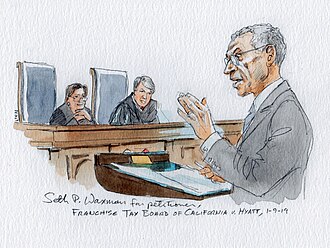
Once a case is accepted, it proceeds through written evidence and oral arguments, where attorneys present their cases and answer questions from the justices.
Landmark Decisions
The Court's rulings have shaped American society. Notable examples include:
- Brown v. Board of Education (1954): Ended school segregation.
- Miranda v. Arizona (1966): Established rights for detained individuals.
- Roe v. Wade (1973): Originally protected abortion access, later overturned by Dobbs v. Jackson (2022).
- Obergefell v. Hodges (2015): Legalized same-sex marriage.
- Trump v. United States (2024): Addressed presidential immunity.

Frequently Asked Questions
How are Supreme Court justices appointed?
Justices are nominated by the President of the United States and must be confirmed by a majority vote in the U.S. Senate.
How long do Supreme Court justices serve?
Justices are granted life tenure, meaning they serve until they retire, resign, or pass away, unless they are removed from office through impeachment.
What is judicial review?
Judicial review is the power of the Supreme Court to examine the actions of the legislative and executive branches and determine whether those actions are consistent with the U.S. Constitution.
How many justices sit on the Court?
By statute, there are currently nine positions on the Supreme Court, consisting of one Chief Justice and eight Associate Justices.
What is the difference between original and appellate jurisdiction?
Original jurisdiction allows the Court to hear a case for the first time, while appellate jurisdiction allows it to review a decision that has already been made by a lower court.