United States States: Sovereignty, Structure, and the History of Admission
The United States is composed of 50 constituent entities known as states. These states operate under a system of shared sovereignty, meaning they hold significant independent power while coexisting with the federal government. Because of this dual authority, Americans hold citizenship in both the federal republic and the specific state in which they reside.
While most entities are officially called states, four specific locations—Kentucky, Massachusetts, Pennsylvania, and Virginia—use the term commonwealth in their official names.
The Foundations of State Power and Governance
States serve as the primary subdivisions of the nation. Under the United States Constitution, states possess all powers that are not explicitly granted to the federal government or prohibited to them by the Constitution. This framework allows state governments to manage matters of local concern, including:
- Regulating intrastate commerce (trade occurring within a single state).
- Conducting and managing elections.
- Establishing local government structures.
- Setting public school policies.
- Overseeing non-federal road construction and maintenance.
Each state functions as a self-governing entity with its own constitution based on republican principles. To manage these responsibilities, every state maintains a government divided into three distinct branches: executive, legislative, and judicial.
Representation in the Federal Government
Despite their individual sovereignty, all states and their residents are integrated into the federal legislative process through the U.S. Congress. This is a bicameral legislature, meaning it is composed of two separate chambers: the Senate and the House of Representatives.
The Senate and the House of Representatives
Representation in Congress is balanced between equality and population:
- The Senate: Every state is represented by exactly two senators, ensuring equal standing regardless of size.
- The House of Representatives: Each state is entitled to at least one representative. The total number of representatives a state receives is determined by its population, as measured during the decennial census (a population count conducted every ten years).
The Electoral College
States also play a critical role in electing the nation's leadership. Each state is assigned a specific number of electors for the Electoral College, the body responsible for electing the President and Vice President. A state's number of electors is equal to its total number of representatives and senators in Congress.
The Evolution of the Union
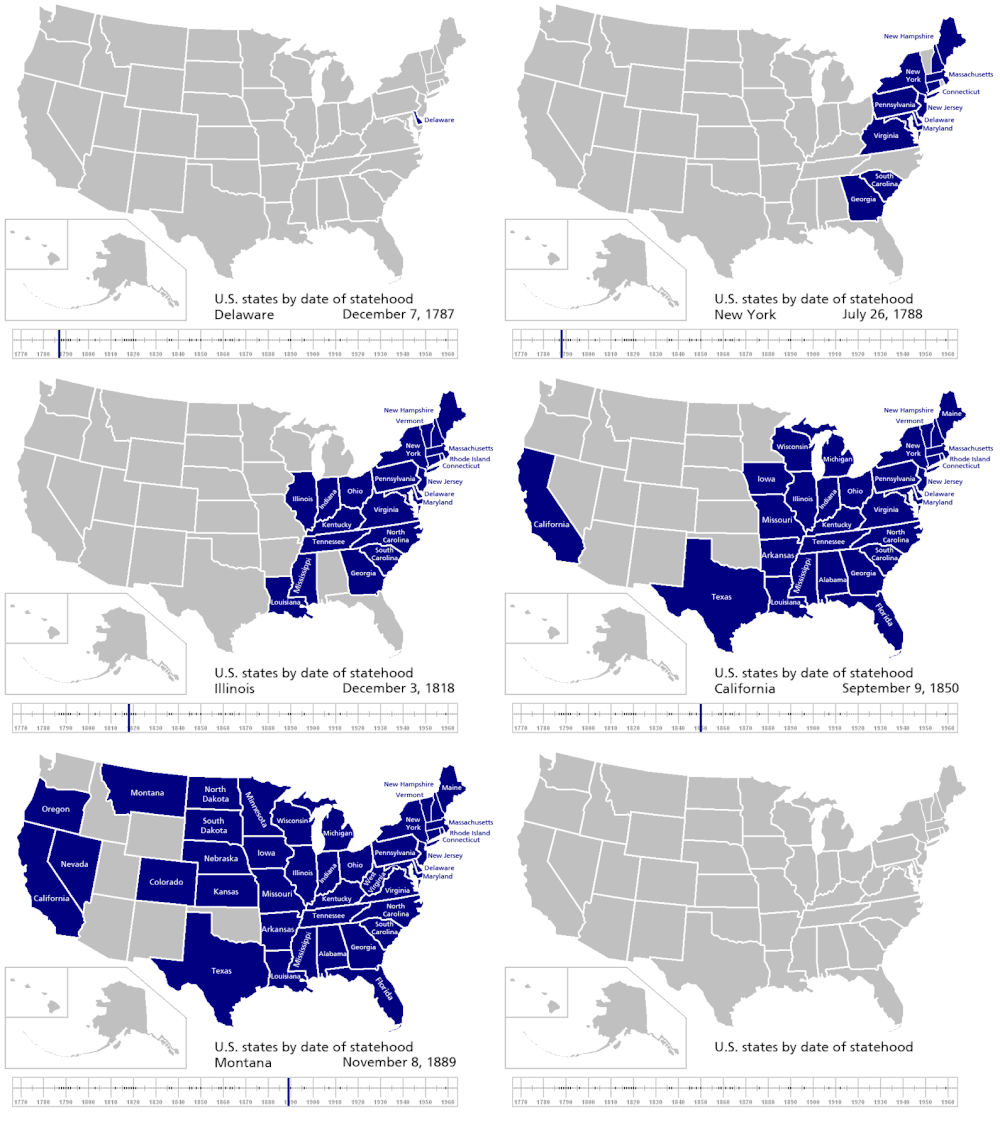
The expansion of the United States from its original 13 colonies to the current 50 states is governed by Article IV, Section 3, Clause 1 of the Constitution, which grants Congress the authority to admit new states. A fundamental principle of the Union is that every new state is admitted on an equal footing with the existing states.
Key Facts
- Total States: 50 constituent entities.
- Original States: 13 states formed from the original colonies.
- Governance: Each state has an executive, legislative, and judicial branch.
- Senate Representation: Exactly 2 senators per state.
- Admission Authority: Granted to Congress by the U.S. Constitution.
Chronology of Statehood
The following table outlines the progression of states into the Union, beginning with the original 13 that ratified the 1787 Constitution, followed by subsequent admissions via Acts of Congress.
| # | State | Date (admitted or ratified) | Formed from |
|---|---|---|---|
| 1 | Delaware | December 7, 1787 (ratified) | Colony of Delaware |
| 2 | Pennsylvania | December 12, 1787 (ratified) | Proprietary Province of Pennsylvania |
| 3 | New Jersey | December 18, 1787 (ratified) | Crown Colony of New Jersey |
| 4 | Georgia | January 2, 1788 (ratified) | Crown Colony of Georgia |
| 5 | Connecticut | January 9, 1788 (ratified) | Crown Colony of Connecticut |
| 6 | Massachusetts | February 6, 1788 (ratified) | Crown Colony of Massachusetts Bay |
| 7 | Maryland | April 28, 1788 (ratified) | Proprietary Province of Maryland |
| 8 | South Carolina | May 23, 1788 (ratified) | Crown Colony of South Carolina |
| 9 | New Hampshire | June 21, 1788 (ratified) | Crown Colony of New Hampshire |
| 10 | Virginia | June 25, 1788 (ratified) | Crown Colony and Dominion of Virginia |
| 11 | New York | July 26, 1788 (ratified) | Crown Colony of New York |
| 12 | North Carolina | November 21, 1789 (ratified) | Crown Colony of North Carolina |
| 13 | Rhode Island | May 29, 1790 (ratified) | Crown Colony of Rhode Island and Providence Plantations |
| 14 | Vermont | March 4, 1791 (admitted) | Vermont Republic |
| 15 | Kentucky | June 1, 1792 (admitted) | Virginia |
| 16 | Tennessee | June 1, 1796 (admitted) | Southwest Territory |
| 17 | Ohio | March 1, 1803 (admitted) | Northwest Territory (part) |
| 18 | Louisiana | April 30, 1812 (admitted) | Territory of Orleans |
| 19 | Indiana | December 11, 1816 (admitted) | Indiana Territory |
| 20 | Mississippi | December 10, 1817 (admitted) | Mississippi Territory |
| 21 | Illinois | December 3, 1818 (admitted) | Illinois Territory (part) |
| 22 | Alabama | December 14, 1819 (admitted) | Alabama Territory |
| 23 | Maine | March 15, 1820 (admitted) | Massachusetts (District of Maine) |
| 24 | Missouri | August 10, 1821 (admitted) | Missouri Territory (part) |
| 25 | Arkansas | June 15, 1836 (admitted) | Arkansas Territory |
| 26 | Michigan | January 26, 1837 (admitted) | Michigan Territory |
| 27 | Florida | March 3, 1845 (admitted) | Florida Territory |
| 28 | Texas | December 29, 1845 (admitted) | Republic of Texas |
| 29 | Iowa | December 28, 1846 (admitted) | Iowa Territory (part) |
| 30 | Wisconsin | May 29, 1848 (admitted) | Wisconsin Territory (part) |
| 31 | California | September 9, 1850 (admitted) | Unorganized territory / Mexican Cession (part) |
| 32 | Minnesota | May 11, 1858 (admitted) | Minnesota Territory (part) |
| 33 | Oregon | February 14, 1859 (admitted) | Oregon Territory (part) |
| 34 | Kansas | January 29, 1861 (admitted) | Kansas Territory (part) |
| 35 | West Virginia | June 20, 1863 (admitted) | Virginia |
| 36 | Nevada | October 31, 1864 (admitted) | Nevada Territory |
| 37 | Nebraska | March 1, 1867 (admitted) | Nebraska Territory |
| 38 | Colorado | August 1, 1876 (admitted) | Colorado Territory |
| 39 | North Dakota | November 2, 1889 (admitted) | Dakota Territory (part) |
| 40 | South Dakota | November 2, 1889 (admitted) | Dakota Territory (part) |
| 41 | Montana | November 8, 1889 (admitted) | Montana Territory |
| 42 | Washington | November 11, 1889 (admitted) | Washington Territory |
| 43 | Idaho | July 3, 1890 (admitted) | Idaho Territory |
| 44 | Wyoming | July 10, 1890 (admitted) | Wyoming Territory |
| 45 | Utah | January 4, 1896 (admitted) | Utah Territory |
| 46 | Oklahoma | November 16, 1907 (admitted) | Oklahoma Territory and Indian Territory |
| 47 | New Mexico | January 6, 1912 (admitted) | New Mexico Territory |
| 48 | Arizona | February 14, 1912 (admitted) | Arizona Territory |
| 49 | Alaska | January 3, 1959 (admitted) | Territory of Alaska |
| 50 | Hawaii | August 21, 1959 (admitted) | Territory of Hawaii |
Frequently Asked Questions
Do all states have the same name format?
No. While most are called states, Kentucky, Massachusetts, Pennsylvania, and Virginia officially use the term commonwealth.
How is the number of representatives for a state determined?
The size of a state's House delegation depends on its total population, which is determined by the most recent constitutionally mandated decennial census.
What is the difference between a state and a territory?
States are constituent entities that share sovereignty with the federal government and have full representation in Congress. Territories, such as those from which many states were formed, are different administrative divisions that eventually may be admitted as states.
How many senators does each state have?
Each state is represented by exactly two senators in the U.S. Senate.
What determines a state's number of electors?
A state's number of electors in the Electoral College is equal to the total of its representatives and senators in Congress.
Who has the power to admit new states?
Under Article IV of the Constitution, Congress has the authority to admit new states into the Union.