President of the United StatesPOTUSExecutive BranchCommander-in-ChiefWhite House

President of the United States: Roles, Powers, and History

President of the United States: Roles, Powers, and History The President of the United States serves as the highest-ranking official in the American government, holding a multifaceted rol...

President of the United States: Roles, Powers, and History

The President of the United States serves as the highest-ranking official in the American government, holding a multifaceted role that encompasses being the head of state, the head of government, and the Commander-in-Chief of the armed forces. Established by the Constitution of the United States in 1789, the office has evolved significantly over more than two centuries, shaping the course of global politics and domestic policy.
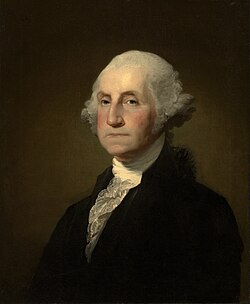
George Washington, the first president of the United States

Key Facts

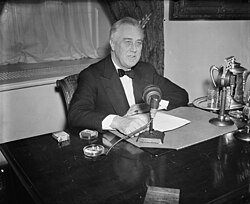
President Franklin D. Roosevelt delivers a radio address in 1933.
  • First President: George Washington
  • Term Length: Four years, renewable once
  • Current Incumbent: Donald Trump (since January 20, 2025)
  • Official Residence: The White House
  • Annual Salary: $400,000
  • Selection Method: Electoral College or via succession

The Powers and Responsibilities of the Presidency
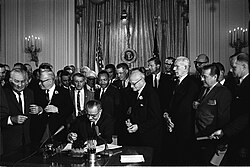
President Lyndon B. Johnson signs the 1964 Civil Rights Act at the White House on July 2, 1964, as Martin Luther King Jr. and others look on.

The President operates within the Executive Branch, supported by the Executive Office of the President and various councils, including the National Security Council and the National Economic Council. The authority of the office is divided into several critical domains:

Executive and Administrative Powers

The President is responsible for managing the federal government and implementing laws. This includes the power to promulgate regulations and oversee the administrative functions of the state. Through the Presentment Clause, the President interacts directly with the legislative process by signing or vetoing bills passed by Congress.
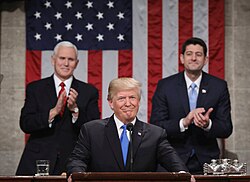
President Donald Trump delivers his 2018 State of the Union Address before Congress.

Legislative and Judicial Roles

Beyond signing legislation, the President has the authority to set the national agenda and convene or adjourn Congress. In the judicial realm, the President plays a vital role in the appointment of federal judges and Supreme Court justices.
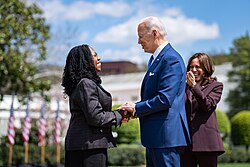
President Joe Biden with his Supreme Court appointee Justice Ketanji Brown Jackson and Vice President Kamala Harris (in background) following Brown Jackson's 2022 United States Senate confirmation

Foreign Affairs and Military Command

As the Commander-in-Chief, the President holds supreme command over the nation's military forces. In the international arena, the President acts as a global leader, conducting diplomacy and representing the United States to foreign nations.
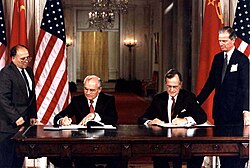
President George H. W. Bush and Soviet president Mikhail Gorbachev sign the 1990 Chemical Weapons Accord at the White House.

Eligibility and the Selection Process
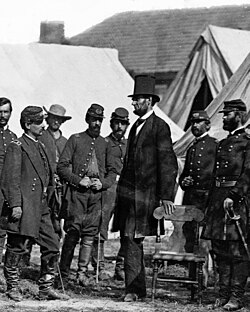
President Abraham Lincoln successfully preserved the Union during the American Civil War. Here he is (center) with General George B. McClellan (left), and soldiers at Antietam, on October 3, 1862.

To serve as President, an individual must meet specific constitutional requirements:

  • Must be a natural-born citizen of the United States.
  • Must be at least 35 years old.

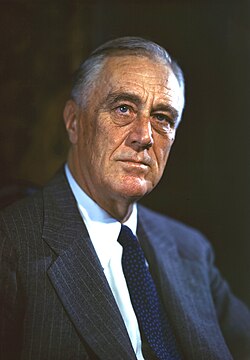
The selection process is primarily conducted through the Electoral College. Following an election and inauguration, the President serves a term of four years. While the 22nd Amendment now limits a president to two terms, historical figures like Franklin D. Roosevelt served more before this restriction was implemented in 1951.
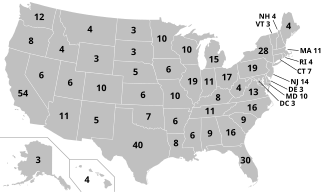
A map of the United States showing the number of electoral votes allocated following the 2020 United States census to each state and the District of Columbia for the 2024 and 2028 presidential elections. 270 electoral votes are required for a majority out of 538 votes possible.
Franklin D. Roosevelt won a record four presidential elections in 1932, 1936, 1940, and 1944 prior to the implementation of the 22nd amendment in 1951, which instituted a two-term limit.

Presidential Residence and Travel

ภาพประกอบบทความ
ภาพประกอบจากบทความต้นฉบับ

The White House serves as the official residence and workplace of the President. For official guests, the administration utilizes Blair House. When traveling, the President utilizes specialized transportation, including the presidential aircraft (known as Air Force One when the President is aboard) and the presidential helicopter (known as Marine One).
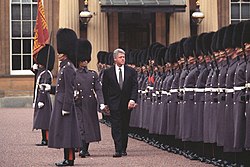
President Bill Clinton reviews honor guards at Buckingham Palace during a 1995 state visit to the UK.

Historical Evolution and Political Affiliation
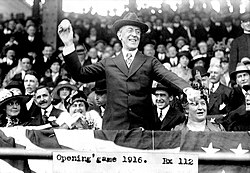
President Woodrow Wilson throws out the ceremonial first ball on Opening Day in 1916.

Since the formation of the office in 1789, various political parties have held the presidency. The Republican Party has seen 19 presidents, while the Democratic Party has seen 15. Other historical groups include the Democratic-Republicans, Whigs, Federalists, and the National Union party.

Summary of Presidential Political Affiliations
Political Party Number of Presidents Notable Examples
Republican 19 Ronald Reagan, Donald Trump
Democratic 15 Bill Clinton, Joe Biden
Democratic-Republican 4 Thomas Jefferson, James Madison
Whig 4 Millard Fillmore, Zachary Taylor
Federalist 1 John Adams
Independent 1 George Washington
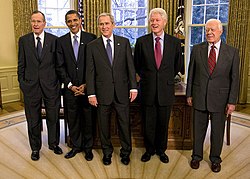
From left to right: Presidents George H. W. Bush, Barack Obama, George W. Bush, Bill Clinton, and Jimmy Carter in the Oval Office on January 7, 2009; Obama took office thirteen days later.
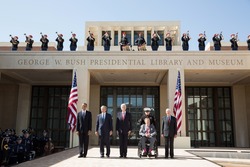
From left to right: Presidents Barack Obama, George W. Bush, Bill Clinton, George H. W. Bush, and Jimmy Carter at the dedication of the George W. Bush Presidential Library and Museum in Dallas in 2013

Presidential Compensation History

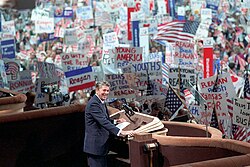
President Ronald Reagan giving his acceptance speech at the 1984 Republican National Convention.

The salary of the President has changed significantly since the office's inception. In 1789, the salary was $25,000 (equivalent to approximately $675,604 in 2025 USD). By 2001, the salary had been set at $400,000 per year.
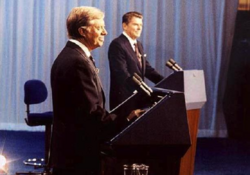
President Jimmy Carter (left) debates Republican nominee Ronald Reagan on October 28, 1980, during the 1980 U.S. presidential campaign.

Frequently Asked Questions

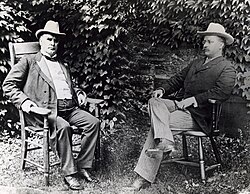
President William McKinley and his vice presidential running mate, New York governor Theodore Roosevelt, c. 1900
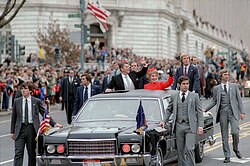
President Ronald Reagan waves following his inauguration as the nation's 40th president on January 20, 1981.

How is the President addressed formally?

Formally, the President is addressed as The Honorable. Informally, they are referred to as Mr. President. In diplomatic contexts, the term His Excellency may be used.

What is the line of succession?

If the President is unable to serve, there is a designated line of succession to ensure the continuity of government. The specific order is established by constitutional and legal frameworks.

What are the term limits for a U.S. President?

Under the 22nd Amendment, a President is limited to serving two terms in office. Each term lasts four years.

What is the role of the Electoral College?

The Electoral College is the formal body that elects the President and Vice President. A candidate must secure a majority of electoral votes to win the presidency.

Where are presidential libraries located?

Many former presidents have established libraries and museums to preserve their history, such as the George W. Bush Presidential Library in Texas and the Harry S. Truman Presidential Library in Missouri.

References

  1. In addition to $100,000 in travel reimbursement, $19,000 for entertainment and $50,000 for additional expenses.[10]
  2. The informal term POTUS originated in the Phillips Code, a shorthand method created in 1879 by Walter P. Phillips for the rapid transmission of press reports by telegraph.[11]
  3. The nine vice presidents who succeeded to the presidency upon their predecessor's death or resignation and served for the remainder of his term are: John Tyler (1841); Millard Fillmore (1850); Andrew Johnson (1865); Chester A. Arthur (1881); Theodore Roosevelt (1901); Calvin Coolidge (1923); Harry S. Truman (1945); Lyndon B. Johnson (1963); and Gerald Ford (1974).
  4. Grover Cleveland and Donald Trump are each counted twice due to serving two nonconsecutive terms.[20]
  5. Nearly all scholars rank Lincoln among the nation's top three presidents, with many placing him first. See Historical rankings of presidents of the United States for a collection of survey results.