Sunset Cafe: The Legendary Jazz Hub of Chicago
During the 1920s, 30s, and 40s, the Sunset Cafe—also known as the Grand Terrace Cafe—stood as one of the most influential jazz venues in the United States. Located in Chicago, Illinois, the club served as a critical epicenter for musical innovation, particularly during the city's creative peak between 1917 and 1928 and again during the rise of bebop (a complex, fast-tempo style of jazz) in the early 1940s.
Beyond the music, the Sunset Cafe was a social pioneer. It operated as a Black and Tan club, a rare integrated space where African Americans and people of other ethnicities could mingle freely with white Americans, providing a sanctuary from the era's strict segregation.
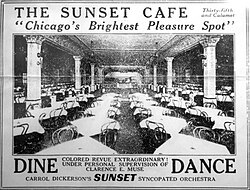
Key Facts
- Location: 315 E 35th St, Bronzeville neighborhood, Chicago.
- Status: Designated as a Chicago Landmark on September 9, 1998.
- Social Impact: One of the few integrated "Black and Tan" clubs of its time.
- Key Figures: Owned by Joe Glaser; hosted legends like Louis Armstrong and Earl Hines.
- Evolution: Transitioned from an automobile garage to a jazz club, and eventually to an Ace Hardware store.
The Architecture and Evolution of the Building
The physical site of the cafe remains standing today in Chicago's Bronzeville neighborhood. Originally constructed in 1909 as an automobile garage, the building underwent a significant remodeling in 1921 to accommodate its new role as a nightlife destination. The renovated space featured a dance floor, a bandstand, and approximately 100 tables.
Unlike New York's original Cotton Club, which was demolished for urban renewal, the Sunset/Grand Terrace building survived. It still retains some of its original wall murals. After the Grand Terrace Cafe closed in 1950, the building served briefly as a political office before becoming an Ace Hardware store.
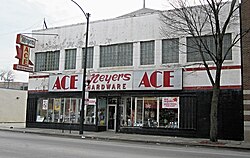
A Stage for Jazz Legends
Under the ownership of Joe Glaser, the manager of Louis Armstrong, the venue became a launching pad for some of the most famous names in music history. The stage hosted a diverse array of talent, including Billie Holiday, Dinah Washington, Cab Calloway, Benny Goodman, and Ella Fitzgerald, who made her Chicago debut there on September 23, 1939.
The Influence of Louis Armstrong
In 1926, Louis Armstrong began performing at the Sunset Cafe with the Carroll Dickerson Orchestra, featuring Earl Hines on piano. The venue hosted Jazzmania, a production by Percy Venable that showcased Armstrong in iconic performances of "Heebie Jeebies" and "Big Butter and Egg Man." This era saw the formation of Louis Armstrong and his Stompers, with Hines serving as the musical director.
The Rise of Cab Calloway
Cab Calloway began his professional career at the Sunset Cafe under the mentorship of Armstrong and Hines. When Armstrong left for New York, the 20-year-old Calloway was chosen by Armstrong and Glaser to take over the residency. Calloway eventually followed Armstrong to New York, where he became a headliner at the Cotton Club.
The Earl Hines Era and the Grand Terrace
Following Calloway's departure, Earl Hines took over the mantle. In 1928, the 25-year-old Hines began a twelve-year residency at the venue, which was renamed the Grand Terrace Cafe. During this period, the club was partially controlled (approximately 25%) by the notorious gangster Al Capone.
Under Hines' leadership, the club continued its tradition of nurturing new talent, introducing the world to Charlie Parker, Dizzy Gillespie, Sarah Vaughan, Nat "King" Cole, and Billy Eckstine. The venue also hosted the famous dancer Bill "Bojangles" Robinson. During this time, the Hines Band became the most frequently radio-broadcast band in the United States.
Venue Summary
| Feature | Details |
|---|---|
| Original Purpose | Automobile Garage (1909) |
| Primary Era | 1920s – 1940s |
| Key Residents | Louis Armstrong, Cab Calloway, Earl Hines |
| Notable Debut | Ella Fitzgerald (Sept 23, 1939) |
| Current Status | Chicago Landmark / Commercial Building |
Frequently Asked Questions
What was a "Black and Tan" club?
A Black and Tan club was an integrated venue where African Americans and white Americans could socialize and mingle freely, which was a rarity during the era of segregation.
Who owned the Sunset Cafe?
The venue was owned by Joe Glaser, who was also the manager for Louis Armstrong.
What is the building used for today?
After serving as a jazz club and a political office, the building became an Ace Hardware store.
Which famous musicians started their careers here?
Many legends developed their careers at the venue, including Cab Calloway, who got his professional start there, as well as bebop pioneers like Charlie Parker and Dizzy Gillespie.
Did Al Capone have a connection to the club?
Yes, during the residency of Earl Hines at the Grand Terrace Cafe, Al Capone is noted to have controlled approximately 25% of the establishment.