Standard High German: History, Evolution, and Global Influence
Standard High German (known as Standardhochdeutsch or Hochdeutsch) serves as the unifying linguistic bridge across German-speaking Europe. As a member of the West Germanic branch of the Indo-European language family, it is the official form of the language used in formal writing, education, and media. With approximately 76 million native speakers and 59 million second-language learners, it reaches a total of 130 million speakers worldwide.
Unlike many languages that evolved from a single central dialect, Standard High German is a pluricentric language, meaning it has multiple national standards—most notably in Germany, Austria, and Switzerland—that are mutually intelligible but possess distinct regional characteristics.
![The national and regional standard varieties of the German language[15]](/images/00/fc/00fc47bfd224a58a067d5fac6074b6599163a413a7a8f7a737369c03e25a2f02.png)
Key Facts
- Total Speakers: 130 million (76 million L1, 59 million L2).
- Language Family: Indo-European > Germanic > West Germanic > High German.
- Primary Regulators: The Council for German Orthography and the Duden dictionary.
- Writing System: Latin script (German alphabet) and German Braille.
- Key Historical Catalyst: Martin Luther's 16th-century Bible translation.
The Path to Standardization
The Influence of Martin Luther
The journey toward a standardized written German began significantly in 1522 with Martin Luther's translation of the New Testament (followed by the Old Testament in 1534). Luther utilized the language of the Saxon chancery, a Central German dialect. Because this dialect sat "halfway" between the northern and southern regional variations, it was more widely understood, providing a foundation for a unified written form.
The Rise of the Duden
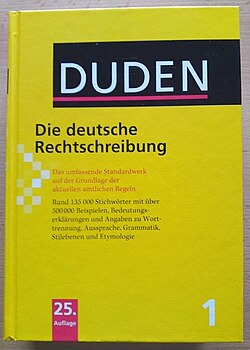
While the 17th century saw the increasing importance of the Saxony-Wittenberg chancery language, formal codification took longer. After a failed attempt at an Orthographical Conference in 1876, Konrad Duden published the first edition of his dictionary in 1880. This work became the basis for the Second Orthographic Conference of 1901, which established the first official spelling codification in 1902.
For decades, the Duden dictionaries acted as the de facto authority on the language. By November 1955, the Ministers of Culture in West Germany officially declared Duden spellings to be binding, cementing its role as the definitive source for grammar and usage.
Regional Variations and Pluricentricity
Austrian and Swiss Standards
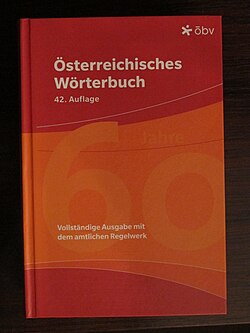
Standard German is not monolithic. In Austria, the Österreichisches Wörterbuch (Austrian Dictionary or ÖWB) serves as the official authority. Edited by linguists under the Austrian Federal Ministry of Education, Arts and Culture, it includes vocabulary and pronunciations unique to Austria and Southern Germany (particularly Bavaria).
The Case of Luxembourgish
The relationship between Standard German and its dialects is complex. For example, Luxembourgish was long considered a German dialect. However, it underwent ausbau (language development), creating its own standardized vocabulary, grammar, and spelling. Today, it is recognized as an independent language, though nearly 90% of the population remains proficient in Standard German due to its use in schools.
Linguistic Connections and Global Reach
Cognates with English
Due to their shared West Germanic roots, English and Standard High German share many cognates—words that have a common etymological origin. Examples include Hand (hand), Finger (finger), Wasser (water), and Haus (house).
German Loanwords in English
Standard German has contributed numerous specialized terms to the English language, ranging from psychological concepts to military and cultural terms. These include Zeitgeist (spirit of the times), Schadenfreude (pleasure in others' misfortune), Kindergarten (children's garden), and Doppelgänger (look-alike).

Language Summary Table
| Category | Details |
|---|---|
| ISO Codes | ISO 639-1: de | ISO 639-2: ger/deu | ISO 639-3: deu |
| Official Status | Regulated by the Council for German Orthography |
| Key Dictionaries | Duden (Germany), Österreichisches Wörterbuch (Austria) |
| Native Speakers | 76 Million (2019) |
| Script | Latin (German alphabet) |
Frequently Asked Questions
What is the difference between High German and Standard German?
In common usage, "High German" (Hochdeutsch) is often used interchangeably with "Standard German." Technically, Standard German is the codified, formal version of the language used in official contexts, whereas High German historically referred to the dialects of the central and southern highlands.
Who decides the official spelling of German?
The Council for German Orthography is the primary regulatory body. Historically, the Duden dictionary provided the prescriptive rules for spelling and grammar, and it remains the most influential reference for the language.
Is Austrian German a separate language?
No, Austrian German is a national variety of Standard High German. While it has its own official dictionary (the ÖWB) and some unique vocabulary, it is mutually intelligible with the standard used in Germany.
How did Martin Luther influence the language?
Luther's translation of the Bible in the 16th century helped standardize written German by blending various dialects into a form that was widely understood across different regions, particularly by drawing on East Central German dialects.
What is a "pluricentric" language?
A pluricentric language is one that has several interacting standard forms. Standard High German is pluricentric because it has distinct but compatible national standards in Germany, Austria, and Switzerland.