LiechtensteinVaduzPrince Hans-Adam IIAlpine geographyLiechtenstein history

Liechtenstein: A Comprehensive Overview of the Alpine Principality

Exploring the Principality of Liechtenstein: A Guide to Europe's Alpine Gem Nestled in the heart of the Alps, the Principality of Liechtenstein is a nation that defies expectations. Despi...

Exploring the Principality of Liechtenstein: A Guide to Europe's Alpine Gem

Nestled in the heart of the Alps, the Principality of Liechtenstein is a nation that defies expectations. Despite being Europe's fourth-smallest country, this tiny sovereign state boasts a sophisticated economy, a rich monarchical history, and a high standard of living. Covering just over 160 square kilometers, Liechtenstein is unique as the world's smallest country to border two nations: Switzerland and Austria.

Gutenberg Castle, Balzers
: Gutenberg Castle, Balzers

A Unique Political Landscape

Liechtenstein operates as a unitary constitutional monarchy with significant elements of direct democracy. This means that while the Prince holds a central role, the citizens have a direct say in many aspects of governance. The current reigning monarch is Hans-Adam II, who has led the principality since 1989. His son, Alois, serves as the Regent and Heir Apparent.

Vaduz Castle, overlooking the capital, is home to the Prince of Liechtenstein.
: Vaduz Castle, overlooking the capital, is home to the Prince of Liechtenstein.

The government is supported by a Prime Minister and a Deputy Prime Minister, with the Landtag serving as the legislative body. This blend of traditional monarchy and modern democratic participation creates a stable and highly functional political environment.

Johann I Joseph, Prince of Liechtenstein from 1805 to 1806 and 1814 to 1836, by Johann Baptist von Lampi the Elder. Liechtenstein Museum, Vienna
: Johann I Joseph, Prince of Liechtenstein from 1805 to 1806 and 1814 to 1836, by Johann Baptist von Lampi the Elder. Liechtenstein Museum, Vienna

Historical Foundations

The history of Liechtenstein is deeply intertwined with the shifting powers of Central Europe. The principality was formed through the union of Vaduz and Schellenberg on January 23, 1719. Over the centuries, its sovereignty evolved through various stages:

  • 1806: The Prince became a member of the Confederation of the Rhine.
  • 1815: Liechtenstein joined the German Confederation, presided over by the Emperor of Austria.
  • 1866: The principality achieved full independence following the separation from the German Confederation.
Ducal hat of Liechtenstein
: Ducal hat of Liechtenstein
Franz I, Prince of Liechtenstein from 1929 to 1938
: Franz I, Prince of Liechtenstein from 1929 to 1938
Franz Joseph II, Prince of Liechtenstein from 1938 to 1989
: Franz Joseph II, Prince of Liechtenstein from 1938 to 1989

Geography and Climate

Liechtenstein's landscape is defined by the stunning scenery of the Alps. The terrain ranges from the low-lying Ruggeller Riet at 430 meters to the towering Grauspitz, the country's highest point, reaching 2,599 meters above sea level.

Topographic map of Liechtenstein in German
: Topographic map of Liechtenstein in German

The country is bordered by the Alpine Rhine, which serves as a natural boundary with Switzerland. This proximity has led to deep integration, including a customs treaty with Switzerland established in 1923, which resulted in the removal of border controls between the two nations.

The Alpine Rhine border between Liechtenstein and Switzerland (view towards the Swiss Alps)
: The Alpine Rhine border between Liechtenstein and Switzerland (view towards the Swiss Alps)

The climate is typical of a mountainous region. Summers are mild, with July seeing mean daily maximum temperatures around 24.9°C (76.8°F), while winters are cold, with January averages seeing daily maximums of only 5.0°C (41.0°F). Snowfall is a regular feature of the winter months, contributing to the region's appeal for outdoor enthusiasts.

Panorama of Vaduz, capital of Liechtenstein
: Panorama of Vaduz, capital of Liechtenstein
Administrative divisions of Liechtenstein, showing numerous exclaves
: Administrative divisions of Liechtenstein, showing numerous exclaves

Demographics and Culture

The official language is German. While the population is predominantly Liechtensteiner (66.2%), the country is home to a diverse international community, including significant Swiss, Austrian, and German residents. Religion plays a structured role in society; Catholicism is the official state religion, and the Catholic Church enjoys the full protection of the State.

The centre of government in Vaduz
: The centre of government in Vaduz

Culture and education are highly valued. The country hosts several higher education institutions, including the University of Liechtenstein. For those interested in history and art, the Liechtenstein National Museum and the Kunstmuseum offer deep dives into the nation's heritage.

Hans-Adam II, Prince of Liechtenstein in 1974
: Hans-Adam II, Prince of Liechtenstein in 1974
Maltese consulate in Schaan
: Maltese consulate in Schaan
Liechtenstein's Embassy in Vienna
: Liechtenstein's Embassy in Vienna
Building hosting Liechtenstein's Embassy in Washington, D.C.
: Building hosting Liechtenstein's Embassy in Washington, D.C.
Representatives of the Principality of Liechtenstein and the United States of America make an agreement to share knowledge in the Field of Apprenticeship Training, 2024.
: Representatives of the Principality of Liechtenstein and the United States of America make an agreement to share knowledge in the Field of Apprenticeship Training, 2024.

Economic Strength and Infrastructure

Despite its size, Liechtenstein possesses a remarkably strong economy. It boasts a very high Human Development Index (HDI) and a significant GDP per capita. The economy is highly developed, supported by robust infrastructure including approximately 250 kilometers of paved roadways and a network of bicycle paths.

Liechtenstein Police
: Liechtenstein Police
Looking southward at Vaduz city centre
: Looking southward at Vaduz city centre

The nation is also a hub for specialized industries and international relations, maintaining embassies in key locations like Vienna and Washington, D.C. The use of the Swiss franc (CHF) as the official currency further integrates the economy with its neighbor, Switzerland.

Silver coin: 5 kronen of Liechtenstein, 1904, the front of the coin is a portrait of Johann II
: Silver coin: 5 kronen of Liechtenstein, 1904, the front of the coin is a portrait of Johann II
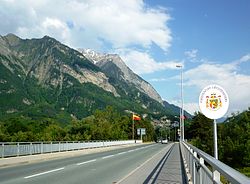
Since 1923, there has been no border control between Liechtenstein and Switzerland.
: Since 1923, there has been no border control between Liechtenstein and Switzerland.
Headquarters of Hilti Corporation in Schaan, Liechtenstein
: Headquarters of Hilti Corporation in Schaan, Liechtenstein
Vaduz, Liechtenstein
: Vaduz, Liechtenstein
St. Florin Catholic Cathedral in Vaduz
: St. Florin Catholic Cathedral in Vaduz
University of Liechtenstein
: University of Liechtenstein
Liechtenstein National Museum
: Liechtenstein National Museum
Kunstmuseum, Liechtenstein Art Museum
: Kunstmuseum, Liechtenstein Art Museum

Quick Reference Summary

Key Statistics of Liechtenstein
Category Details
Capital Vaduz
Official Language German
Currency Swiss franc (CHF)
Population (2025 est.) 41,237
Total Area 160.50 km²
GDP per capita (2024 est. PPP) $210,600
Highest Point Grauspitz (2,599 m)
Marco Büchel, the first Liechtensteiner alpine skier to compete at six Winter Olympics
: Marco Büchel, the first Liechtensteiner alpine skier to compete at six Winter Olympics
Liechtenstein Olympic Committee in Schaan
: Liechtenstein Olympic Committee in Schaan

Key Facts

  • Liechtenstein is the world's smallest country to border two other countries.
  • The official state religion is Catholicism.
  • It uses the Swiss franc as its official currency.
  • The country has no border control with Switzerland.
  • The highest point in the country is the Grauspitz.

Frequently Asked Questions

What is the official language of Liechtenstein?

The official language of Liechtenstein is German.

Who is the current leader of Liechtenstein?

The reigning monarch is Prince Hans-Adam II, with his son Alois serving as the Regent and Heir Apparent.

What is the capital city?

The capital of Liechtenstein is Vaduz.

Does Liechtenstein have its own currency?

No, Liechtenstein uses the Swiss franc (CHF) as its official currency.

How large is Liechtenstein?

Liechtenstein covers a total area of approximately 160.50 square kilometers (61.97 square miles).