Germans: History, Identity, and the Evolution of a Nation
The term Germans (German: Deutsche) refers to the native inhabitants of Germany, individuals of German descent, or native speakers of the German language. While the 1949 constitution defines a German primarily as a citizen of the Federal Republic of Germany, the concept of "Germanness" has evolved over centuries, shifting from ethnic and linguistic markers to a complex modern identity rooted in pluralism and law.
With a global population of approximately 100 million, the vast majority of Germans reside within Germany, though a significant diaspora exists worldwide. The journey of the German people is one of transition—from a collection of fragmented tribes and princedoms to a unified global power, and eventually to a modern state defined by a commitment to constitutional values.
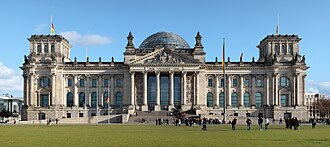
Key Facts
- Global Population: Approximately 100 million people.
- Primary Identity Marker: The German language remains the dominant criterion for national belonging.
- Historical Core: The ethnic group emerged from the separation of the Kingdom of Germany from the Frankish Empire in the 10th century.
- Legal Definition: Since 1949, German identity is legally defined by citizenship under the Basic Law.
- Diaspora: Significant populations exist in the United States, Brazil, and the former Soviet Union.
Ancient and Medieval Foundations
German ethnicity began to coalesce in medieval times among descendants of Germanic peoples living between the Rhine and Elbe rivers. These groups, including the Franks, Saxons, Frisians, Thuringii, Alemanni, and Baiuvarii, spoke related West Germanic dialects. Initially, these peoples were influenced by Rome and later dominated by the western Franks under Clovis I in the 5th century.
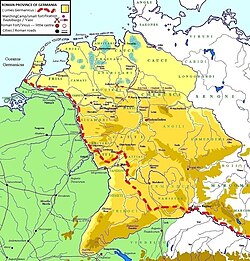
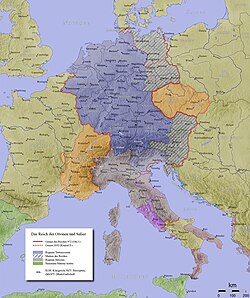
By the 9th century, Charlemagne consolidated power over these groups, establishing the Carolingian Empire and being crowned emperor in 800. This era laid the groundwork for the Holy Roman Empire, which formed the core of German political life for centuries. Medieval society was strictly feudal, dominated by a warrior nobility and the Church, while the majority of the population consisted of peasants.
The Eastward Expansion
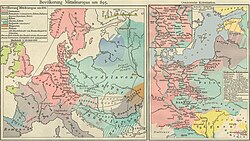
Between the 11th and 13th centuries, German speakers expanded into Slavic-speaking regions, a process known as the Ostsiedlung (German eastward settlement). This migration led to the conquest of Polabian Slavs and the settlement of merchants and craftsmen in the Kingdom of Poland. The 13th-century conquest of the Old Prussians by the Teutonic Knights eventually gave rise to the powerful state of Prussia.
The Path to Unification
The early modern period was marked by deep religious and political division. The Thirty Years' War, fueled by the conflict between Protestantism and Roman Catholicism, devastated the population and weakened the central authority of the Holy Roman Emperor. The Peace of Westphalia (1648) further decentralized the empire, allowing states like Protestant Prussia to rise in power.
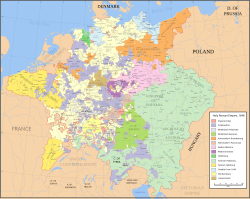
The 18th-century Enlightenment and the subsequent Napoleonic Wars catalyzed a national awakening. Intellectuals like Johann Gottfried Herder argued that German identity was rooted in a shared language. After Napoleon dissolved the Holy Roman Empire in 1806, the German Confederation was established in 1815, though it remained a loose association dominated by Austria.
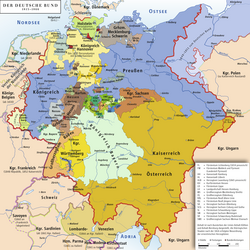
Under the leadership of Otto von Bismarck, Prussia utilized economic tools like the Zollverein (customs union) and military victories over Denmark, Austria, and France to unify the states. In 1871, the German Empire was proclaimed, finally creating a single nation-state.
The 20th Century: Crisis and Reconstruction
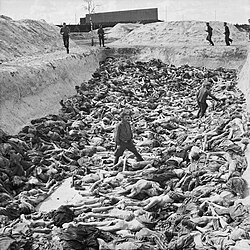
The aftermath of World War I, the Great Depression, and the "humiliation of Versailles" provided the catalyst for Adolf Hitler and the Nazi Party to seize power. The resulting Third Reich was a totalitarian regime that perpetrated the Holocaust, murdering six million Jews. World War II left Germany partitioned and its international reputation shattered.
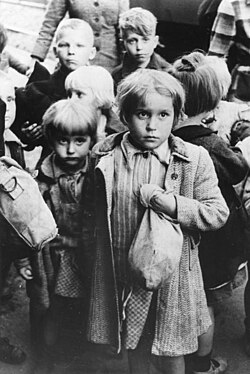
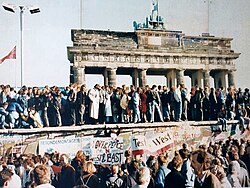
Following the war, approximately 12 million Germans were expelled from Eastern Europe. The nation was split into East and West Germany, each attempting to forge a new identity distanced from the Nazi past. Reunification in 1990 brought the country back together, though the 1990s saw a rise in xenophobic tensions.
Modern Identity and Language
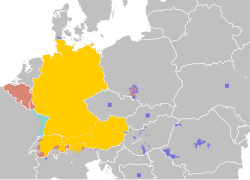
Today, German identity is a blend of Kulturnation (a nation sharing a common culture) and constitutional patriotism (commitment to the pluralism and laws of the German constitution). While biological or ethnic definitions of "Germanness" became suspect after the Holocaust, the German language remains the primary marker of identity.
Remembering the atrocities of the past is now an essential pillar of modern German culture, serving as a moral compass for the nation's democratic future.
![A Memorial to the Murdered Jews of Europe in Berlin; remembering the Holocaust is an essential part of modern German culture.[26]](/images/fb/27/fb27c0bf049f36249e6a136e51091eb00b837561f2031601c222756bc41ca14f.jpg)
| Era | Key Political Entity | Defining Characteristic |
|---|---|---|
| Medieval | Holy Roman Empire | Feudalism, Eastward expansion (Ostsiedlung) |
| 17th-18th Century | Fragmented Princedoms | Religious conflict, Enlightenment |
| 1871-1918 | German Empire | Unification under Prussian leadership |
| 1933-1945 | Third Reich | Totalitarianism, Holocaust, WWII |
| 1949-Present | Federal Republic of Germany | Constitutional patriotism, Reunification |
Frequently Asked Questions
Who is legally considered a German today?
According to the 1949 constitution, a German is defined as a person who possesses German citizenship, or those admitted as refugees or expellees of German ethnic origin (and their descendants) from territories within the boundaries of December 31, 1937.
What was the Ostsiedlung?
The Ostsiedlung was the eastward migration of German speakers into Slavic-speaking regions of Eastern Europe starting around the 11th century, leading to the establishment of German communities in areas like Poland and the eventual creation of Prussia.
How did the German language influence national identity?
In the late 18th century, intellectuals proposed that a shared language was the primary bond of the German people. This linguistic unity served as a catalyst for the nationalist movement that eventually led to the unification of the German Empire in 1871.
Where is the German diaspora most prominent?
The largest populations of German descent outside of Central Europe are found in the United States (approximately 5 million) and Brazil (approximately 3 million), with other significant communities in the former Soviet Union, Argentina, and Canada.
What is "constitutional patriotism"?
Constitutional patriotism is a modern concept of German identity that emphasizes a commitment to the democratic values, pluralism, and the legal framework of the German constitution rather than relying on ethnic or biological descent.