Solar Eclipses: The Science, Types, and Celestial Mechanics
A solar eclipse is a breathtaking celestial event that occurs when the Moon passes directly between the Earth and the Sun. This alignment obscures the Sun's light, casting a shadow over a small portion of the Earth's surface. While these events are natural phenomena, they have been interpreted throughout history as everything from supernatural omens to critical scientific proofs.
Unlike lunar eclipses, which are visible from anywhere on the night side of the planet, solar eclipses are localized. Because the Moon's shadow is relatively narrow, only people located within a specific path can experience the full effect. While a total solar eclipse occurs somewhere on Earth roughly every 18 months, any single location may only witness one every 360 to 410 years.
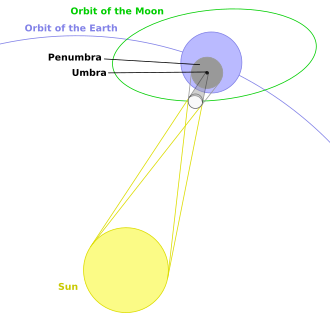
Key Facts
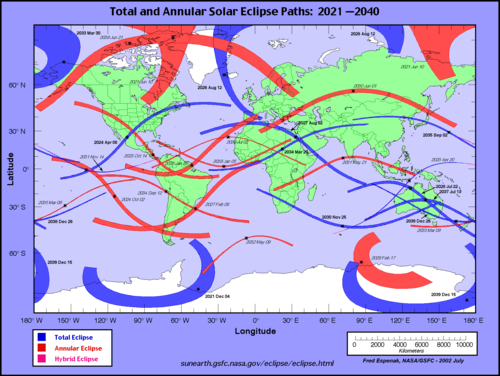
![Total solar eclipse paths: 1001–2000, showing that total solar eclipses occur almost everywhere on Earth. This image was merged from 50 separate images from NASA.[36]](/images/c5/b3/c5b30069368f3968905d6b79d86c3a52beacf838a839fb6aa917017b6bf36473.gif)
- Frequency: Between two and five solar eclipses occur every year.
- Alignment: Eclipses happen during the new moon phase when the Moon's orbital plane aligns with Earth's orbit.
- Rarity: Total eclipses are rarer than partial or annular ones due to the need for precise alignment and apparent size.
- Prediction: Modern astronomers can predict eclipses hundreds of years into the future with high accuracy.
- Visibility: A total eclipse is only visible from a narrow path of totality.
The Geometry of an Eclipse

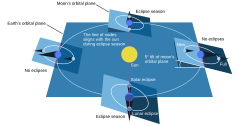
If the Moon orbited the Earth in a perfect circle on the same plane as Earth's orbit around the Sun, we would experience a solar eclipse every single month. However, the Moon's orbit is tilted by approximately 5 degrees relative to the Earth's orbital plane. This tilt means that during most new moons, the Moon's shadow passes either above or below the Earth.
Eclipses only occur during eclipse seasons, which happen approximately every six months. These are periods when the lunar nodes—the two points where the Moon's orbit crosses the Earth's orbital plane—align with the Sun.
Apparent Size and Distance
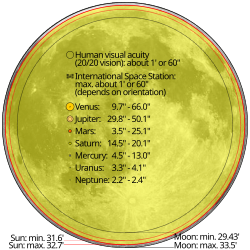
The type of eclipse observed depends heavily on the distance between the celestial bodies. Because orbits are elliptical, the Moon's distance from Earth varies between perigee (nearest) and apogee (farthest). Similarly, Earth's distance from the Sun varies between perihelion and aphelion.
If the Moon is at apogee, its apparent size (how large it looks in the sky) may be smaller than the Sun's. In this scenario, the Moon cannot fully cover the solar disk, resulting in an annular eclipse rather than a total one.
Types of Solar Eclipses
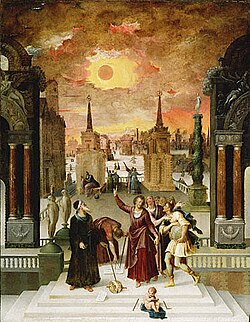
There are three primary types of solar eclipses, categorized by how much of the Sun is obscured from view.
Total Solar Eclipse
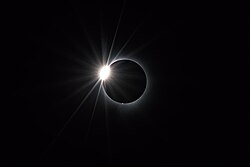
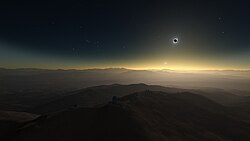
A total eclipse occurs when the Moon completely covers the disk of the Sun. This is only possible when the Moon is close enough to Earth to appear larger than or equal to the Sun in the sky. During the phase of totality, the sky darkens significantly, and the Sun's outer atmosphere, the corona, becomes visible.
Annular Solar Eclipse
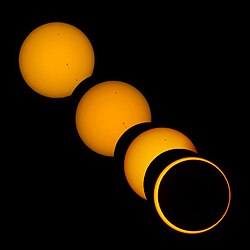
An annular eclipse happens when the Moon is too far from Earth (near apogee) to fully cover the Sun. This creates a "ring of fire" effect, where a bright ring of the Sun remains visible around the dark silhouette of the Moon.
Partial Solar Eclipse
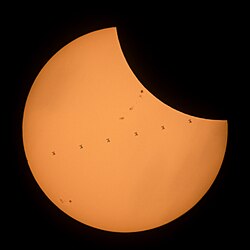
A partial eclipse occurs when the Sun, Moon, and Earth are not perfectly aligned. Only a portion of the Sun is obscured, making it look as though a "bite" has been taken out of the solar disk.
Hybrid Eclipses
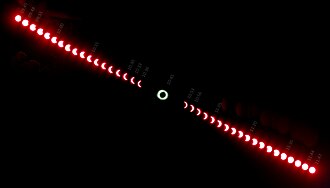
A rare hybrid eclipse shifts between an annular and a total eclipse depending on the observer's position along the path, caused by the curvature of the Earth.
Celestial Measurements Summary

The following table outlines the physical and angular dimensions that influence the occurrence and type of solar eclipses.
| Feature | Moon (Minimum/Mean) | Moon (Maximum) | Sun (Minimum) | Sun (Maximum) |
|---|---|---|---|---|
| Radius | 1,737.10 km | 1,737.10 km | 696,000 km | 696,000 km |
| Distance from Earth | 363,104 km (Perigee) | 405,696 km (Apogee) | 147,098,070 km (Perihelion) | 152,097,700 km (Aphelion) |
| Angular Diameter | 33' 30" (0.5583°) | 29' 26" (0.4905°) | 32' 42" (0.5450°) | 31' 36" (0.5267°) |
Historical and Scientific Impact
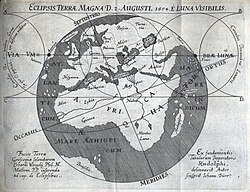
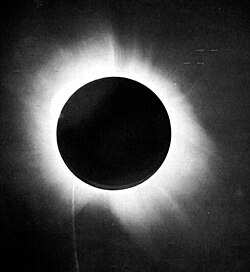
Solar eclipses have provided critical data for scientific breakthroughs. One of the most famous examples occurred during the 1919 eclipse, when observations provided the first empirical evidence for Albert Einstein's theory of general relativity by demonstrating that gravity could bend light.
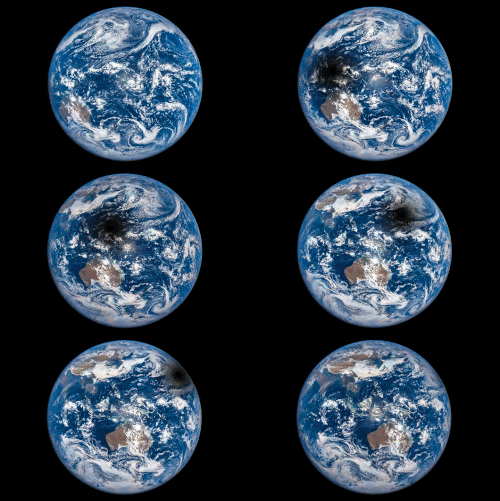
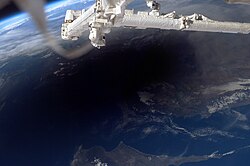
In the modern era, astronomers use artificial satellites and spacecraft to observe eclipses. These observations are not hindered by weather conditions, as seen by the crew of Gemini 12 in 1966 and observations from the Mir space station in 1999.
Frequently Asked Questions
Why don't we have a solar eclipse every month?
Because the Moon's orbit is tilted by about 5 degrees relative to Earth's orbit around the Sun, the Moon usually passes above or below the Sun from our perspective during the new moon phase.
What is the difference between a total and an annular eclipse?
In a total eclipse, the Moon completely covers the Sun. In an annular eclipse, the Moon is too far from Earth to cover the Sun entirely, leaving a visible ring of sunlight around the Moon's edges.
How often do solar eclipses occur?
There are between two and five solar eclipses every year globally. However, a total eclipse only visits any specific geographic location once every 360 to 410 years on average.
Is it safe to look at a solar eclipse?
Only the phase of totality during a total solar eclipse is safe to view with the naked eye. For partial and annular eclipses, specialized solar filters or eclipse glasses are required to prevent permanent eye damage.
What is the "path of totality"?
The path of totality is the narrow track of the Moon's darkest shadow (the umbra) as it moves across the Earth's surface. Only people within this path experience a total solar eclipse.