Sir Peter Squire: A Legacy of Leadership in the Royal Air Force
Air Chief Marshal Sir Peter Ted Squire was a distinguished senior officer of the Royal Air Force (RAF) whose career spanned nearly four decades of evolution in aerial warfare. From his early days as a fast jet pilot to his tenure as the professional head of the RAF, Squire's journey was marked by operational bravery, tactical innovation, and strategic leadership.
Born on October 7, 1945, in Felixstowe, Suffolk, Squire was the son of Wing Commander Frank Squire. His path to aviation was paved early; at sixteen, he earned a scholarship to RAF College Cranwell, entering the institution in 1963. He received his commission as a pilot officer on July 15, 1966, beginning a trajectory that would eventually lead him to the highest ranks of British military aviation.
Key Facts
- Highest Rank: Air Chief Marshal.
- Top Command: Chief of the Air Staff (2000–2003).
- Combat Milestone: First RAF pilot to drop a laser-guided bomb in combat.
- Key Conflict: Led No. 1 (F) Squadron during the Falklands War.
- Major Awards: Distinguished Flying Cross (DFC) and Air Force Cross (AFC).
Early Career and the Red Arrows
Squire's early service saw him deployed to Singapore in 1968 with No. 20 Squadron, where he flew Hunter aircraft. By 1970, he had joined the No. 4 Flying Training School in Anglesey. His skill in the cockpit led to a prestigious appointment in 1973, when he commanded the RAF's renowned aerobatic display team, the Red Arrows.
Following his time with the Red Arrows, Squire transitioned to the Harrier—a Vertical/Short Take-Off and Landing (VSTOL) jet—serving with No. 3 Squadron in West Germany starting in 1975. His exceptional service during this period earned him the Air Force Cross in 1979.
Command in the Falklands War
In 1981, Squire was appointed commanding officer of No. 1 (F) Squadron at RAF Wittering, operating the Harrier GR.3. When the Falklands War erupted in 1982, he led the squadron in one of the most challenging deployments in RAF history.
The squadron's journey was perilous; after deploying to Canada and then Ascension Island, the aircraft were transported via the merchant vessel SS Atlantic Conveyor. In a fortunate turn of events, the Harriers were transferred to the aircraft carrier HMS Hermes shortly before the Atlantic Conveyor was sunk by Exocet missiles.
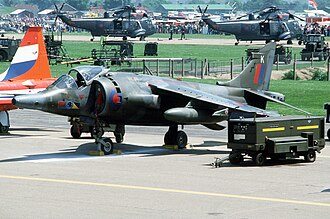
No. 1 (F) Squadron made history as the first RAF unit to operate in a combat role from a British aircraft carrier since World War II. Squire flew twenty-four sorties against Argentine positions. His courage was tested when a 7.62 mm round penetrated his cockpit, and later, when he survived an engine failure during an emergency landing at the San Carlos forward operating base on June 8, 1982.
On June 13, 1982, during the Battle of Mount Tumbledown, Squire achieved a significant tactical milestone by becoming the first RAF pilot to employ a laser-guided bomb in combat. For his leadership and bravery, he was awarded the Distinguished Flying Cross.
No. 1 (F) Squadron Losses (1982)
| Aircraft Registration | Pilot | Date | Cause of Loss |
|---|---|---|---|
| XZ972 | Flt-Lt Jeff Glover | 21 May 1982 | Blowpipe SAM |
| XZ988 | Sqn Ldr Bob Iveson | 27 May 1982 | 20mm cannon AA fire |
| XZ963 | Sqn Ldr Jerry Pook | 30 May 1982 | Small-arms fire / Fuel exhaustion |
| XZ989 | Wg Cdr Peter Squire | 8 June 1982 | Mechanical failure on landing |
Rise to Senior Command
Following the war, Squire continued to ascend through the ranks. He served as Station Commander at RAF Cottesmore (1986–1988) and Director Air Offensive at the Ministry of Defence in 1989. By the 1990s, he held several high-level positions, including Air Officer Commanding No. 1 Group and Deputy Chief of the Defence Staff (Programmes and Personnel).
In March 1999, he was promoted to Air Chief Marshal and appointed Commander-in-Chief of RAF Strike Command. His career culminated in his appointment as Chief of the Air Staff (CAS) from 2000 to 2003. In this capacity, he was the primary advisor to the British Government on air contributions to Operation Veritas in Afghanistan and Operation Telic in Iraq.
Retirement and Later Life
After retiring from the RAF on December 5, 2003, Sir Peter Squire remained dedicated to military history and public service. He served as the chairman of the board of trustees for the Imperial War Museum (2003–2011) and vice-chairman of the Commonwealth War Graves Commission (2005–2008).
He also shared his experiences through the privately issued narrative The Harrier Goes to War (2004) and an extensive interview with the Imperial War Museum's Sound Archive. Sir Peter Squire passed away from heart failure on February 19, 2018, at the age of 72, at his home in Gidleigh, Devon.
Frequently Asked Questions
What was Sir Peter Squire's most significant combat achievement?
Sir Peter Squire is noted for being the first RAF pilot to successfully drop a laser-guided bomb in combat, which occurred during the Battle of Mount Tumbledown in June 1982.
Which aircraft did Sir Peter Squire fly during the Falklands War?
He flew the Harrier GR.3, a VSTOL (Vertical/Short Take-Off and Landing) jet, while commanding No. 1 (F) Squadron.
What was the significance of No. 1 (F) Squadron's deployment in 1982?
The squadron was the first Royal Air Force unit to operate in a combat role from a British aircraft carrier since the Second World War.
What senior roles did he hold after the Falklands War?
He served as the Commander-in-Chief of RAF Strike Command and eventually reached the position of Chief of the Air Staff (CAS), the professional head of the Royal Air Force.
How did Sir Peter Squire contribute to military history after retirement?
He served as the chairman of the board of trustees for the Imperial War Museum and wrote a narrative of the combat operations of No. 1 (F) Squadron titled "The Harrier Goes to War."