Separate but Equal: The Legal Doctrine of Racial Segregation in the US
For decades, the United States operated under a legal paradox known as separate but equal. This constitutional doctrine asserted that racial segregation did not violate the Fourteenth Amendment, provided that the facilities provided to each race were equal. While nominally guaranteeing "equal protection" under the law to all citizens, the doctrine served as the legal backbone for systemic segregation across public services, education, and transportation.
The phrase originated from a Louisiana law in 1890, though that specific statute used the wording "equal but separate." This concept allowed state and local governments to mandate segregation in housing, medical care, employment, and public accommodations, effectively institutionalizing a racial caste system that was already prevalent in the former Confederacy.
Key Facts
- Legal Basis: Formalized by the Supreme Court in Plessy v. Ferguson (1896).
- Constitutional Conflict: Claimed to comply with the Fourteenth Amendment's "equal protection" clause while enforcing segregation.
- Reality: Facilities for African Americans were rarely equal and often non-existent or severely underfunded.
- Overturning: The doctrine was dismantled starting with Brown v. Board of Education (1954).
- Legislative End: The Civil Rights Act of 1964 prohibited discrimination in public accommodations.
The Rise of State-Sponsored Segregation
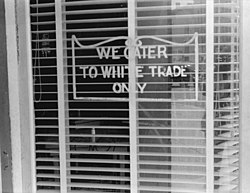
Following the American Civil War and the ratification of the Thirteenth Amendment in 1865, the Reconstruction era attempted to integrate former slaves into society. However, after the Compromise of 1877 ended Reconstruction, Southern states began implementing Jim Crow laws—statutes designed to mandate the separation of white and Black citizens.
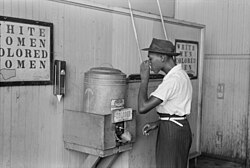
These laws varied by state but were consistently restrictive. In Texas, segregation applied to restrooms and water fountains. In Georgia, restaurants and cemeteries were segregated. In Florida and West Virginia, the state constitutions mandated separate educational systems.
The Role of the Second Morrill Act
Federal policy also implicitly supported this divide. The Morrill Act of 1890 provided funding for higher education but accepted the "separate but equal" concept in 17 states. This led to the creation of separate land-grant colleges for Black students, which are known today as public Historically Black Colleges and Universities (HBCUs).
Plessy v. Ferguson: The Legal Turning Point
The doctrine reached its peak in 1896 with the Supreme Court case Plessy v. Ferguson. The case began in 1892 when Homer Plessy, a man of mixed ancestry, boarded an all-white railroad car in Louisiana. When he refused to move to a "colored" car, he was arrested.
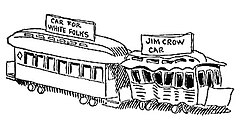
Plessy's legal team argued that the segregation violated the Thirteenth and Fourteenth Amendments. However, the Supreme Court ruled against him, formalizing the principle that separate accommodations were constitutional as long as they were equal. This decision emboldened segregationist states and supplanted the earlier "Black Codes" of the Reconstruction era.
The Myth of Equality in Practice
While the law demanded equality, the reality was a stark disparity in quality and funding. Facilities for African Americans were almost always inferior. In the 1930s, Florida provided a clear example of this inequality: while Black people made up 42% of the population, the value of white school property was $70,543,000 compared to just $4,900,000 for Black school property.
Many Black schools were housed in shacks or churches without toilets, water, or desks. In Pompano, Florida, white schools had one teacher for every 25 students, while the "Colored School" had one teacher for every 54 students. Furthermore, Black teachers were paid significantly less; in 1939–1940, the average white teacher in Florida earned $1,148, while a Black teacher earned $585.
| Metric | White Facilities | African American Facilities |
|---|---|---|
| School Property Value | $70,543,000 | $4,900,000 |
| Avg. Teacher Salary (1939-40) | $1,148 | $585 |
| Student-Teacher Ratio (Pompano) | 25:1 | 54:1 |
The Path to Legal Rejection
The dismantling of "separate but equal" began in graduate education. In Sweatt v. Painter, the Supreme Court ruled that a separate law school for Black students in Texas was not equal because it lacked the "intangible factors" of a prestigious institution, such as interaction with future lawyers. Similarly, McLaurin v. Oklahoma State Regents outlawed the practice of forcing Black graduate students to sit in hallways.
The Warren Court and Brown v. Board
The most significant shift occurred under Chief Justice Earl Warren. In the landmark 1954 case Brown v. Board of Education, the Court overturned Plessy v. Ferguson, declaring that "separate educational facilities are inherently unequal." This ruling established that segregation in public education was unconstitutional.
This victory was expanded by the Civil Rights Act of 1964, which prohibited discrimination in public accommodations, and Loving v. Virginia (1967), which invalidated anti-miscegenation laws (laws banning interracial marriage) across the United States.
Frequently Asked Questions
What was the legal basis for the "separate but equal" doctrine?
The doctrine was formalized by the U.S. Supreme Court in the 1896 case Plessy v. Ferguson, which ruled that racial segregation did not violate the Fourteenth Amendment as long as the facilities provided to each race were equal.
Were the facilities actually equal in practice?
No. In reality, facilities for African Americans were almost always inferior, underfunded, or non-existent. For example, in 1930s Florida, the value of white school property dwarfed that of Black school property by more than 14 to 1.
Which court case finally overturned the doctrine in public schools?
The doctrine was overturned in public education by the 1954 Supreme Court decision Brown v. Board of Education, which stated that separate facilities are inherently unequal.
How did the Second Morrill Act contribute to segregation?
The Morrill Act of 1890 implicitly accepted the "separate but equal" concept by allowing 17 states to establish separate land-grant colleges for Black students, leading to the creation of public HBCUs.
When did segregation in public accommodations become illegal?
While Brown v. Board addressed education in 1954, it was the Civil Rights Act of 1964 that prohibited racial discrimination in public accommodations such as hotels and transportation.