School Integration in the United States: History, Legal Battles, and Modern Challenges
School integration, also referred to as desegregation, is the systemic process of ending race-based separation within American public and private educational institutions. While racial segregation has persisted throughout much of U.S. history, the mid-20th century marked a pivotal shift as integration became a central priority of the civil rights movement. Despite significant legal victories and a period of rapid decline in segregation during the late 1960s and early 1970s, the nation continues to grapple with de facto segregation—segregation that occurs in practice through social and economic factors rather than by law.
Key Facts
- Brown v. Board of Education (1954): The landmark Supreme Court ruling that declared segregated schools unconstitutional.
- The Little Rock Nine: Nine African American students who integrated Central High School in 1957 under federal protection.
- Peak Integration: By 1988, nearly 45% of Black students attended previously all-white schools.
- Modern Trends: Segregation levels appear to have increased since 1990.
- Achievement Gap: The disparity in poverty rates between schools attended by white and Black students is the primary driver of the educational achievement gap.
Early History and Legal Foundations
Integration did not begin with the 20th-century civil rights movement. Some institutions were integrated from their inception; for example, Lowell High School in Massachusetts has accepted students of all races since 1831, with Caroline Van Vronker recorded as the first known African American student in 1843.
Following the Civil War, the Reconstruction Amendments (the 13th, 14th, and 15th) established the legal groundwork for equality by abolishing slavery and guaranteeing citizenship and voting rights. In 1868, Iowa became the first state to desegregate schools via court order in Clark v. Board of School Directors, making the Iowa Supreme Court the only 19th-century court to rule school segregation unconstitutional.
The Fight for Desegregation in the Jim Crow South
The mid-1950s saw a surge in legal and social battles to dismantle the "separate but equal" doctrine. On May 17, 1954, the U.S. Supreme Court issued its historic decision in Brown v. Board of Education of Topeka. Invoking the 14th Amendment, the Court ruled that segregated schools were inherently unconstitutional and ordered desegregation nationwide.
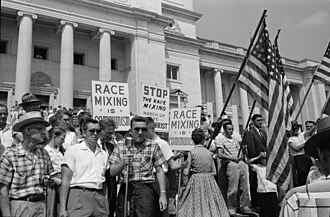
Implementation, however, was met with fierce resistance. In Little Rock, Arkansas, the school board approved a gradual integration plan for the 1957 school year. When the "Little Rock Nine" attempted to enroll at Central High School on September 4, 1957, Governor Orval Faubus used the Arkansas National Guard to block their entry.
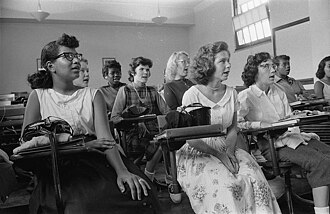
The crisis ended only after President Dwight D. Eisenhower issued Executive Order 10730, federalizing the National Guard and deploying 1,000 U.S. Army soldiers to protect the students and ensure their entry into the school.
Integration in Higher Education
Universities also became battlegrounds for equality. In 1955, Thelma Joyce White sued the University of Texas system after being rejected from Texas Western College. Her legal challenge, combined with Supreme Court guidance, led the university regents to allow Black students to enroll on July 8, 1955.
The Rise and Retreat of Integration
The 1960s and 70s saw a wave of legislative support, including the Civil Rights Act of 1964 and the Voting Rights Act of 1965. In 1971, the Supreme Court case Swann v. Charlotte-Mecklenburg Board of Education approved the use of busing—transporting students to schools outside their immediate neighborhoods—to achieve racial balance.
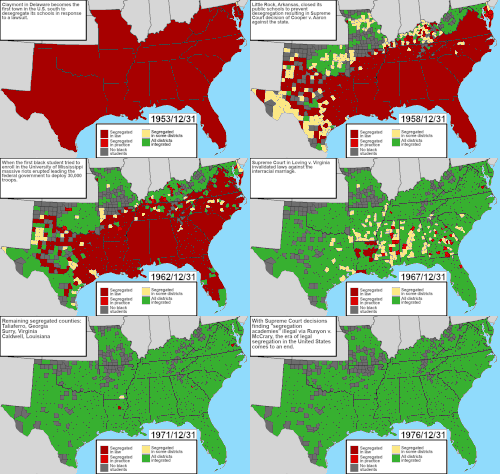
Despite these gains, white populations found ways to avoid integrated classrooms. This occurred primarily through two methods:
- White Flight: The movement of white families from urban centers to suburban areas to attend wealthier, whiter schools. In Houston's Independent School District, white enrollment dropped from 49.9% in 1970 to 25.1% by 1980.
- Segregation Academies: The creation of private schools to bypass public desegregation. In Mississippi, private school attendance jumped from 23,181 students in 1968 to 63,242 in 1970 following the Green v. County School Board ruling.
Modern Implications and the Achievement Gap
While legal segregation ended, the educational landscape remains divided. Current data suggests that the gap in reading test scores between white and African American students is closely tied to socioeconomic disparities.
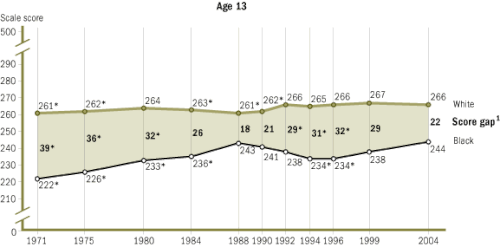
Research indicates that the single most significant factor in the achievement gap is the disparity in average poverty rates between the schools white students attend and those Black students attend.
| Grade | States |
|---|---|
| A / A- | Missouri, West Virginia |
| B / B+ / B- | Kentucky, Oklahoma, Maryland |
| C / C+ / C- | Arkansas, Texas, Delaware, Tennessee, North Carolina |
| D / D+ | Virginia, Florida |
| F | Alabama, Georgia, Louisiana, Mississippi, South Carolina |
Frequently Asked Questions
What was the significance of Brown v. Board of Education?
It was a landmark 1954 Supreme Court decision that declared state laws establishing separate public schools for black and white students to be unconstitutional, effectively outlawing legal segregation in U.S. schools.
Who were the Little Rock Nine?
They were a group of nine African American students who enrolled in Little Rock Central High School in 1957. Their integration of the school required the intervention of President Eisenhower and the U.S. Army to protect them from violent opposition.
What is "white flight"?
White flight refers to the phenomenon where white families moved from racially mixed urban areas to predominantly white suburban areas to avoid the integration of public schools.
What are segregation academies?
These were private schools established specifically to provide an alternative for white students who wished to avoid attending newly desegregated public schools.
Why is there still an educational achievement gap today?
The most critical factor is the disparity in poverty rates between the schools attended by white students and those attended by Black students, which contributes to unequal access to resources and support.