Orval Faubus: The Controversial Legacy of Arkansas' 36th Governor
Orval Eugene Faubus remains one of the most polarizing figures in 20th-century American politics. Serving as the 36th governor of Arkansas from 1955 to 1967, Faubus navigated a complex path from a liberal New Deal Democrat to a symbol of resistance against racial integration. While he achieved remarkable electoral success, winning six consecutive terms, his legacy is forever tied to the 1957 Little Rock Crisis.
Key Facts
- Tenure: Served as Governor of Arkansas for 12 years (1955–1967).
- The Little Rock Crisis: Used the Arkansas National Guard to block black students from entering Central High School in 1957.
- Military Service: Served as a Major in the U.S. Army during World War II, participating in the liberation of France and the Battle of the Bulge.
- Political Shift: Transitioned from a liberal Democrat to a segregationist stance to maintain political support.
- Electoral Record: Won six two-year terms before choosing not to run for a seventh in 1966.
Early Life and Political Ascent
Born on January 7, 1910, Orval Faubus began his political journey with a loss in a 1936 race for the Arkansas House of Representatives. However, his decision not to contest the results earned him favor within the Democratic Party, leading to two terms as the circuit clerk and recorder of Madison County.
Faubus's worldview was shaped by his military service from 1942 to 1946. As a Major in the 320th Infantry Regiment, he saw combat during Operation Overlord and the Siegfried Line campaign. Upon returning to Arkansas, he aligned himself with progressive reform Governor Sid McMath, serving as the director of the state's highway commission.
During his 1954 gubernatorial campaign, Faubus faced scrutiny for his time at Commonwealth College, an institution founded by leftist activists with ties to the Communist Party USA. Despite these attacks, Faubus positioned himself as a liberal Democrat and a pragmatic supporter of the New Deal, defeating Mayor Pratt Remmel with 63% of the vote.
The Little Rock Crisis and Federal Conflict
Although elected as a moderate, Faubus became increasingly sensitive to pressure from the political right. In 1956, when challenger Jim Johnson accused him of betraying the "Southern way of life," Faubus pivoted, pledging that no school district would be forced to integrate while he was governor.
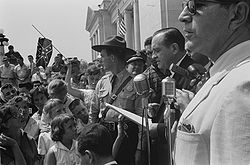
This stance culminated in the 1957 Little Rock Crisis. In defiance of the U.S. Supreme Court's ruling in Brown v. Board of Education—which declared segregated schools unconstitutional—Faubus ordered the Arkansas National Guard to prevent African American students from attending Little Rock Central High School.
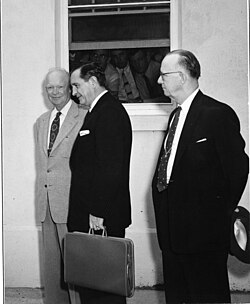
The crisis sparked a direct confrontation with President Dwight D. Eisenhower. After a series of tense communications and a meeting in Newport, Rhode Island, Faubus initially claimed he would comply with the Constitution. However, when mobs continued to disrupt integration efforts, Eisenhower took decisive action.
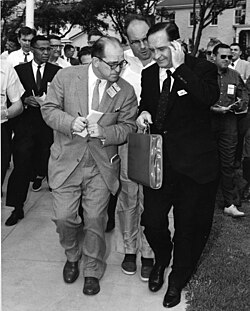
In October 1957, Eisenhower federalized the Arkansas National Guard, removing them from Faubus's control, and deployed the 101st Airborne Division to protect the students. In a retaliatory move, Faubus closed Little Rock high schools for the 1958–1959 school year, a period known as "The Lost Year."
Political Survival and Later Years
Despite the international condemnation of his actions during the crisis, Faubus remained popular within Arkansas for years. He utilized a populist image and shifted his approach to be more cordial with subsequent presidents, including John F. Kennedy and Lyndon B. Johnson.
By 1962, Faubus began to distance himself from the White Citizens' Councils, casting himself once again as a moderate. His ability to maintain a broad coalition was evident in 1964, when he won 81% of the black vote despite his history of supporting segregation.
After leaving office in 1967, Faubus experienced a varied retirement. He briefly served as the general manager of Dogpatch USA, a theme park in the Ozark Mountains. He attempted several political comebacks in 1970, 1974, and 1986, but was defeated in the Democratic primaries by future leaders including Bill Clinton.
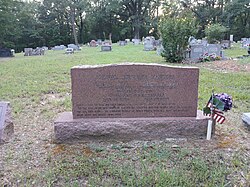
In a surprising late-life shift, Faubus supported civil rights activist Jesse Jackson for President in 1984 and 1988. He died of prostate cancer on December 14, 1994.
Summary of Gubernatorial Terms
| Election Year | Opponent | Faubus Vote % | Opponent Vote % |
|---|---|---|---|
| 1954 | Pratt Remmel | 62% | 38% |
| 1956 | Roy Mitchell | 81% | 19% |
| 1958 | George W. Johnson | 82% | 18% |
| 1960 | Henry Britt | 69% | 31% |
| 1962 | Willis Ricketts | 73% | 27% |
| 1964 | Winthrop Rockefeller | 57% | 43% |
Frequently Asked Questions
Why did Orval Faubus oppose the integration of Little Rock Central High School?
Faubus argued that the Brown v. Board of Education decision was illegal because it allowed federal courts to usurp state control over schools. Politically, he was also reacting to pressure from segregationist elements within the Democratic Party to maintain the "Southern way of life."
What was "The Lost Year" in Little Rock?
"The Lost Year" refers to the 1958–1959 school year, during which Governor Faubus shut down the public high schools in Little Rock in retaliation for the federal government's enforcement of integration.
How did President Eisenhower respond to Faubus's actions?
President Eisenhower first attempted diplomacy through meetings and telegrams. When that failed and mobs threatened students, he federalized the Arkansas National Guard and deployed the 101st Airborne Division to ensure the federal court order was upheld.
Did Faubus ever change his views on civil rights?
While his early governorship was marked by segregation, Faubus later cast himself as a moderate and, in his later years, supported civil rights activist Jesse Jackson's presidential campaigns in 1984 and 1988.
How many terms did Orval Faubus serve as governor?
Orval Faubus was elected to six two-year terms, serving as the Governor of Arkansas for a total of 12 years from 1955 to 1967.