Seleucus I Nicator: Founder of the Seleucid Empire
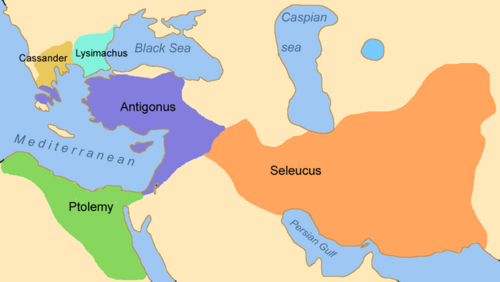
Following the death of Alexander the Great in 323 BC, his vast conquests were thrown into chaos. Among the competing generals, known as the Diadochi (successors), rose Seleucus I Nicator. A skilled commander and opportunistic politician, Seleucus transformed a precarious position as a regional governor into one of the largest empires of the Hellenistic world, stretching from the Mediterranean to the borders of India.
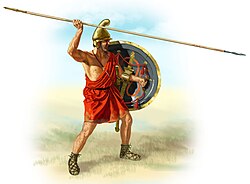
Seleucus began his career as a commander of the Hypaspistai, an elite Macedonian infantry unit. His journey from a loyal officer to a sovereign king is a study in resilience, as he faced exile, betrayal, and the daunting task of carving a kingdom out of the remnants of the Persian Empire.
Key Facts
- Reign: 305 – September 281 BC.
- Empire: Founded the Seleucid Empire, ruling the eastern territories of Alexander's former conquests.
- Major Cities: Founded Antioch, Edessa, and Seleucia on the Tigris.
- Key Victory: Played a decisive role at the Battle of Ipsus (301 BC) using war elephants.
- Diplomacy: Established a peace treaty and marriage alliance with Chandragupta Maurya of India.
- Death: Assassinated in 281 BC by Ptolemy Ceraunus in Thrace.
Early Career and the Wars of the Successors
Born around 358 BC in Europus, Macedon, Seleucus was the son of Antiochus and Laodice. After Alexander's death, he initially served under the regent Perdiccas. However, the volatile nature of the Diadochi wars led Seleucus to conspire in the assassination of Perdiccas in either 321 or 320 BC.
At the Partition of Triparadisus in 321 BC, Seleucus was appointed Satrap (a provincial governor) of Babylon. This appointment was short-lived; the powerful general Antigonus forced Seleucus to flee his post, leading to a period of exile. He eventually found refuge in Egypt under Ptolemy I Soter.
The Return to Babylon
While in Egypt, Seleucus served as an admiral for Ptolemy, operating in the Aegean Sea and Cyprus. In 312 BC, following the Battle of Gaza, Seleucus saw an opportunity to reclaim his former territory. With a small force of approximately 3,000 soldiers provided by Ptolemy and recruited along the way, he swiftly recaptured Babylon.
This return is historically significant as it marks the official beginning of the Seleucid era and the foundation of the Seleucid Empire.
Expansion and the Mauryan Conflict
Once established in Babylon, Seleucus expanded his reach across the Persian and Median lands. His ambitions eventually led him to the easternmost satrapies in Gandhara and northwest India. This brought him into conflict with Chandragupta Maurya, the founder of the Maurya Empire.
The resulting Seleucid–Mauryan War (305–303 BC) ended in a treaty that favored the Mauryas. Seleucus ceded the eastern satrapies in exchange for a marriage alliance—marrying a daughter to Chandragupta—and a massive military gift of 500 war elephants. These elephants would later prove indispensable in the struggle for dominance in Asia.
The Path to Hegemony
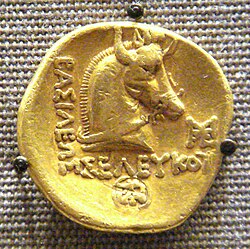
![Portrait of Seleucus I or possibly a Greco-Bactrian ruler, with royal diadem. Temple of the Oxus, Takht-i Sangin, 3rd–2nd century BC, Tajikistan.[63]](/images/7c/01/7c01136c7099375674c3fed464ce3692f45156a08655008996d0d302687b4079.jpg)
The Battle of Ipsus in 301 BC was a turning point. Seleucus' war elephants helped crush the forces of Antigonus, leaving the Seleucid dynasty as the dominant power among the remaining successors. Seleucus continued to consolidate power, eventually defeating Lysimachus at the Battle of Corupedium in 281 BC, which added much of Asia Minor to his domains.
To solidify his rule, Seleucus founded several strategic cities. Most notable was Seleucia on the Tigris (c. 305 BC), which became his capital and eventually eclipsed Babylon in importance. He also founded Antioch in 300 BC.
Death and Legacy
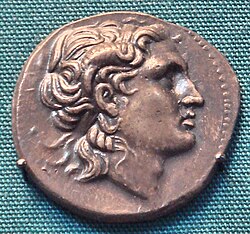
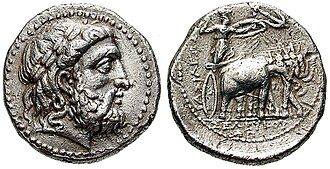
![Tetradrachm of Seleucus I, minted at Susa.[75] Obv: Portrait of male figure (probably Seleucus, but possibly Alexander or Dionysus),[75] wearing a leopard-skin helmet, with a bull's ear and horns. Rev: Nike, holding a wreath over a trophy, probably referring to the Battle of Ipsus. Legend "King Seleucus".[76]](/images/a0/32/a032ae2d718519c1405e3195807d07d95092be5884ed671760393d25477ff18a.jpg)
Despite his successes, Seleucus' final ambition was to control Thrace and Macedon. In 281 BC, while in Thrace, he was assassinated by Ptolemy Ceraunus. This event halted Seleucid expansion into Europe and left the empire to his son, Antiochus I Soter.
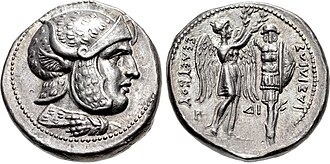
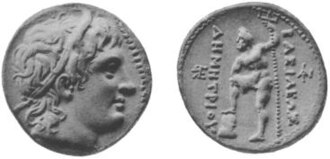
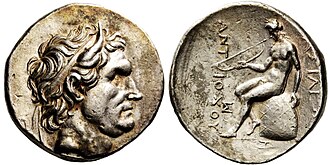
Seleucus left behind a legacy of Hellenization, blending Greek culture with the administrative structures of the Near East. His coinage and architecture reflected this synthesis, often blending images of Greek gods with local symbols of power.
![The Hellenistic world view after Seleucus: ancient world map of Eratosthenes (276–194 BC), incorporating information from the campaigns of Alexander and his successors[72]](/images/de/4e/de4e853e4cdbd86d0c113cf725e8313ec9a2d0718aa69681acc0af49e917f0d3.jpg)
| Category | Details |
|---|---|
| Birth | c. 358 BC, Europus, Macedon |
| Death | September 281 BC, Lysimachia, Thrace |
| Key Titles | Basileus, Satrap of Babylon |
| Major Cities Founded | Antioch, Seleucia on the Tigris, Edessa |
| Successor | Antiochus I Soter |
Frequently Asked Questions
How did Seleucus I Nicator acquire war elephants?
Seleucus acquired 500 war elephants through a peace treaty with Chandragupta Maurya following the Seleucid–Mauryan War (305–303 BC). These elephants were critical to his victory at the Battle of Ipsus.
What was the significance of Seleucia on the Tigris?
Seleucia on the Tigris served as the capital of the Seleucid Empire. It was a major economic and political hub that eventually led to the depopulation of the ancient city of Babylon.
Who were the Diadochi?
The Diadochi were the rival generals and officers of Alexander the Great who fought a series of wars to divide and rule his empire after his death in 323 BC.
How did Seleucus I die?
Seleucus was assassinated in 281 BC by Ptolemy Ceraunus in Thrace, just as he was attempting to extend his control over Macedon and European territories.
What was the Seleucid era?
The Seleucid era begins with the year 312 BC, marking the date when Seleucus I successfully returned to and recaptured Babylon.