Classical Antiquity: The Rise and Fall of the Greco-Roman World
Classical antiquity refers to the long period of cultural history centered on the Mediterranean basin, spanning roughly from 800 BC to 300 AD. This era laid the foundational stones of Western civilization, characterized by the emergence of the Greek city-states and the subsequent rise of the Roman superpower. From the early alphabetic inscriptions of the Archaic period to the sprawling administration of the Roman Empire, this epoch defined the trajectory of art, philosophy, and governance for millennia.
Key Facts
- Timeline: Spans from approximately 800 BC to 300 AD, extending into Late Antiquity.
- Core Regions: Centered in the Mediterranean, including Greece, Italy, North Africa, and Asia Minor.
- Major Powers: The Greek city-states, the Macedonian Empire under Alexander the Great, and the Roman Republic and Empire.
- Cultural Legacy: Produced the foundations of Western philosophy, democratic governance, and neoclassical architecture.
- End Point: Marked by various milestones, including the fall of the Western Roman Empire in 476 AD and the Muslim conquests of the 7th century.
The Archaic Period (c. 8th to 6th Centuries BC)
The dawn of classical antiquity followed the Late Bronze Age collapse, marked by a gradual resurgence of historical records. The first Greek alphabetic inscriptions appeared in the first half of the 8th century BC. This era is often associated with the legendary poet Homer and the traditional establishment of the Ancient Olympic Games in 776 BC.
While Greece was developing, the Phoenicians expanded from Canaan to dominate Mediterranean trade. By 814 BC, they founded Carthage, which eventually established strongholds in Italy, Sicily, and Sardinia. Simultaneously, the Neo-Assyrian Empire expanded its influence, as evidenced by the victory of King Sargon II over Cyprus in 709 BC.
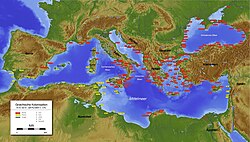
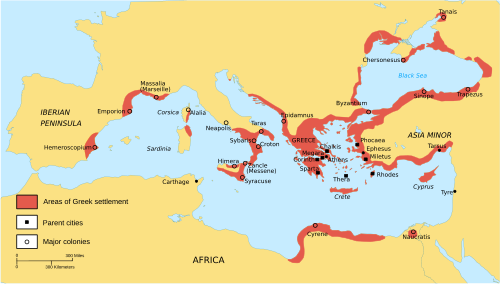
Early Greek and Italian Expansion
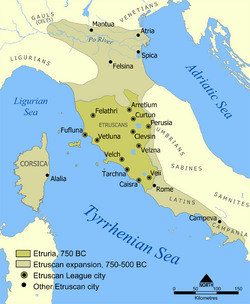
During this time, Greek colonies began to spread across the Mediterranean, while in Italy, the Etruscan civilization flourished in the north and the early Roman kingdom began to take shape.
Classical Greece (5th to 4th Centuries BC)
The classical period of Greece is generally defined from the end of the Athenian tyranny in 510 BC to the death of Alexander the Great in 323 BC. This era saw the rise of Athens as a cultural and political powerhouse, particularly after the Greco-Persian Wars (499–449 BC). The resulting dominance of Athens within the Delian League—a defensive alliance of Greek city-states—eventually sparked conflict with Sparta and the Peloponnesian League.
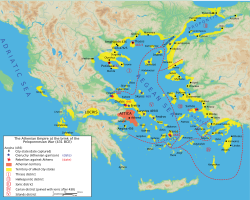
The Peloponnesian War (431–404 BC) ended in a Spartan victory, leading to a period of Spartan hegemony. However, this dominance was short-lived; by 371 BC, Thebes established its own hegemony following a victory at the Battle of Leuctra. This cycle of power shifts continued until the rise of Macedon.
Under Philip II, Macedon expanded its territory, but it was his son, Alexander the Great, who fundamentally altered the ancient world. Alexander extended Macedonian power across the central Greek city-states and the Persian Empire, reaching as far as Egypt and the borders of India. His death in 323 BC marked the end of the classical Greek period and the beginning of the Hellenistic period, as his empire was divided among his generals, the Diadochi.

The Rise of the Roman Republic and Empire
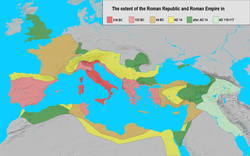
The Roman Republic began around 509 BC after the overthrow of the monarchy. For over 450 years, Rome grew from a regional power in Latium to the dominant force in Italy through conflicts such as the Samnite, Latin, and Pyrrhic Wars. Victory in the Punic Wars and Macedonian Wars elevated Rome to a super-regional power by the 2nd century BC.
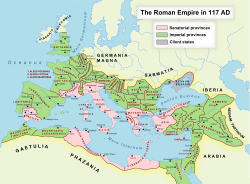
This rapid expansion brought economic instability and social unrest, leading to the First Triumvirate and the eventual transition to the Roman Empire in the 1st century BC. At its peak under Emperor Trajan in AD 117, the empire controlled the entire Mediterranean, parts of Germania, Britannia, Dacia, and Mesopotamia.
Late Antiquity and the Transition to the Middle Ages
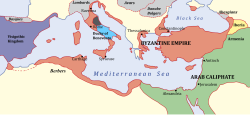
The decline of the classical world is a subject of historical debate. Key symbolic dates include the deposition of the last Western Roman Emperor in 476 AD and the closing of the Platonic Academy in Athens in 529 AD. However, the Pirenne Thesis suggests that the true end of antiquity occurred between 634 and 718 AD, when Muslim conquests of Syria, Egypt, and North Africa severed the economic and cultural links that had united the Mediterranean.
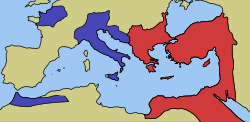
While the West fragmented, the Eastern Roman Empire (Byzantine Empire) persisted. Constantinople remained the largest city in Europe and a bastion of classical scholarship, preserving Greek and Roman texts, laws, and technologies. Even after the fall of Constantinople to the Ottomans in 1453, refugees carried this preserved knowledge to the West, fueling the Renaissance.
Summary of Classical Eras
| Period | Approximate Dates | Key Characteristics | Defining Power |
|---|---|---|---|
| Archaic Period | 8th – 6th c. BC | Rise of Greek alphabet, early colonization | Greek City-States / Phoenicians |
| Classical Period | 5th – 4th c. BC | Golden age of Athens, Persian Wars | Athens / Sparta / Macedon |
| Hellenistic Period | 323 – 146 BC | Spread of Greek culture across Asia | Diadochi / Early Rome |
| Roman Republic | 509 – 1st c. BC | Unification of Italy, Punic Wars | Roman Senate |
| Roman Empire | 1st c. BC – 5th c. AD | Pax Romana, maximum territorial extent | Roman Emperors |
| Late Antiquity | 4th – 6th c. AD | Division of Empire, rise of Christianity | Byzantine Empire |
Frequently Asked Questions
When exactly did classical antiquity end?
There is no single agreed-upon date. Common markers include the fall of the Western Roman Empire in 476 AD, the closing of the Platonic Academy in 529 AD, or the Muslim conquests of the 7th century which broke Mediterranean unity.
What was the significance of the Delian League?
The Delian League was an alliance of Greek city-states led by Athens. While it initially served to protect Greece from Persia, it eventually became a tool for Athenian dominance, which triggered the Peloponnesian War with Sparta.
How did the Roman Republic become an Empire?
The transition was a gradual process caused by rapid territorial expansion, which led to economic instability and civil wars. This culminated in the 1st century BC with the rise of figures like Julius Caesar and Octavian.
What is the relationship between the Roman and Byzantine Empires?
The Byzantine Empire was the continuation of the Roman Empire in the East. Its capital, Constantinople, preserved Roman administration and classical culture long after the Western Roman Empire had collapsed.
How did classical antiquity influence the Renaissance?
Fragments of classical culture survived in the Byzantine Empire and other regions. When Constantinople fell in 1453, scholars fled to the West with ancient texts, sparking a revival of classical learning, art, and philosophy known as the Renaissance.