Second Schleswig War: The Conflict That Reshaped Denmark and Germany
The Second Schleswig War, fought between February 1 and October 30, 1864, was a pivotal conflict that fundamentally altered the map of Northern Europe. Centered on the control of the duchies of Schleswig, Holstein, and Lauenburg, the war pitted the Kingdom of Denmark against the combined forces of Prussia and Austria. This struggle was not merely a territorial dispute but a critical step in the broader process of German unification.
The roots of the conflict lay in complex succession disputes and nationalistic tensions. While the Danish King also served as the duke of these territories, the German populations within them sought greater independence or integration into a larger German state. The tension reached a breaking point with the introduction of the November Constitution of 1863, which attempted to tie Schleswig more closely to Denmark, violating previous international agreements.
Key Facts
- Duration: February 1 – October 30, 1864.
- Belligerents: Denmark vs. Prussia and Austria.
- Outcome: Decisive Austro-Prussian victory.
- Territorial Loss: Denmark ceded Schleswig, Holstein, and Lauenburg.
- Demographic Impact: Denmark's population decreased by approximately 38.5%.
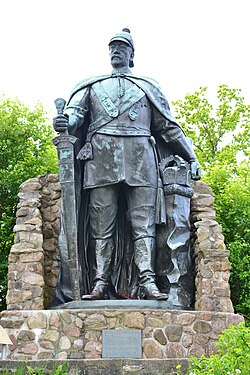
- Key Figure: Otto von Bismarck, the Prussian minister-president who orchestrated the diplomatic and military strategy.
The Road to War: Constitutional Crisis and Diplomacy
The Duchies and the London Protocol
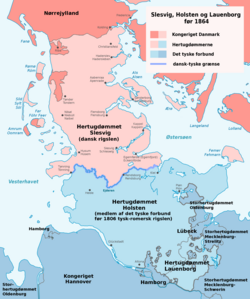
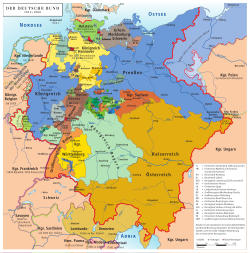
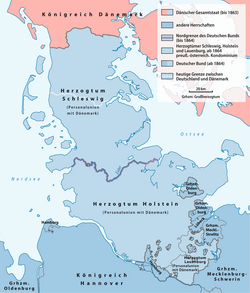
The conflict revolved around three duchies: Holstein (ethnically German and part of the German Confederation), Lauenburg, and Schleswig (a Danish fief with a mixed population of Danes, Low Germans, and North Frisians). Following the First Schleswig War (1848–1851), the London Protocol of 1852 established that Schleswig should be treated similarly to Holstein in its relations with the Danish crown.
The November Constitution
The crisis escalated upon the death of King Frederick VII in 1863. His successor, King Christian IX, signed the November Constitution on November 18, 1863. This document established a common parliament and law of succession for Denmark and Schleswig, effectively bypassing Holstein. Prussia and the German Confederation viewed this as a clear breach of the London Protocol, providing Otto von Bismarck with the casus belli (justification for war) he required.
The International Landscape
Unlike the First Schleswig War, where Russian intervention supported Denmark, the geopolitical climate had shifted. Following the Crimean War, Russia became a revisionist power, less interested in maintaining the European status quo. Simultaneously, tensions between Britain and France—particularly over French intervention in Mexico—made a coordinated European effort to support Denmark unlikely.
Military Campaigns and Major Battles
The Outbreak of Hostilities
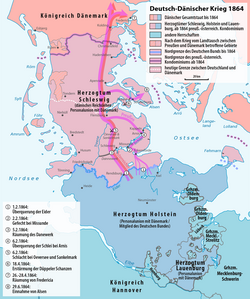
War began in earnest in February 1864. The Danish army, consisting of roughly 38,000 men, attempted to defend the Dannevirke, a system of ancient fortifications. However, they were outnumbered by the combined Prussian and Austrian forces, led by Field Marshal Friedrich Graf von Wrangel.
Key Engagements
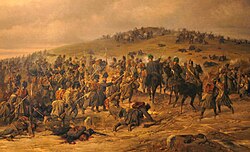
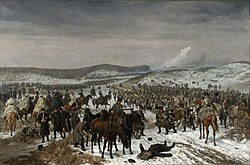
- Battle of Königshügel: Fought on February 3, 1864, in a severe snowstorm at −10 °C, where Austrian forces pushed the Danes back toward the Dannevirke.
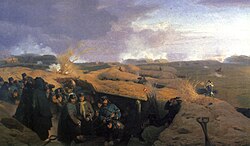
- Battle of Dybbøl: On April 18, 1864, after a massive artillery bombardment of 65,000 shells, 10,000 Prussian soldiers stormed the fort. Despite brave counterattacks by the Danish 8th Brigade, the fort fell, resulting in 1,700 Danish casualties.
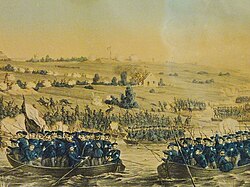
- Battle of Als: A significant engagement occurring on June 29, 1864.
The Treaty of Vienna and Aftermath
The war concluded with the Treaty of Vienna on October 30, 1864. The terms were severe for Denmark, which was forced to cede Schleswig, Holstein, and Lauenburg to the victors. While Denmark retained the town of Ribe and a few parishes, the overall impact was devastating: the monarchy's land area decreased by 40%, and its population dropped from 2.6 million to 1.6 million.
Long-term Consequences
For Prussia, the victory demonstrated the efficiency of its reorganized military, a fact that would become evident during the subsequent Austro-Prussian War. For Denmark, the defeat is remembered as a national trauma, often referred to simply as "1864," which catalyzed the formation of the modern Danish nation-state.
![The Infirmary Flag (Ambulanceflaget), adopted in 1850 and replaced in 1870 by the Red Cross[39]](/images/d3/fb/d3fb1e55ddebb9e41730c77a899fa84c49636ff040d6b2e2d5522685cb984461.webp)
| Category | Denmark | Prussia & Austria |
|---|---|---|
| Initial Strength | ~38,000 soldiers | ~61,000 soldiers |
| Key Leaders | Christian IX, Christian Julius de Meza | Otto von Bismarck, Friedrich Graf von Wrangel |
| Casualties (Dead) | 2,933 | 1,275 |
| Territorial Result | Lost Schleswig, Holstein, Lauenburg | Acquired the Duchies |
Frequently Asked Questions
What caused the Second Schleswig War?
The war was triggered by the November Constitution of 1863, which attempted to integrate the Duchy of Schleswig more closely with Denmark. This was viewed by Prussia and the German Confederation as a violation of the 1852 London Protocol.
Who were the primary leaders of the conflict?
The Prussian side was led politically by Minister-President Otto von Bismarck and militarily by Field Marshal Friedrich Graf von Wrangel. Denmark was led by King Christian IX and General Christian Julius de Meza.
What was the significance of the Battle of Dybbøl?
The Battle of Dybbøl was a major Prussian victory on April 18, 1864, following a massive artillery barrage. It remains a significant military memorial day in Denmark, symbolizing the bravery of the defenders despite the eventual defeat.
How did the war affect Denmark's size and population?
Denmark suffered massive losses, with its land area decreasing by 40% and its population falling from 2.6 million to 1.6 million after ceding the three duchies.
What was the role of the London Protocol?
The London Protocol of 1852 was an international agreement intended to maintain the integrity of the Danish state while ensuring that Schleswig was not incorporated into Denmark proper, treating it instead similarly to Holstein.