Sebastian Cabot: The Venetian Explorer of Three Crowns
Sebastian Cabot (c. 1474 – c. December 1557) was a distinguished Venetian explorer whose career spanned the service of three major powers: the Kingdom of England, the Crown of Aragon, and the Holy Roman Emperor. Born into a family of navigators, Cabot spent his life charting the unknown reaches of the Atlantic and Pacific, contributing significantly to the early European understanding of North America and the search for a route to Asia.
Key Facts
- Origins: Born in the Venetian Republic, though he later claimed to be born in Bristol, England.
- Family Legacy: Son of the famous explorer John Cabot (Giovanni Caboto).
- Major Expeditions: Led early attempts to find the Northwest Passage (a navigable route from the Atlantic to the Pacific) and served as captain general of a Spanish fleet in 1525.
- Political Service: Worked for King Henry VII and Henry VIII of England, King Ferdinand II of Aragon, and Emperor Charles V.
- Later Career: Served as governor of the Muscovy Company, advising on English ventures to the north.
Early Life and Conflicting Origins
The exact details of Sebastian Cabot's birth remain a subject of historical debate. While he was likely born in the Venetian Republic around 1474, Cabot provided varying accounts of his origins depending on his audience. To the Englishman Richard Eden, he claimed to have been born in Bristol; however, he told the Venetian ambassador Gasparo Contarini that he was Venetian but educated in England.
His father, John Cabot, a Venetian citizen, moved the family to England by 1495. Sebastian, along with his brothers Ludovico and Santo, was named in the royal letters patent issued by King Henry VII in March 1496, which authorized their father's expeditions to the "New Found Land." This early exposure to maritime exploration laid the foundation for Sebastian's own career.
The 1494 Controversy and Early Voyages
In a 1544 map of North America, Sebastian Cabot included a Latin text claiming he had discovered North America with his father in 1494—three years before the widely accepted 1497 voyage. Historians suggest this may have been a strategic inaccuracy. Since Cabot was funded by Charles V (the Holy Roman Emperor and King of Spain) at the time, he may have sought to suggest that the first discovery was funded by Castilians or Portuguese rather than the English or French.
Cabot's independent career began in 1504 when he led an expedition from Bristol using two ships, the Jesus and the Gabriel. This voyage returned with salted fish, indicating a commercial fishing purpose. For these services, King Henry VII granted him an annuity of £10 in 1505.
The Quest for the Northwest Passage
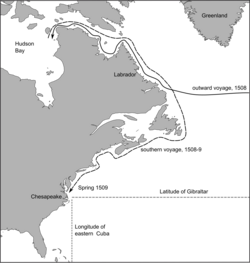
Between 1508 and 1509, Cabot led one of the first attempts to locate the Northwest Passage. He reached high latitudes, encountering icebergs and reporting an open passage of water, though he was eventually forced to turn back. Some accounts suggest he may have reached the entrance of Hudson Bay.
According to records from 1516, Cabot sailed south along the North American coast, potentially reaching as far as the Chesapeake Bay. Upon his return to England, he found that King Henry VII had died; his successor, Henry VIII, showed significantly less interest in New World exploration, which eventually prompted Cabot to seek opportunities elsewhere.
Service to the Spanish Crown
Seeking better financial support, Cabot moved to Spain in 1512 to serve King Ferdinand II of Aragon. After a brief return to England following Ferdinand's death in 1516, he returned to Spanish service in 1525 as captain general of a fleet. His mission was twofold: to use astronomical observations to determine the precise demarcation line of the Treaty of Tordesillas (the agreement dividing newly discovered lands between Spain and Portugal) and to transport settlers to the Molucca Islands.
This expedition, which departed in 1526 with four ships and 250 men, was fraught with difficulty. After facing mutinies and attacks by Indigenous populations at Espíritu Santo, Cabot eventually returned to Seville in 1530 with only one ship and 24 men.
Later Years and the Muscovy Company
In his final years, Cabot remained an influential advisor on navigation. In 1553, he became the governor of the Muscovy Company, where he worked alongside the scholar John Dee to prepare expeditions led by Sir Hugh Willoughby and Richard Chancellor. He also served as life-governor of the Company of Merchant Adventurers.
Cabot's life ended around December 1557, as evidenced by the cessation of his quarterly pension payments.
Personal Life and Partnerships
Cabot was married twice. His first wife, Joanna, died around 1514. In 1523, he married Catalina de Medrano, a widow with significant business expertise. Catalina played a vital role in Cabot's life, managing family finances and handling business affairs through a power of attorney—a rare arrangement for women of that era. Her social connections and financial management helped Cabot navigate the complex social and economic challenges of Seville.
| Period | Primary Sponsor | Key Objective/Achievement |
|---|---|---|
| 1504–1509 | Kingdom of England | Commercial fishing and search for the Northwest Passage. |
| 1512–1516 | Crown of Aragon | Early Spanish exploration. |
| 1525–1530 | Spanish Empire | Treaty of Tordesillas demarcation and Molucca Islands settlement. |
| 1553–1557 | Muscovy Company | Advising on Northern routes to Asia. |
Frequently Asked Questions
Where was Sebastian Cabot actually born?
While Cabot claimed to have been born in Bristol, England, most historians and contemporary accounts, including those of Peter Martyr d'Anghiera, indicate he was born in the Venetian Republic around 1474.
What was the purpose of the Treaty of Tordesillas mission?
Cabot was commissioned to use astronomical observations to determine the exact line that divided Spanish and Portuguese territories in the New World, as agreed upon in the Treaty of Tordesillas.
Did Sebastian Cabot find the Northwest Passage?
No, although he reached high latitudes and encountered icebergs, he was unable to find a viable open passage to Asia and was forced to turn back.
What role did Catalina de Medrano play in his life?
Catalina de Medrano was Cabot's second wife and a skilled business manager. She handled his financial affairs and used her own dowry and connections to support him during his time in Spain.
What was the Muscovy Company?
The Muscovy Company was an English trading company focused on establishing trade routes to Russia and searching for a Northeast Passage to Asia, which Cabot helped govern in his later years.