Saxe-Weimar-Eisenach: The History and Legacy of a Thuringian Grand Duchy
The Grand Duchy of Saxe-Weimar-Eisenach was a prominent German state that played a significant role in the cultural and political landscape of Central Europe from 1809 to 1918. Formed through the merger of the Ernestine duchies of Saxe-Weimar and Saxe-Eisenach, it evolved from a small territorial union into a sophisticated constitutional monarchy known for its patronage of the arts and scientific innovation.
The state's trajectory was marked by strategic alliances and a commitment to liberal governance, eventually becoming a constituent state of the German Empire. Though it officially changed its name to the Grand Duchy of Saxony in 1903, it remained widely known by its original name to distinguish it from the neighboring Kingdom of Saxony.
Key Facts
- Formation: Created in 1809 via the merger of Saxe-Weimar and Saxe-Eisenach.
- Status: Raised to a Grand Duchy in 1815 by the Congress of Vienna.
- Capital: Weimar.
- Dynasty: Ruled by the Saxe-Weimar-Eisenach branch of the House of Wettin.
- Political Milestone: Introduced the first liberal constitution in Germany on May 5, 1816.
- End of Monarchy: The monarchy ended during the German Revolution of 1918–19.
Political Evolution and Governance
The roots of the state lie in a personal union established in 1741. By 1809, this union became a formal merger. The state's status shifted frequently due to the volatile nature of European politics, moving from the Confederation of the Rhine to the German Confederation, and finally into the German Empire in 1871.
Governance transitioned from an absolute monarchy (1809–1816) to a constitutional monarchy. The 1816 constitution was a landmark in German history, reflecting the cosmopolitan and liberal views of Grand Duke Charles Augustus. The legislative body, the Landtag, eventually grew to 33 members, with a voting system that included general elections and specific seats for wealthy landowners, known as "thousand thaler men."
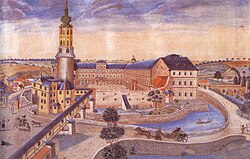
Geography and Administration
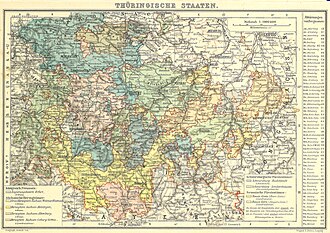
The Grand Duchy was characterized by a fragmented geography, consisting of three main districts (Kreise) and several exclaves. The landscape varied from the flat Thuringian Basin in the north to the rugged Thuringian Forest and the Rhön mountains in the south.
Administrative Districts (1895)
The state was divided into three primary administrative zones:
- District Weimar: The largest area, encompassing the capital and the city of Ilmenau.
- District Eisenach: A hilly region featuring the town of Eisenach and the Werra valley.
- District Neustadt: A hilly region with altitudes between 200 and 400 meters.
Major Waterways and Elevations
The territory was drained by several key rivers, including the Saale, Werra, Unstrut, and White Elster. The highest point in the grand duchy was the Kickelhahn, reaching 861 meters above sea level.
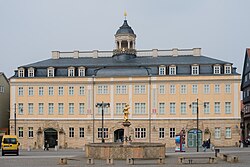
Economic Development and Industry
While agriculture was the dominant economic force until 1900—with 56% of the land used for farming—the late 19th century saw rapid industrialization. This shift led to massive population growth in urban centers like Jena and Eisenach.
Scientific and Industrial Innovation
The region became a global hub for optics and precision engineering. In 1846, Carl Zeiss founded his optical company in Jena, which later became a world leader. This was complemented by the glassworks of the Schott factories and the subsequent establishment of the Carl-Zeiss-Stiftung by Ernst Abbe in 1889.
Other Key Industries
- Textiles: Concentrated in Apolda (hosiery) and Neustadt an der Orla.
- Metalworking: Centered in Ruhla.
- Automotive: The state's first car plant was established in Eisenach in 1895.
Culture, Education, and Religion
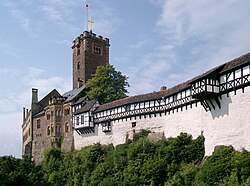
Saxe-Weimar-Eisenach was a beacon of intellectualism. The University of Jena served as a primary center for higher learning, while Weimar hosted various art and music schools. The state's commitment to the arts was championed by Grand Duke Charles Alexander, who rebuilt the Wartburg Castle as a national monument in the romantic historicism style.
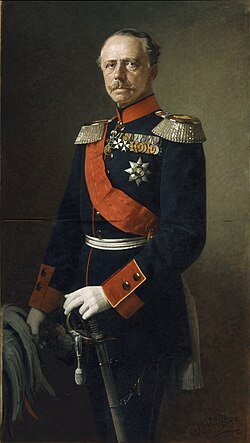
Religiously, the state was overwhelmingly Lutheran. In 1895, approximately 95.9% of the population identified as Evangelical, with small minorities of Catholics (3.6%) and Jewish citizens (0.4%).
Summary of State Profile
| Category | Details |
|---|---|
| Capital | Weimar |
| Government | Constitutional Monarchy (after 1816) |
| Currency | Saxon thaler → Vereinsthaler → Gold mark |
| Major Cities (1910) | Jena, Eisenach, Weimar, Apolda |
| Primary Industries | Optics, Glass, Textiles, Agriculture |
| Successor State | Free State of Saxe-Weimar-Eisenach (1918), then Thuringia (1920) |
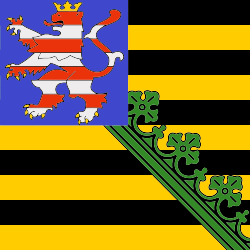
Heraldry and Symbols
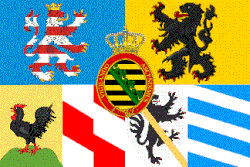
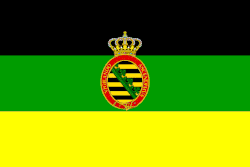
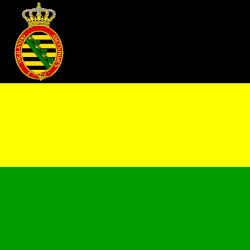
The Grand Duchy maintained distinct standards that evolved over the decades, reflecting its changing status and the reigns of different Grand Dukes.
Frequently Asked Questions
How was the Grand Duchy of Saxe-Weimar-Eisenach formed?
It was created in 1809 through the formal merger of the duchies of Saxe-Weimar and Saxe-Eisenach, which had already been ruled by the same branch of the House of Wettin in a personal union since 1741.
What was the significance of the 1816 Constitution?
The constitution granted on May 5, 1816, by Grand Duke Charles Augustus was the first liberal constitution in Germany, marking a shift toward constitutional monarchy.
Which world-famous companies originated in this state?
The state was the birthplace of the Carl Zeiss precision engineering and optical company and the Schott glass factories, both based in Jena.
What happened to the state after the 1918 Revolution?
Following the abdication of Grand Duke William Ernest on November 9, 1918, the monarchy ended. The state became the Free State of Saxe-Weimar-Eisenach before merging into the new State of Thuringia in 1920.
Who were the primary rulers of the Grand Duchy?
The state was ruled by the House of Wettin, with notable Grand Dukes including Charles Augustus, Charles Frederick, Charles Alexander, and finally William Ernest.