Saturn V: The Super Heavy-Lift Rocket That Took Humanity to the Moon
The Saturn V stands as one of the most significant engineering achievements in human history. Developed by NASA under the Apollo program, this retired American super heavy-lift launch vehicle was specifically designed for the human exploration of the Moon. As a human-rated, three-stage, liquid-fueled giant, it provided the raw power necessary to break Earth's gravitational hold and propel astronauts into the deep void of space.
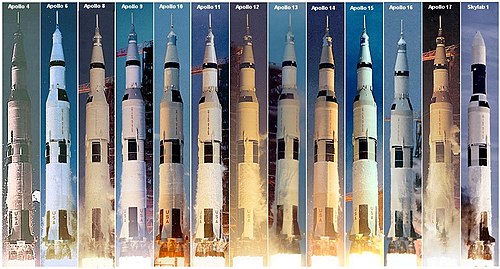
Between 1967 and 1973, thirteen Saturn V vehicles were launched from the Kennedy Space Center's Launch Complex 39. Of these, nine missions successfully carried 24 astronauts toward the Moon, spanning from Apollo 8 to Apollo 17. The rocket's final mission was the launch of Skylab, the first American space station, which was uniquely converted from the rocket's own third stage.
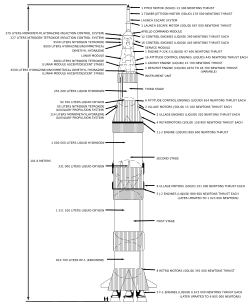
Key Facts
- Height: 111 meters (363 feet).
- Payload Capacity: Up to 140,000 kg (310,000 lb) to Low Earth Orbit (LEO).
- Success Rate: 12 successful launches out of 13 (one partial failure during Apollo 6).
- Thrust: 34.5 meganewtons at launch.
- Total Project Cost: US$ 6.4 billion (approximately $34.5 billion in 2024).
- Legacy: First launch vehicle to carry humans beyond LEO.
Design and Development
The Saturn rocket family derived its name from the planet Saturn, following the lineage of the earlier Jupiter vehicles. Between 1960 and 1962, the Marshall Space Flight Center (MSFC) developed a series of rockets to facilitate Earth orbit and lunar missions. While NASA initially considered an Earth orbit rendezvous (EOR) method, the requirements grew, leading to the design of the massive Saturn V.
The development process involved several specialized contractors: Boeing manufactured the S-IC first stage, North American produced the S-II second stage, and Douglas built the S-IVB third stage. The instrument unit, the rocket's "brain," was constructed at the MSFC in Huntsville, Alabama, with electronic components installed by IBM.
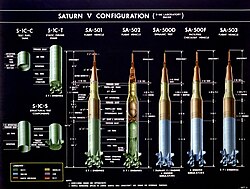
Testing and Integration
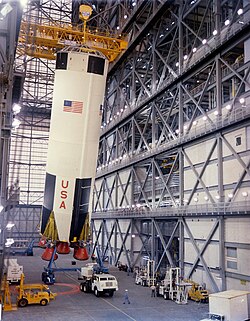
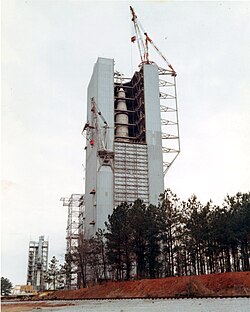
Before flight, NASA utilized the SA-500D for dynamic testing—a process used to analyze the structural vibrations and stresses the rocket would face during ascent. The S-IVB-D third stage arrived first in January 1965 to support testing for the Saturn IB rocket, followed by the instrument unit. The S-IC-D first stage arrived via the NASA barge Poseidon in October 1965.
Technical Specifications
The Saturn V was a marvel of staged combustion, utilizing different propellants and engines to maximize efficiency as the vehicle ascended through the atmosphere and into the vacuum of space.
| Stage | Height | Engines | Propellant | Burn Time |
|---|---|---|---|---|
| S-IC (1st) | 42 m | 5 × F-1 | LOX / RP-1 | 150 seconds |
| S-II (2nd) | 24.87 m | 5 × J-2 | LOX / LH2 | 395 seconds |
| S-IVB (3rd) | 17.86 m | 1 × J-2 | LOX / LH2 | 165 + 312 seconds |
The S-IC First Stage
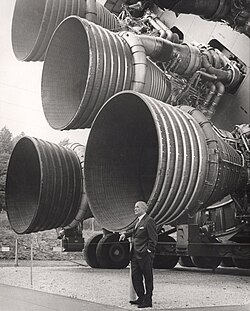
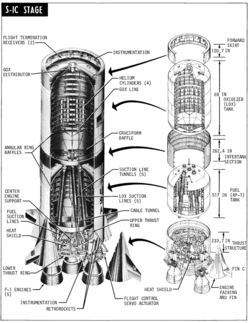
The S-IC was the powerhouse of the vehicle, designed to lift the massive weight of the rocket off the pad. It used five F-1 engines burning a combination of liquid oxygen (LOX) and RP-1 (refined kerosene), generating a maximum sea-level thrust of 33,000 kN.
The S-II Second Stage
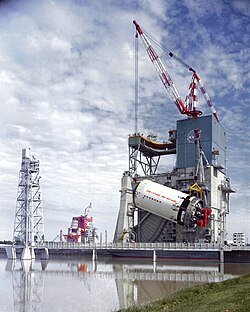
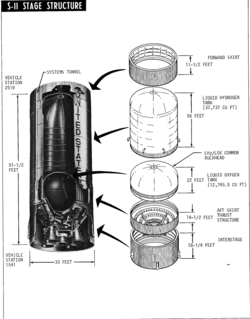
Once the first stage was exhausted, the S-II took over. It utilized five J-2 engines powered by liquid oxygen and liquid hydrogen (LH2), which provided a higher specific impulse—a measure of propellant efficiency—in the vacuum of space.
The S-IVB Third Stage and Instrument Unit
The S-IVB stage was unique because its single J-2 engine was designed for two separate burns. The first burn placed the spacecraft into a parking orbit approximately 190 km above Earth. After orbiting the Earth one and a half times, the engine restarted for trans-lunar injection (TLI), the maneuver that pushed the crew toward the Moon.
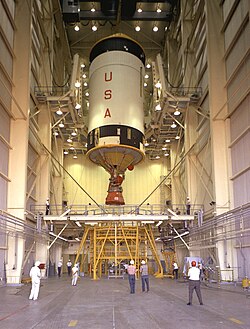
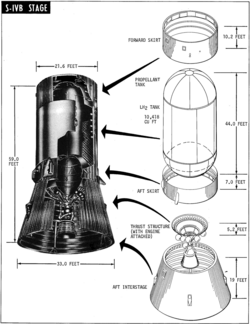
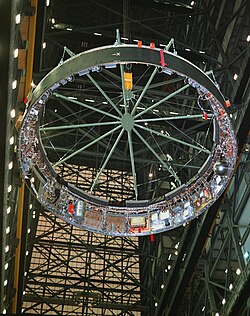
The Instrument Unit (IU) sat atop the S-IVB, acting as the guidance and control center for the entire vehicle during its ascent.
Mission Profile and Flight History
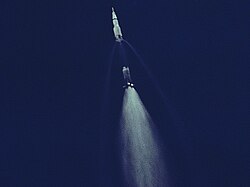
A typical Saturn V launch began with the thunderous ignition of the S-IC, creating massive condensation clouds as it pushed through the dense lower atmosphere. After the S-IC separated, the S-II accelerated the craft further before the S-IVB completed the journey to orbit.
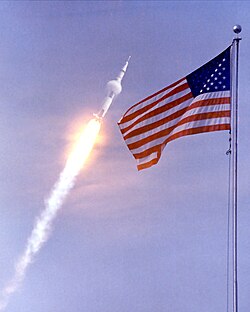
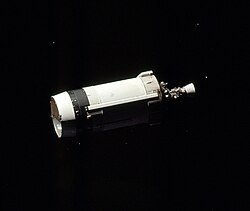
Following the TLI burn, the S-IVB stage remained attached to the spacecraft until the crew performed a transposition and docking maneuver with the Lunar Module.
The launch history of the Saturn V is nearly flawless. From the first flight of Apollo 4 on November 9, 1967, to the final Skylab launch on May 14, 1973, the vehicle maintained a stellar record, with only Apollo 6 being classified as a partial failure.
Preservation and Legacy
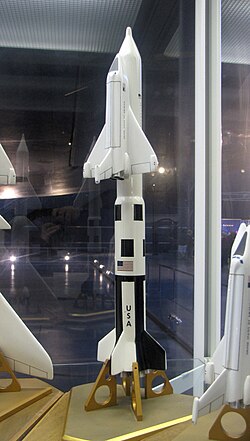
While the Saturn V is retired, several examples are preserved for the public. The SA-500D dynamic test vehicle is displayed at the U.S. Space & Rocket Center in Huntsville. The Johnson Space Center houses a display consisting of stages from SA-514, SA-515, and SA-513, making it the only display composed entirely of flight-intended stages.
Frequently Asked Questions
How many Saturn V rockets were launched?
A total of 13 Saturn V vehicles were launched between 1967 and 1973.
What was the payload capacity of the Saturn V?
The Saturn V could deliver 140,000 kg (310,000 lb) to low Earth orbit (LEO) and 43,500 kg (95,900 lb) to a trans-lunar injection trajectory.
What fuels did the Saturn V use?
The first stage (S-IC) used liquid oxygen (LOX) and RP-1. The second (S-II) and third (S-IVB) stages used liquid oxygen (LOX) and liquid hydrogen (LH2).
Which mission was the only partial failure?
Apollo 6 is the only Saturn V launch recorded as a partial failure.
What was the purpose of the S-IVB's second burn?
The second burn of the S-IVB stage was used for trans-lunar injection (TLI), which provided the necessary velocity to send the Apollo spacecraft from Earth orbit toward the Moon.