Sanjak: The Administrative Divisions of the Ottoman Empire
The sanjak (or sancak) served as a fundamental administrative unit of the Ottoman Empire. Derived from the Ottoman Turkish word for "flag" or "banner," the term reflects the empire's nomadic roots, where banners were used to organize groups across the Eurasian Steppe. Over centuries, the sanjak evolved from a military organization into a sophisticated territorial division that helped the Ottomans manage a vast and diverse empire.
Initially, sanjaks were the primary first-level divisions of the state. However, as the empire expanded, larger provinces known as eyalets were established, shifting sanjaks to a second-level administrative role. This structure persisted even after the 19th-century Tanzimat reforms replaced eyalets with vilayets.
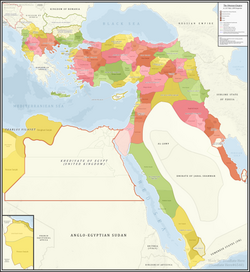
Key Facts
- Etymology: The word sancak means "flag" or "banner," originating from the Proto-Turkic word for "lance" or "spear."
- Hierarchy: Sanjaks were typically subdivisions of larger provinces (eyalets or vilayets) and were further divided into districts called kazas.
- Leadership: They were traditionally governed by a sanjakbey (bey), though later reforms introduced roles like the mutasarrif.
- Evolution: The system transitioned from military-based fiefs (timars) to standardized administrative units by the 1840s.
- Legacy: The term survives in the name of the Sandžak region in Serbia and Montenegro and the Arabic term liwa.
The Evolution of Sanjak Administration
Early Formation and Structure
The first sanjaks are believed to have been created around 1340 by Orhan, including regions such as Koca-eli and Karasi-eli. In the early empire, the pattern of sanjaks often followed existing lordships, principalities, or territories acquired by marcher lords. Some sanjaks even retained the names of the dynasties that ruled them prior to the Ottoman conquest.
By the 16th century, the system became more rationalized. A typical sanjak was centered around a major town or settlement and generally supported a population of approximately 100,000 people. Under the timar system, these regions were characterized by fiefs held by sipahis (cavalrymen), who provided military service in exchange for land revenue.
Variations in Governance
Not all sanjaks were governed identically. While most were under non-hereditary appointees, some regions maintained degrees of autonomy:
- Ottoman Districts: Standard districts under direct imperial control.
- Kurdish Lordship Districts: Regions where governorship was hereditary, passing from father to son, though revenues were still registered.
- Sovereign Sanjaks: Rare districts treated as private property by their lords, remaining outside the formal provincial government.
Tanzimat Reforms and Modernization
During the 19th-century Tanzimat reforms, the Ottoman administration sought greater standardization. In the 1840s, boundaries were redrawn to create units with comparable wealth and population, each headed by a muhassil. Later, sanjaks governed by a mutasarrif were specifically referred to as mutasarrifliks.
Administrative Hierarchy and Local Government
The governance of a sanjak mirrored that of a vilayet but on a smaller scale. The mutasarrif was appointed by imperial decree and generally reported to the vali (provincial governor), though independent sanjaks communicated directly with the Ministry of the Interior.
The Kaza and Nahiye
Each sanjak was subdivided into kazas, which encompassed a major city and its hinterland. Originally, these were overseen by a kadi (Islamic judge), making the administrative area identical to the judge's jurisdiction, known as a kadiluk. Following the 1864 reforms, administrative duties shifted from the kadi to a kaymakam. Kazas were further divided into subdistricts (nahiye) and individual villages.
| Level | Entity | Primary Official | Notes |
|---|---|---|---|
| 1st Level | Eyalet / Vilayet | Vali | Largest provincial unit |
| 2nd Level | Sanjak / Liva | Sanjakbey / Mutasarrif | The primary administrative division |
| 3rd Level | Kaza | Kadi / Kaymakam | City and surrounding hinterland |
| 4th Level | Nahiye | Appointed Official | Subdistrict level |
Post-Empire Legacy
The sanjak system influenced the borders of several modern states. After World War I, the Occupied Enemy Territory Administration (OETA) used sanjaks as the basis for its divisions in the Middle East. For example, OETA South was composed of the sanjaks of Jerusalem, Nablus, and Acre.
In 1939, the Sanjak of Alexandretta was ceded by the French Mandate for Syria and Lebanon to Turkey, eventually becoming the Hatay Province. In the Arab world, the term liwa (the Arabic calque of sanjak) continued to be used by successor states before being replaced by terms like mintaqah. Additionally, the geocultural region of Sandžak in Serbia and Montenegro takes its name from the former Sanjak of Novi Pazar.
Frequently Asked Questions
What does the word "Sanjak" actually mean?
The word sanjak means "flag" or "banner" in Ottoman Turkish. It originates from the Proto-Turkic word for "lance" or "spear," referring to the streamers attached to the weapons of Turkish riders.
Who was in charge of a sanjak?
Traditionally, a sanjak was led by a sanjakbey. Following the Tanzimat reforms, leadership roles evolved to include mutasarrifs (in a mutasarriflik) or muhassils.
How did a sanjak differ from a kaza?
A sanjak was a larger second-level administrative division, while a kaza was a smaller district within a sanjak, typically centered around a city and its surrounding rural area.
Were all sanjaks governed the same way?
No. While most were under non-hereditary imperial appointees, some were hereditary (such as certain Kurdish districts) and a few were "sovereign sanjaks" treated as private property by their lords.
What happened to the sanjaks after the Ottoman Empire fell?
In Turkey, they were reorganized into provinces (il) during the 1920s. In other regions, they served as the basis for post-WWI military administrations (OETA) or evolved into the liwa divisions in Arab states.