Istanbul: A Journey Through the Crossroads of Continents
Spanning two continents and thousands of years of history, Istanbul is a city of unparalleled depth. As a major metropolitan municipality and province in Turkey, it serves as a bridge between Europe and Asia, shaped by the legacies of the Byzantine and Ottoman Empires. From the ancient structures of the historical peninsula to the modern financial hubs of Levent, Istanbul is a living museum of human civilization.
Whether you are exploring the UNESCO World Heritage-listed historic areas or navigating its bustling modern districts, Istanbul offers a unique blend of cultural heritage, economic power, and vibrant urban life.

Key Facts

- Population: Approximately 15.75 million (as of December 2025).
- Geography: Located in the Marmara region, spanning both Europe and Asia.
- Status: A UNESCO World Heritage Site (Historic Areas of Istanbul).
- Economy: A massive economic engine with a nominal GDP of approximately US$ 396.3 billion (2024).
- Governance: Managed by a Mayor-council government.
Historical Foundations and Landmarks

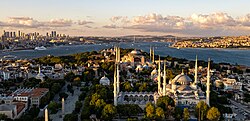
The history of Istanbul is etched into its architecture. The city's identity was significantly shaped during the Byzantine era and the subsequent Ottoman Empire. One of the most iconic landmarks is the Hagia Sophia, built by Justinian in the 6th century.

Nearby, the Hagia Irene stands as a rare survivor; originally built by Constantine the Great in the 4th century and rebuilt by Justinian I after the Nika riots in 532, it is one of the few Byzantine-era churches that was never converted into a mosque. During the Ottoman period, it served as the principal armoury for Topkapı Palace.

The Topkapı Palace, built by Sultan Mehmed II between 1459 and 1465, remains a testament to Ottoman imperial grandeur. The city's religious landscape is equally diverse, featuring the Blue Mosque with its famous courtyard and the Süleymaniye Mosque, designed by the illustrious architect Mimar Sinan for Suleiman the Magnificent between 1550 and 1557.


![Built by Suleiman the Magnificent, the Süleymaniye Mosque (1550–1557) was designed by his chief architect Mimar Sinan, the most illustrious of all Ottoman architects[239]](/images/56/60/5660332511c7042737dd016bc3b2fdbfadb83f4982d8de62babe337adadb43a6.jpg)
Ancient Engineering and Infrastructure
Istanbul's ability to sustain a massive population has long relied on ingenious engineering. The 6th-century Basilica Cistern, built by Justinian the Great, is a prime example of ancient water management.

The city's transportation history is also remarkable. The Tünel, inaugurated on January 17, 1875, is the second-oldest underground urban railway in the world, following London's Underground. Originally powered by steam and lit by gas lamps, it remains a functional piece of history.
![The Tünel was inaugurated on January 17, 1875, making it the second-oldest underground urban railway in the world after the London Underground which opened on January 10, 1863.[376] It was originally powered by two 150 HP steam-power plants.[376] Wagons were lit up with gas lamps due to the lack of electric power in that period.[376]](/images/a4/71/a471b7c948cb40941627a994e5ca27ebaa1bc6987b485ad679965ca0ee1b40b4.jpg)
For long-distance travel, the Sirkeci Terminal served as the eastern terminus of the legendary Orient Express from Paris. While the original terminal opened in 1873, the current building was constructed between 1888 and 1890.
![Originally opened in 1873 with a smaller terminal building as the main terminus at the Ottoman Chemins de fer Orientaux, which connected Istanbul with Vienna, the current Sirkeci Terminal building was constructed between 1888 and 1890, and became the eastern terminus of the Orient Express from Paris.[392]](/images/95/78/95781b1a9394e18c8b1997c9933c68a5455ab73d394f13af92f35ee87e23de12.jpg)
Modern Istanbul: Economy and Urban Life
![A view of Bankalar Caddesi (Banks Street) in the late 1920s. Completed in 1892, the Ottoman Bank headquarters is seen at left. In 1995 the Istanbul Stock Exchange moved to İstinye, while numerous Turkish banks have moved to Levent and Maslak[94]](/images/10/d2/10d210f208d597cb20180c9c8e83e1366eb56d09cb9c5edd0f8b4bd57a417e82.jpg)
Today, Istanbul is a global financial powerhouse. The city's economic landscape is divided between major districts on both sides of the Bosporus. On the European side, Levent, Maslak, and Şişli serve as primary financial hubs, while the Istanbul Financial Center in the Finanskent quarter near Ataşehir acts as the main financial district on the Asian side.


The city's demographics reflect its status as a global melting pot. As of recent data, the population is predominantly Turkish (78%), with significant Kurdish (17%), Zaza (1%), and Arab (1%) communities. The city's high Human Development Index (HDI) of 0.888 places it among the highest in the region.

Culture, Leisure, and Shopping
Istanbul offers endless opportunities for leisure. Shopping enthusiasts can visit Bağdat Avenue on the Asian side or Abdi İpekçi Street in Nişantaşı. For a more historic atmosphere, İstiklal Avenue in Beyoğlu is a central artery of culture and commerce.


The arts are well-represented through institutions like the Istanbul Modern Art Museum, designed by Renzo Piano, and the Atatürk Cultural Center, which serves as the main opera house on the European side. The city also boasts significant sporting venues, including the Atatürk Olympic Stadium and Rams Park.


Geography and Climate

The geography of Istanbul is defined by the Bosporus, the strait that separates Europe from Asia. This waterway, along with the Golden Horn, dictates much of the city's climate and lifestyle. The Black Sea helps temper the local weather, providing a maritime influence.

The climate is characterized by warm summers and cool winters. July and August are the warmest months, with mean daily maximums around 28°C (82.4°F), while January is the coolest, with mean daily maximums of 8.8°C (47.8°F). Precipitation is distributed throughout the year, with the highest averages occurring in December.

| Month | Mean Daily Max (°C) | Mean Daily Min (°C) | Avg. Precipitation (mm) |
|---|---|---|---|
| January | 8.8 | 3.6 | 96.1 |
| April | 16.1 | 8.1 | 45.1 |
| July | 28.0 | 20.3 | 36.3 |
| October | 19.9 | 13.6 | 98.3 |
| December | 10.7 | 9.2 | 124.8 |
Frequently Asked Questions

![A view of the fourth Galata Bridge (1912–1992) in 1966, with the restoration works (1965–1967)[105] of the conical roof of Galata Tower (the previous one was removed in the 19th century)[105][106][107][f] visible at left.](/images/71/91/7191ef29ac2aaa26b18ed57a46242440e4ed674d59c0dfdb6399091ddf227557.jpg)




![There are 234 active churches and chapels in the city,[246] including the Church of St. Anthony of Padua on İstiklal Avenue in Beyoğlu (Pera)](/images/00/37/003744a6593628aff642ac194d0ee5c7933b9a6fa4f6920caacaed0207bd9c9d.jpg)


![Küçük Çamlıca TV Radio Tower (369 m (1,211 ft)) is the tallest structure in the city[332]](/images/8e/5d/8e5dddf4d96d427663b05e4a570a1f893acd3d014142d82a4c9b439554935d9d.jpg)


What are the main financial districts in Istanbul?
On the European side, the main financial districts are Levent, Maslak, and Şişli. On the Asian side, the primary hub is the Istanbul Financial Center located in the Finanskent quarter near Ataşehir.
Is Istanbul located in Europe or Asia?
Istanbul is a transcontinental city, meaning it is located in both Europe and Asia, divided by the Bosporus strait.
How old is the Tünel railway?
The Tünel was inaugurated on January 17, 1875, making it the second-oldest underground urban railway in the world.
What is the significance of the Hagia Irene?
The Hagia Irene is one of the few Byzantine-era churches that was never converted into a mosque. It was originally built by Constantine the Great and later rebuilt by Justinian I.
Which area is the historical heart of Istanbul?
The historical peninsula, which includes the Fatih district, contains many of the city's most famous landmarks, such as the Blue Mosque and Hagia Sophia.