Christian Art: A History of Sacred Imagery and Evolution
Christian art is a form of sacred art that utilizes subjects, themes, and imagery derived from Christianity. Throughout history, most Christian denominations have employed art and architecture to express their faith, ranging from the hidden frescoes of early catacombs to the towering spires of Gothic cathedrals. While the focus often centers on the life of Jesus, the breadth of this artistic tradition encompasses a vast array of biblical narratives and theological concepts.
The most prevalent subjects in this tradition are images of Jesus and narrative scenes from the Life of Christ, complemented by stories from the Old Testament. Depending on the denomination, images of the Virgin Mary and various saints are also common—particularly within Catholicism, Eastern and Oriental Orthodoxy, and Evangelical Lutheranism. In contrast, these figures appear less frequently in Reformed Christianity.
Unlike related faiths such as Islam and Judaism, where figurative representations are generally forbidden, Christianity has made extensive use of images. However, this has not been without conflict; the faith has experienced periods of aniconism (the absence of material representations of the natural and supernatural world) and iconoclasm (the deliberate destruction of religious icons).
Key Facts
- Core Subjects: The Life of Christ and Old Testament narratives are the most common themes.
- Denominational Differences: Catholic and Orthodox traditions embrace icons and saints, while Reformed traditions are historically more iconoclastic.
- Evolution of Imagery: The conventional appearance of Jesus in art became standardized by the 6th century.
- Diverse Mediums: Christian art spans mosaics, frescoes, wood carvings, stained glass, and monumental sculpture.
- Cultural Blending: Medieval Christian art often integrated local styles, such as Nordic animal motifs or Islamic muqarnas.
The Beginnings of Christian Art
Early Christian art emerged near the origins of the faith, though it was initially met with suspicion. Many early believers associated figurative art with pagan religions. This hostility eventually faded, although large free-standing sculptures—the primary medium for pagan imagery—remained distrusted for centuries and are still largely shunned in the Orthodox world today.
The earliest known Christian sculptures are small reliefs found on Roman sarcophagi from the early 2nd century. However, the most significant collections of early paintings are found in the Catacombs of Rome. These works document the gradual evolution of how Jesus was depicted, a process that reached its conventional form by the 6th century.
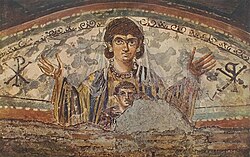
Art of the Middle Ages
Nordic and Germanic Influence
In Scandinavia, Stave Churches—named for their foundational pillars—became prominent displays of Christian Viking art. These structures featured engravings that blended Christian beliefs with Nordic symbolism, often depicting animal-like figures on walls and entrances. The cross served as a vital symbol, often marking those baptized abroad. Some of these crosses incorporated Doric capital ends, reflecting German and English influence during the 12th and 13th centuries.
Similarly, Germanic Christian art utilized wood carvings to depict the Crucifixion within churches and cathedrals. A primary example is the Cologne Cathedral in Germany. Construction began in 1248 under Archbishop Conrad von Hostaden on the ruins of Romantic and Frankish buildings, though it was not completed until the 1880s.
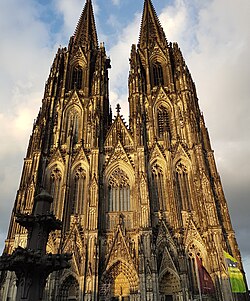
The Byzantine East and Mediterranean Shifts
The Orthodox Church of Constantinople played a pivotal role in glorifying Christianity through extravagant art. They commissioned shrines and churches adorned with relief sculptures, paintings, and stained glass. The Hagia Sophia, the world's largest cathedral until the 15th century, was decorated almost entirely with mosaics to honor God. Even after its conversion into a mosque following the fall of Constantinople, much of this art survived.
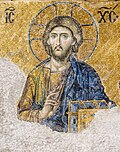
In the Mediterranean, a transition occurred from Islamic to Christian art. This is evident in the use of muqarnas (ornamental honeycombed vaulting), with 78 of the 86 known examples found in Christian kingdoms of the Iberian Peninsula, where they were used in important buildings like chapels to signal political power. Additionally, sites like the Mar Musa Monastery in Syria and Egypt reveal medieval wall paintings often featuring Greek script, a result of the mobility of artists at the time.
The Renaissance and Early Modern Era
The fall of Constantinople in 1453 ended the era of high-quality Byzantine art produced in imperial workshops. However, Orthodox icons continued to be produced with little change in style, with Russia eventually becoming the primary center of production.
In Western Europe, the Renaissance saw a rise in secular works, yet the church and aristocracy continued to commission vast amounts of religious art. The Reformation significantly altered this landscape. Martin Luther and the Evangelical Lutheran Church encouraged a limited range of imagery, viewing their church as a continuation of the apostolic tradition. Lutheran altarpieces, such as the 1565 Last Supper by Lucas Cranach the Younger, often replaced Catholic works and sometimes featured reformers as apostles while maintaining the traditional image of Jesus.
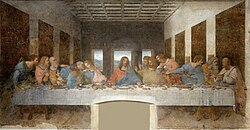
While Lutherans viewed the crucifix as a central highlight of the "Theology of the Cross," Reformed (Calvinist) Christians were generally iconoclastic, destroying religious imagery and limiting new art to book illustrations. In Catholic regions, religious art increased during the Counter-Reformation, though it was placed under stricter hierarchical control. By the 18th century, leading artists began producing fewer religious works, though some continued to do so independently.
The Modern Period and Popular Devotion
With the invention of printing, the mass production of pious works became a staple of popular culture. The 19th century saw the rise of genre painters like Mihály Munkácsy, and the advent of color lithography led to the widespread circulation of holy cards. In the contemporary era, commercial artists such as Thomas Kinkade and Thomas Blackshear have found great success, though their work is often categorized as kitsch by the fine art community.
Summary of Christian Art Themes
| Category | Examples of Subjects/Motifs |
|---|---|
| Life of Christ | Nativity, Baptism, Last Supper, Crucifixion, Resurrection, Ascension |
| The Virgin Mary | Annunciation, Madonna and Child, Assumption, Coronation of the Virgin |
| Theological Concepts | Holy Trinity, Christ Pantocrator, The Last Judgment, Hand of God |
| Devotional Symbols | Crucifix, Stations of the Cross, Pietà, Tree of Jesse |
Frequently Asked Questions
How did the Reformation affect Christian art?
The impact varied by branch: Lutherans generally retained and renewed religious imagery, including the crucifix, to support their theology. In contrast, Reformed (Calvinist) Christians were iconoclastic, often destroying images and preferring unadorned church interiors.
What is the significance of the Hagia Sophia in Christian art?
The Hagia Sophia was the world's largest cathedral until the 15th century and served as a pinnacle of Byzantine art, utilizing extensive mosaics to honor God before its later conversion into a mosque.
What are Stave Churches?
Stave Churches are medieval wooden structures found in Scandinavia, characterized by strong foundational pillars and carvings that blend Christian themes with Nordic animal motifs and symbolism.
When did the depiction of Jesus become standardized?
The evolution of Jesus's depiction in art, seen in the paintings of the Roman catacombs, was largely complete by the 6th century, after which his appearance remained remarkably consistent.
What is the difference between an icon and a general religious painting?
While the terms are often used interchangeably, in the Orthodox tradition, icons are a specific medium of sacred art that has maintained a relatively consistent subject and style from the Byzantine era to the present day.